Gut Health Basics: What the Research Actually Supports
Walk through any natural grocery store in Portland or a Hannaford in Concord and you’ll find probiotic supplements, kombucha, and prebiotic fiber bars filling entire aisles. The science behind gut health is real. The marketing, though, has outpaced it considerably, and the gap between what products promise and what studies actually show is worth understanding before you spend money on either.
What the Microbiome Actually Does
The gut microbiome is a community of trillions of bacteria, fungi, and other microorganisms living primarily in the large intestine. These organisms produce short-chain fatty acids, synthesize certain vitamins, help regulate immune signaling, and influence neurotransmitter production. In 2026, the International Scientific Association for Probiotics and Prebiotics published a consensus statement in Nature Reviews Gastroenterology and Hepatology identifying six core domains of gut health: the microbiome itself, gut barrier function, gastrointestinal physiology, the gut-brain axis, immune function, and metabolism.
That’s a broad mandate. It also explains why gut health claims feel like they apply to everything. They kind of do.
Correlation is not causation, and that distinction matters here. Many gut health products jump from association to recommendation without the clinical trials to bridge the gap. Keep that in mind as you read the rest of this.
What the Evidence Actually Supports
Dietary fiber diversity is the most consistently supported approach for improving microbiome health. A large study by the American Gut Project found that people who ate 30 or more different plant foods per week had significantly greater gut microbial diversity than those who ate fewer than 10. The diversity plateaus around the 30-plant mark, meaning 35 plant types doesn’t offer dramatically more benefit than 30, but the gap between 10 and 30 is measurable and meaningful.
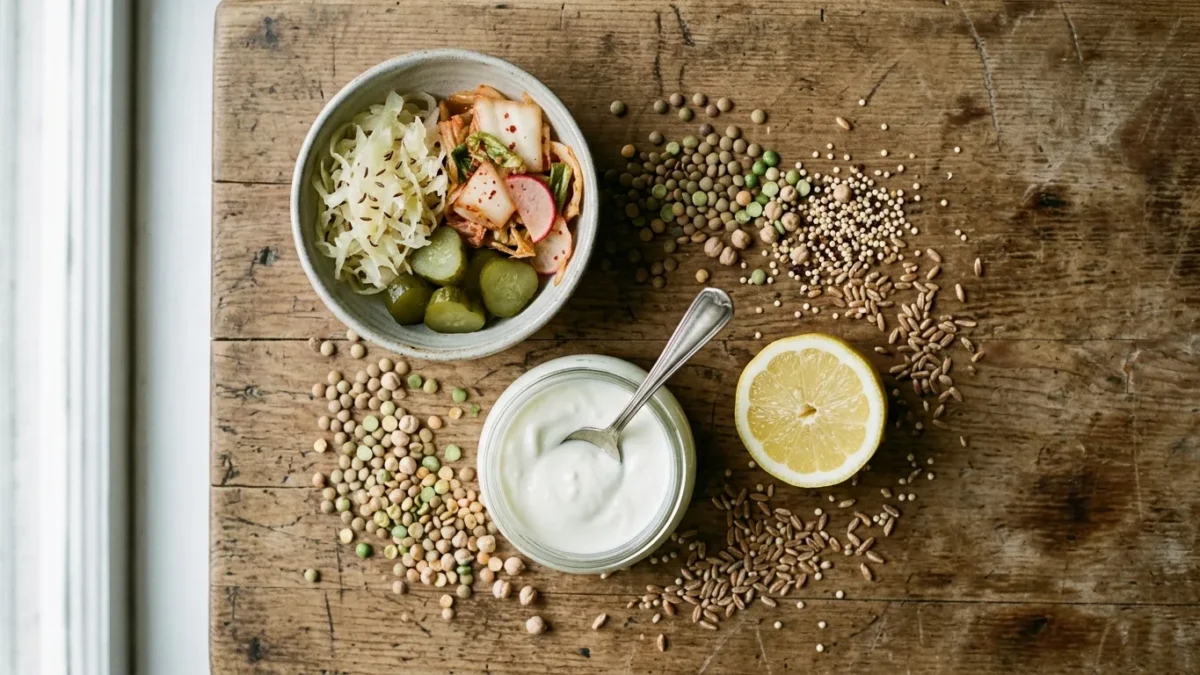
Fermented foods have solid trial data too. A 17-week randomized study from Stanford, published in Cell in 2021, compared a high-fiber diet against a fermented-food diet in healthy adults. The fermented-food group showed measurable increases in microbiome diversity and decreases in inflammatory markers. Yogurt, kefir, sauerkraut, kimchi, and miso were the foods studied.
Probiotic supplements are more nuanced than their packaging suggests. Specific strains have evidence for specific conditions. Lactobacillus rhamnosus GG, for instance, has well-supported research behind it for reducing antibiotic-associated diarrhea. But broad-spectrum probiotics marketed for general gut health rely on much weaker data. Buying a multi-strain capsule because it has 50 billion CFUs printed on the label is a marketing decision, not a clinical one, much like the label-reading challenges that apply to other popular supplements.
What to Be Skeptical About
At-home microbiome tests have grown into a sizable industry. You mail in a sample, get back a report with charts and personalized supplement recommendations, and feel like you have insight into your gut. The problem is that the science of interpreting an individual’s microbiome results is still early-stage. Researchers study population-level patterns. Translating those patterns into actionable guidance for one specific person is not something the field has figured out reliably.
Leaky gut syndrome is another term worth scrutinizing. Intestinal permeability is a real physiological phenomenon studied in clinical research. But many products and social media accounts use leaky gut as a root-cause explanation for a wide range of symptoms, most without evidence for that specific connection. If a protocol promises to seal your gut and reverse multiple chronic conditions in 30 days, that’s a marketing claim, not a clinical one.
Maine winters don’t help. Low sun exposure, heavier reliance on shelf-stable processed foods between November and April, and less variety in fresh produce can all affect dietary diversity. It’s worth thinking about how to eat well through the colder months when local fresh options are limited.
A Reasonable Starting Point
You don’t need a supplement stack or a test kit to support gut health. Start by counting how many different plant foods you eat in a week. Herbs and spices count. Different-colored vegetables count separately. Most people are surprised to find they eat 8 to 12 types on a good week. Getting to 20 is achievable. Getting to 30 takes some planning but isn’t extreme. The Portland farmers markets are a practical starting point for expanding plant variety seasonally.
Add one or two fermented foods you actually like. Talk to a healthcare provider before starting any probiotic supplement, especially if you have a specific condition you’re hoping to address. And treat any product promising to transform your gut in a few weeks with the same skepticism you’d apply to any other health claim.
Sources
- Wastyk HC, et al. Gut-microbiota-targeted diets modulate human immune status. Cell. 2021;184(16):4137-4153. doi:10.1016/j.cell.2021.06.019
- McDonald D, et al. American Gut: An Open Platform for Citizen Science Microbiome Research. mSystems. 2018;3(3):e00031-18. (American Gut Project, University of California San Diego / Microsetta Initiative)
- International Scientific Association for Probiotics and Prebiotics (ISAPP). Consensus statement on the definition and scope of gut health. Nature Reviews Gastroenterology and Hepatology. 2026;23(5):432-448.
- International Scientific Association for Probiotics and Prebiotics (ISAPP). isappscience.org — probiotic strain evidence summaries and educational resources.
This article is for informational purposes only and does not constitute medical advice. Consult a qualified healthcare provider before making any health decisions.