Fall Leaf-Peeping Hikes With Real Health Payoff
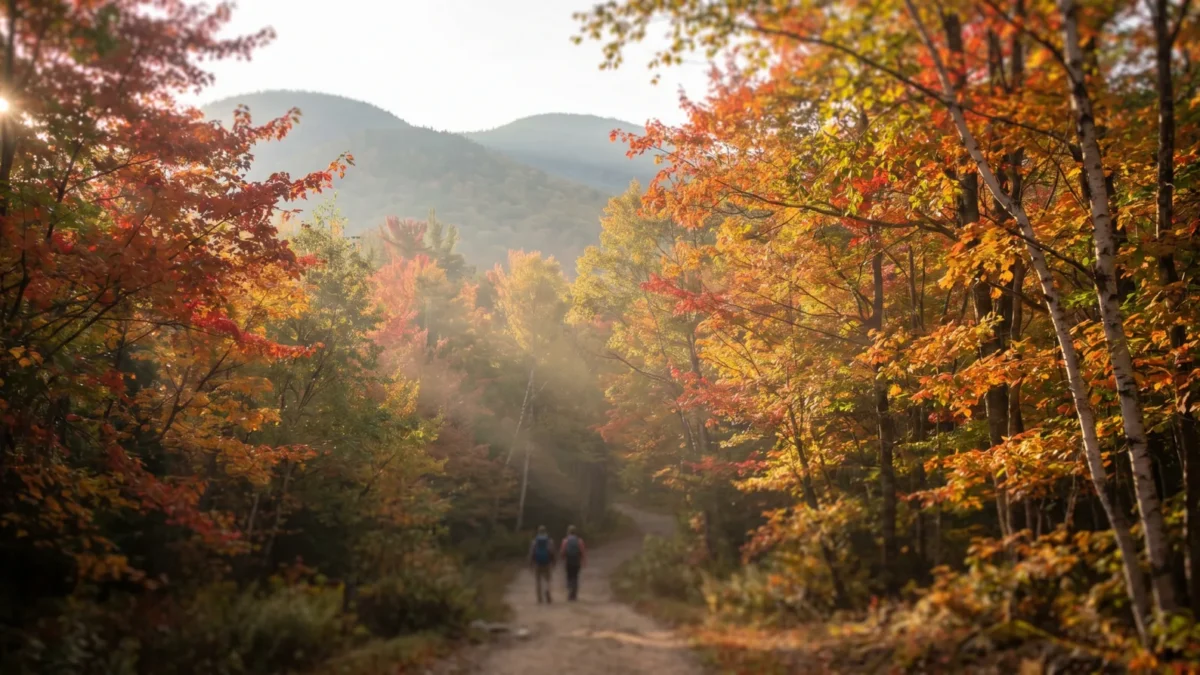
By the second week of October, the maples along Route 16 north of Conway are doing the thing people drive hundreds of miles to see. What gets lost in all the talk about peak color and traffic and where to park is a quieter fact. The same hike you take to gawk at the leaves happens to be one of the better things you can do for your heart and your head, and the research backing that up is surprisingly solid.
Autumn is the easiest season to get outside up here
Summer in Maine and New Hampshire comes with blackflies in June and humidity in August. Winter buries the trails. October splits the difference. Cool air, dry footing, low bug pressure, and a payoff at every overlook. If you have been meaning to move more and keep not doing it, the season is quietly removing your excuses.
And the window is longer than most people think. According to the Maine Forest Service, northern Maine usually peaks the last week of September into early October, the western mountains turn around Indigenous Peoples’ Day weekend, and coastal and southern Maine hold their color from mid-October through the end of the month. That is close to five weeks of good hiking if you are willing to drive a little.
What a moderate hike does for the rest of you
Start with the baseline. Federal guidelines say adults should get at least 150 minutes of moderate-intensity aerobic activity a week, and the CDC counts brisk walking as exactly that kind of activity. A two-hour leaf-peeping hike on rolling terrain clears most of the weekly bar in one outing.
The reasons to bother are not vague. The Physical Activity Guidelines for Americans (2nd edition) tie regular activity to lower risk of heart disease, stroke, high blood pressure, type 2 diabetes, several cancers, depression, and early death. That is not a wellness slogan. It is a federal review of the evidence.
The forest itself seems to add something. A 2017 systematic review and meta-analysis in BMC Complementary and Alternative Medicine found that systolic blood pressure measured in forest settings ran about 3 mmHg lower than in non-forest settings, with diastolic pressure lower too. Modest, sure. But it is a real difference, and you are getting it while doing something you already wanted to do.
The part that helps your head
Autumn walking earns its keep above the neck, too. A 2015 study in PNAS had people take a 90-minute walk in either a natural setting or a city setting. The nature walkers came back with less rumination, that loop of stewing over the same worry, and quieter activity in a brain region tied to it. The city walkers got neither effect. Same minutes, same legs, different scenery, different result.
Forest time also tracks with lower stress hormones. A 2019 meta-analysis in the International Journal of Biometeorology pooled studies on forest bathing and found salivary cortisol measurably lower in forest groups than in urban ones.
The CDC adds that physical activity sharpens memory and eases anxiety and depression, with some of the brain benefit kicking in right after a single session. You do not have to wait months to feel the difference. And the long game looks good too. A 2025 analysis from the Johns Hopkins Bloomberg School of Public Health, published in the Journal of the American Medical Directors Association, found that as little as 35 minutes of moderate-to-vigorous activity a week was linked to a 41% lower risk of developing dementia compared with none at all. Thirty-five minutes. One walk.
Where to chase peak color in the White Mountains
The White Mountain National Forest covers roughly 750,000 acres across the New Hampshire and Maine border, and it gives leaf-peepers a handy trick. Higher elevations turn first, valleys hold their color longer, so you can chase peak by adjusting how high you climb. Too early for the lowlands? Go up. Missed the summits? Drop into the notches.
You do not need a summit bid to get the benefit, either. Plenty of moderate, well-marked routes deliver the views without the exposure. If you are eyeing something bigger, read up on Mount Washington training and safety before you commit, because that mountain makes its own weather and turns on people fast. Prefer a number on your bib? The region’s fall foliage races and turkey trots fold the same movement into a social morning.
Going safely once you are out there
October light is generous at midday and gone by dinner. Daylight is shrinking by a few minutes every day, so start earlier than feels necessary and carry a headlamp even on a short loop. Dress in layers you can shed and re-add, because a trailhead at 50 degrees and a windy ridge can feel like two seasons. Tell someone your route, check the forecast for the elevation you are actually climbing to, and turn around if conditions or your legs say so. The leaves will be there next weekend.
None of this requires being an athlete. It requires a decent pair of shoes, a thermos, and a free Saturday in the best month New England has. The health math just happens to be on your side.
Sources
- Centers for Disease Control and Prevention. Adult Activity: An Overview. CDC. 2024. https://www.cdc.gov/physical-activity-basics/guidelines/adults.html
- U.S. Department of Health and Human Services. Physical Activity Guidelines for Americans, 2nd edition. HHS. 2018. https://odphp.health.gov/sites/default/files/2019-09/Physical_Activity_Guidelines_2nd_edition.pdf
- Ideno Y, et al. Blood pressure-lowering effect of Shinrin-yoku (Forest bathing): a systematic review and meta-analysis. BMC Complementary and Alternative Medicine / National Library of Medicine (PMC). 2017. https://pmc.ncbi.nlm.nih.gov/articles/PMC5559777/
- Bratman GN, et al. Nature experience reduces rumination and subgenual prefrontal cortex activation. PNAS / PubMed (National Library of Medicine). 2015. https://pubmed.ncbi.nlm.nih.gov/26124129/
- Centers for Disease Control and Prevention. Physical Activity Boosts Brain Health. CDC. 2024. https://www.cdc.gov/physical-activity/features/boost-brain-health.html
- Johns Hopkins Bloomberg School of Public Health. Small Amounts of Moderate to Vigorous Physical Activity Are Associated with Big Reductions in Dementia Risk. Johns Hopkins Bloomberg School of Public Health. 2025. https://publichealth.jhu.edu/2025/small-amounts-of-moderate-to-vigorous-physical-activity-are-associated-with-big-reductions-in-dementia-risk
- Antonelli M, Barbieri G, Donelli D. Effects of forest bathing (shinrin-yoku) on levels of cortisol as a stress biomarker: a systematic review and meta-analysis. International Journal of Biometeorology / PubMed (National Library of Medicine). 2019. https://pubmed.ncbi.nlm.nih.gov/31001682/
- Maine Department of Agriculture, Conservation and Forestry (Maine Forest Service). Maine Fall Foliage – When and Where to Visit. Maine DACF. 2025. https://www.maine.gov/dacf/mfs/projects/fall_foliage/whenandwhere/
This article is for informational purposes only and does not constitute medical advice. Consult a qualified healthcare provider before making any health decisions.