Gardening as Exercise: The Maine Growing Season
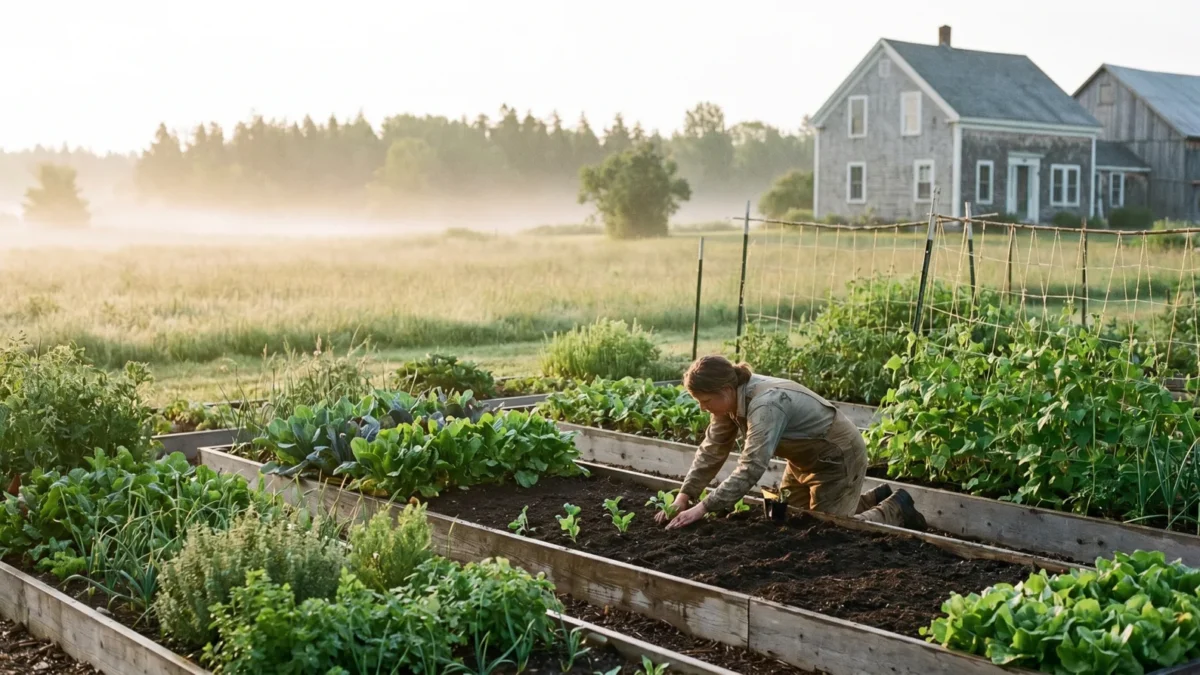
Ask a Maine gardener when the season starts and you will get a careful answer. Not a date, a window. The University of Maine Cooperative Extension puts the average freeze-free stretch around Portland at about 136 days, with the last spring frost landing near May 13 and the first fall frost near September 26. Down East runs a little different. Extension’s garden column estimates Hancock County at roughly May 6 to October 2, about 149 days, while warning that the frost-date model is only around 30% accurate for light frosts. Hard freezes tend to come earlier in spring and later in fall than the averages suggest.
That short window is the whole point. The work is packed into a few months, which means the physical effort is too. And there is a growing pile of research saying that effort counts as exercise, the kind your body actually keeps score of.
Yard work is moderate exercise, by the book
This is not a stretch or a feel-good reframe. The CDC’s own guide to measuring activity intensity lists general yard work and home repair right alongside brisk walking and recreational swimming as examples of moderate-intensity activity. Moderate, in the federal definition, means burning 3 to 5.9 METs, the unit researchers use to measure how hard your body is working compared to sitting still.
How does digging and weeding stack up against that bar? A review of gardening and older-adult health found most tasks sit in the low-to-moderate range, with the moderate jobs (think turning a bed, hauling soil, sustained raking) reaching around 4.5 METs. Lighter work like deadheading or pruning comes in under 3.0. So a long Saturday in the garden is rarely all-out, but big chunks of it land squarely in the zone that public health guidelines are asking for.
A full season, measured
The strongest evidence comes from a study that did something rare. Researchers ran an actual randomized trial. The CAPS trial, published in The Lancet Planetary Health in 2023, assigned 291 adults across 37 community gardens in the Denver area either to start gardening that season or to wait. Then they tracked what changed.
Within six months, the new gardeners had bumped their moderate-to-vigorous activity by roughly 42 minutes a week and were eating about 1.4 grams more fiber a day than the control group. Both differences were statistically significant. Forty-two minutes may not sound dramatic, but it is close to a third of the weekly activity target, earned without a gym, a membership, or a single workout that felt like one.
The fiber bump is worth a second look too. People who grow vegetables tend to eat more of them, which is partly why a garden plot pairs so naturally with a trip to the stalls. If you want the eating side of that equation, our guide to Portland’s farmers markets covers what to do with the haul when your own beds cannot keep up.
The part that happens above the neck
Anyone who has lost an afternoon to weeding already suspects this, but the trials back it up. In that same CAPS research, a 2024 process evaluation reported that the new gardeners saw bigger drops in perceived stress and anxiety than the people who stayed on the waitlist.
A smaller pilot trial pushed the question further. Researchers randomized 32 healthy women to either gardening or art-making, eight one-hour sessions over four weeks. The gardening group’s mood scores improved with a large effect, their depression scores fell 66%, perceived stress dropped 37%, and trait anxiety declined too. It was a pilot, so the numbers are a first look rather than a verdict. Still, the direction is hard to ignore, and it matches what people report on their own.
Staying steady on your feet
Here is the finding that tends to surprise people. A study drawing on the Health and Retirement Study looked at more than 3,200 adults aged 65 and up and compared gardeners to non-gardeners. The gardeners had better balance and faster gait speed, fewer chronic conditions, fewer functional limitations, and they were significantly less likely to report a fall in the past two years.
That last one matters in a state where the ground spends a good chunk of the year frozen, icy, or both. The researchers went so far as to suggest gardening belongs in fall-prevention programs. Crouching, standing, carrying, reaching low and high, shifting your weight over uneven soil: it is functional movement, the unglamorous kind that keeps you upright when the porch step is slick in February.
Counting it toward the guideline
The federal Physical Activity Guidelines for Americans ask adults for at least 150 minutes, and up to 300, of moderate aerobic activity each week, plus muscle-strengthening work on two or more days. The CDC is clear that you can spread this across the week and break it into smaller pieces. There is no rule that says it has to happen in a single sweaty block, or in sneakers.
Which means a couple of solid hours in the beds over a weekend can put a real dent in that 150. Hauling compost and turning soil leans toward the strength side. Steady weeding and planting leans aerobic. A normal gardening day quietly does both.
One honest caveat. Gardening is not free of risk. In one observational study folded into the older-adult review, almost 60% of gardeners reported pain while working, and lower-back pain led the list at 63%. The fix is not to stop, it is to switch tasks before your back files a complaint. Rotate between standing and kneeling jobs, trade the shovel for the pruners, and treat a raised bed as a back-saver rather than a luxury.
Working with the frost, not against it
Maine gardeners already plan around the calendar out of necessity. You cannot rush May 13, and you cannot argue with September 26. Coastal plots gain a few days on each end from the ocean’s moderating pull, and those frost dates are estimates, not promises, so the smart move is to watch the forecast rather than the average.
The same patience pays off physically. A short season means the work clusters into spring planting and fall cleanup, two stretches where it is easy to do too much in one go and pay for it the next morning. Spreading the effort, the way the activity guidelines suggest, fits the Maine rhythm anyway. Start a little before the soil is fully ready, ease off when the freeze closes the window, and let the months in between do the quiet work of keeping you moving.
Sources
- University of Maine Cooperative Extension. Vegetable Gardening: Keep Your Garden Growing, Plant from Spring to Fall (Cumberland County). 2024. https://extension.umaine.edu/cumberland/horticulture/vegetable-gardening-keep-your-garden-growing-plant-from-spring-to-fall/
- University of Maine Cooperative Extension. When is the last spring frost in Hancock County and first fall frost? 2024. https://extension.umaine.edu/gardening/2024/03/29/when-is-the-the-last-spring-frost-in-hancock-county-and-first-fall-frost/
- U.S. Centers for Disease Control and Prevention. How to Measure Physical Activity Intensity. 2023. https://www.cdc.gov/physical-activity-basics/measuring/index.html
- Journal of Aging and Physical Activity / PMC (NIH). Gardening Activities and Physical Health Among Older Adults: A Review of the Evidence. 2015. https://pmc.ncbi.nlm.nih.gov/articles/PMC4469628/
- The Lancet Planetary Health. Effects of a community gardening intervention on diet, physical activity, and anthropometry outcomes in the USA (CAPS): an observer-blind, randomised controlled trial. 2023. https://www.thelancet.com/journals/lanplh/article/PIIS2542-5196(22)00303-5/fulltext
- Scientific Reports / PMC (NIH). A process evaluation of a randomized-controlled trial of community gardening to improve health behaviors and reduce stress and anxiety. 2024. https://pmc.ncbi.nlm.nih.gov/articles/PMC11176184/
- PLOS ONE / PMC (NIH). A pilot randomized controlled trial of group-based indoor gardening and art activities demonstrates therapeutic benefits to healthy women. 2022. https://pmc.ncbi.nlm.nih.gov/articles/PMC9258874/
- Journal of Aging and Physical Activity. Gardening as a Potential Activity to Reduce Falls in Older Adults. 2012. https://journals.humankinetics.com/view/journals/japa/20/1/article-p15.xml
- PubMed / NIH. Gardening as a potential activity to reduce falls in older adults. 2012. https://pubmed.ncbi.nlm.nih.gov/22190117/
- U.S. Department of Health and Human Services (ODPHP). Physical Activity Guidelines for Americans, 2nd edition. 2018. https://odphp.health.gov/sites/default/files/2019-09/Physical_Activity_Guidelines_2nd_edition.pdf
- U.S. Centers for Disease Control and Prevention. Physical Activity Recommendations for Adults. 2023. https://www.cdc.gov/physical-activity-basics/guidelines/adults.html
This article is for informational purposes only and does not constitute medical advice. Consult a qualified healthcare provider before making any health decisions.