Ice Fishing as Active Winter Recreation
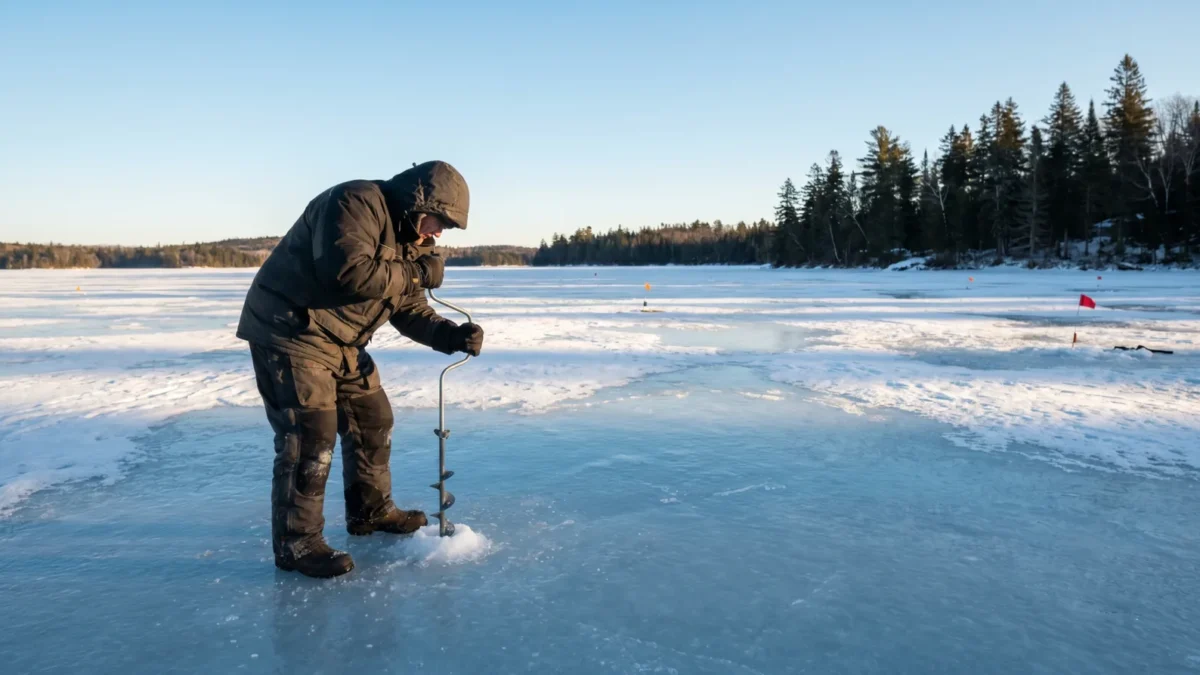
By the first week of January, the parking turnouts around Maine’s South Zone ponds start filling with trucks before sunrise. Somebody is dragging a sled of gear out onto the ice, and from the shore it looks like the least athletic thing a person could do all winter: sit on a bucket and stare at a hole. Spend a day doing it and you learn otherwise. Ice fishing asks more of the body than it lets on, which makes it a quietly useful answer to a problem most of us have from December through March.
The winter slump is real, and it has data behind it
We tend to move less once the snow flies. A 2020 study in BMC Public Health tracked rural older adults across a non-snowfall and a snowfall season and found sedentary time climbed during the snowy months, from roughly 54 percent to 65 percent of the day in men and 48 percent to 56 percent in women, with light activity dropping off. The authors called the seasonal shift unfavorable. Anyone who has watched a Maine February swallow their step count knows the feeling.
Federal guidance sets the bar at 150 minutes of moderate activity a week plus two days of muscle work, and the CDC is blunt that some activity beats none. A morning on the ice will not hit that target by itself. It can still be a real piece of it, especially in the months when the alternative is the couch.
The sitting is light. The rest of the day is not.
Here is the honest accounting. The 2024 Adult Compendium of Physical Activities, the standard reference for the energy cost of human movement, rates ice fishing while seated at 2.0 METs, which is light. So the jigging itself does not count for much. The work is everything around it: hauling a loaded sled across a frozen lake, hand-augering holes, and walking the ice to check tip-ups. General fishing comes in at 3.5 METs and fishing while walking the bank at 4.0, both squarely moderate. The intensity tracks how much you move, not the fact that you eventually sit down.
The cold pitches in a little too. A 2018 PLOS ONE study of lean young men found energy use rose about 16.7 percent at the onset of cold exposure and roughly 31.7 percent once shivering kicked in, as the body burned fuel to stay warm. Then there is the part the compendium cannot measure. A 2019 study in Scientific Reports, drawing on nearly 20,000 people, found that spending at least 120 minutes a week in nature was linked to better self-reported health and wellbeing, with no benefit below that two-hour mark. A long morning on a quiet lake clears it in one sitting.
Ice safety comes before any of this
None of the upside matters if the ice is not solid, and that is not a judgment call you eyeball from shore. Maine’s Department of Inland Fisheries and Wildlife keeps the numbers simple: under 4 inches, stay off; 4 inches of good ice may hold a person on foot; 5 to 7 inches an ATV or snowmobile; 8 to 12 inches most cars and small pickups. New ice beats old ice, and it never forms evenly. IF&W warns it can be a foot thick in one spot and two or three inches twenty feet away. Color helps you read it. Clear blue ice is the strongest; gray to black ice is melting and weak. The agency’s reminder is worth memorizing: thick and blue, tried and true, thin and crispy, way too risky.
The deadliest hazard is not the cold air, it is the water under the ice. A fall through cold water triggers an involuntary gasp reflex, documented in immersion research going back decades, that can pull water into the lungs in seconds and has been tied to rapid drowning even in strong swimmers. That is why anglers carry ice picks and fish near someone who knows they are out there.
Where a beginner should actually start
Sebago and Moosehead are the marquee names, Moosehead being the state’s largest lake at about 75,000 acres. But the big water is not always the friendly water. Warmer winters have left Sebago short of full ice cover in several recent years, including three winters running as of the early 2020s, which has pushed plenty of anglers toward smaller ponds that lock up sooner and more reliably. South Zone waters generally open to ice fishing around January 1, while North Zone lakes follow special season codes, so check the water-specific laws before you load the truck.
You do not need much to try it. A borrowed auger, a couple of tip-ups, warm layers, and a thermos go a long way. If you want a broader plan for staying active through the dark months, our guide to winter exercise in northern New England covers the indoor and outdoor options that pair well with the occasional day on the ice.
Sources
- Maine Department of Inland Fisheries and Wildlife. Statewide General Fishing Laws. 2026. https://www.maine.gov/ifw/fishing-boating/fishing/laws-rules/statewide-laws.html
- Maine Department of Inland Fisheries and Wildlife. Ice Safety Tips. 2026. https://www.maine.gov/ifw/programs-resources/outdoor-safety/ice-safety-tips.html
- Piscataquis Observer. Maine’s ice fishing season is changing. 2023. https://observer-me.com/2023/03/13/news/maines-ice-fishing-season-is-changing/
- BMC Public Health. Changes in rural older adults’ sedentary and physically-active behaviors between a non-snowfall and a snowfall season: a compositional data analysis. 2020. https://pmc.ncbi.nlm.nih.gov/articles/PMC7433168/
- Centers for Disease Control and Prevention. Adult Activity: An Overview (Physical Activity Basics). 2023. https://www.cdc.gov/physical-activity-basics/guidelines/adults.html
- U.S. Department of Health and Human Services. Physical Activity Guidelines for Americans, 2nd edition. 2018. https://www.cdc.gov/physical-activity/media/pdfs/Physical_Activity_Guidelines_2nd_edition.pdf
- Compendium of Physical Activities (Arizona State University). 2024 Adult Compendium of Physical Activities: Fishing & Hunting. 2024. https://pacompendium.com/fishing-hunting/
- Journal of Sport and Health Science. 2024 Adult Compendium of Physical Activities: A third update of the energy costs of human activities. 2024. https://pmc.ncbi.nlm.nih.gov/articles/PMC10818145/
- PLOS ONE. Physiological responses to acute cold exposure in young lean men. 2018. https://pmc.ncbi.nlm.nih.gov/articles/PMC5937792/
- European Journal of Applied Physiology. Reliability and validity of methods in the assessment of cold-induced shivering thermogenesis. 2020. https://pmc.ncbi.nlm.nih.gov/articles/PMC7042274/
- Scientific Reports (Nature). Spending at least 120 minutes a week in nature is associated with good health and wellbeing. 2019. https://www.nature.com/articles/s41598-019-44097-3
- Respiration Physiology. Respiratory drive during sudden cold water immersion. 1987. https://pubmed.ncbi.nlm.nih.gov/3659607/
- Frontiers in Psychology. Acute Anxiety Predicts Components of the Cold Shock Response on Cold Water Immersion. 2018. https://www.ncbi.nlm.nih.gov/pmc/articles/PMC5904285/
This article is for informational purposes only and does not constitute medical advice. Consult a qualified healthcare provider before making any health decisions.