Ticks and Your Yard: Reducing Risk Where You Live
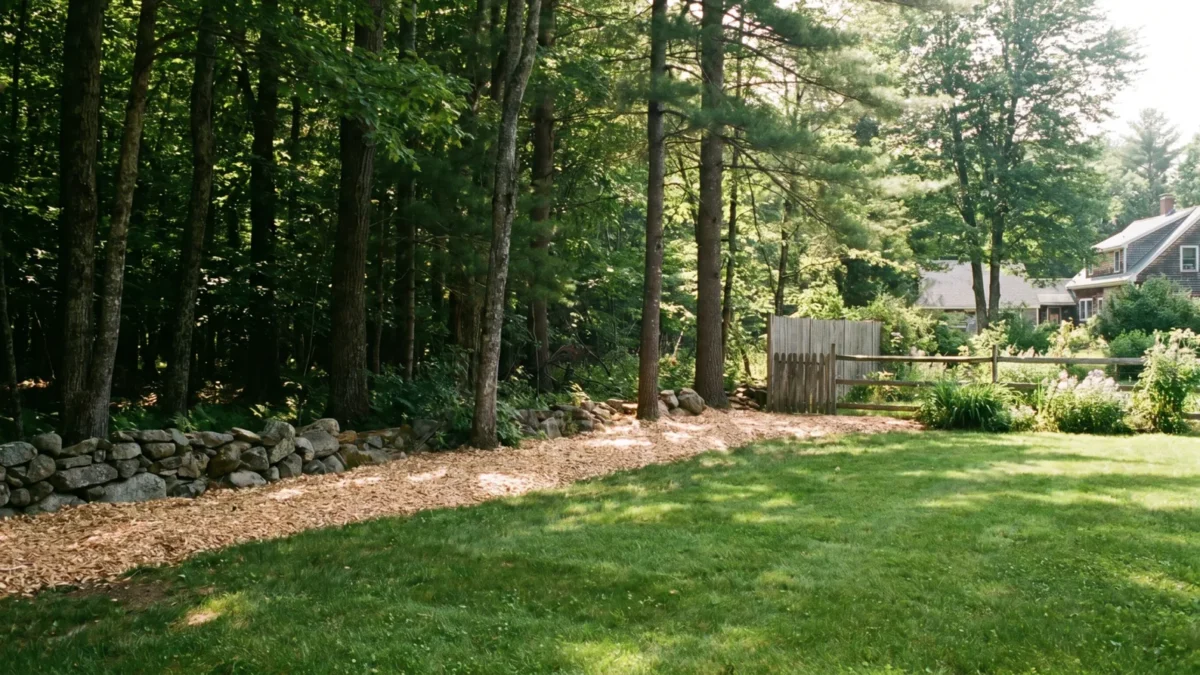
If you live along a wooded edge in Maine or New Hampshire, the riskiest patch of ground for a tick bite is probably the one you can see from your kitchen window. Not the trail up Tumbledown, not the deep spruce woods behind the house. The yard. In the University of Maine Cooperative Extension Tick Lab’s 2024 surveillance report, 68 percent of the ticks people mailed in were picked up on the submitter’s own property. The Lab processed 4,776 submissions that year from 398 towns, covering every one of Maine’s 16 counties.
Why the backyard does the damage
A tick can’t fly or jump. It climbs a blade of grass or a low branch, holds out its front legs, and waits for something warm to brush past. That patient little ambush is called questing, and it happens wherever ticks already live. For most of us, that means the yard, because the yard is where we spend unhurried time. Gardening. Letting the dog out. Reading on the back step.
The numbers behind the worry are local. Of the 3,650 deer ticks the UMaine lab analyzed in 2024, 41.5 percent carried the bacterium that causes Lyme disease. Smaller shares carried the pathogens behind babesiosis, anaplasmosis, and, rarely, Powassan virus. Those are state figures from the state lab, not a national average, which is part of why this is worth taking seriously here. For the full regional picture, our Maine and New Hampshire tick and Lyme guide walks through the diseases and the season.
Ticks live at the edge, not the open lawn
Here is the useful part. Ticks are not spread evenly across a property. They cluster, and they cluster in predictable places.
The Connecticut Tick Management Handbook, an integrated guide published with the CDC, summarized research showing that about 82 percent of the deer ticks found on residential lawns sat within roughly nine feet of the lawn’s edge. The hot zones were the borders next to woods, the bases of stone walls, and leaf-covered ground. Far fewer ticks turned up in the open, sunny, regularly mowed middle of the yard.
Why the edge? Moisture. Both young ticks and questing adults need air with relative humidity above roughly 80 percent, and they need it for long stretches or they dry out and die. A 2014 study in the Journal of Medical Entomology tracked how blacklegged tick activity rises and falls with humidity. Leaf litter and shaded brush hold that damp microclimate at ground level. A short, sunbaked lawn does the opposite. It bakes them.
That single fact, ticks dry out in the sun, is the thread running through almost every landscaping recommendation worth following.
The landscaping moves with real evidence behind them
The CDC and the UMaine Tick Lab give nearly identical advice, and it is low-cost and unglamorous. None of it involves a single chemical.
- Rake and remove leaf litter, especially along the wooded edge and around stone walls and woodpiles.
- Mow the lawn regularly and keep grass short. Dry, sunlit turf is hostile to ticks.
- A 3-foot-wide barrier of wood chips or gravel between the lawn and the woods. Ticks are reluctant to cross that dry strip, and it marks a line you and the kids can stay inside of.
- Trim trees and brush to let more sunlight reach the ground.
- Keep swing sets, play areas, and patio furniture out toward the sunny center, away from the tree line.
- Stack firewood neatly and keep it dry. Loose, damp woodpiles are good tick and rodent habitat.
The UMaine lab frames all of this around one idea: lower the ground-level humidity that ticks depend on. Rake the leaves, cut back the brush, open up the canopy. You are not trying to kill every tick. You are making your yard a place where they struggle to live.
Barberry, deer, and the hosts that bring ticks home
Two pieces of this are easy to overlook. One is a plant. The other has hooves.
Japanese barberry is an invasive shrub that has spread through New England woods and landscaping for decades, prized once for its tidy red foliage and the way deer leave it alone. Dense barberry thickets trap humidity near the ground, which is exactly what ticks want. Connecticut researchers led by Scott Williams counted roughly 120 Lyme-infected ticks per acre in uncontrolled barberry, about 40 per acre where it was managed, and only about 10 per acre where barberry was absent. When crews cut the barberry back, infected-tick numbers fell to the no-barberry level within two seasons. If you have a wall of barberry along your property line, that is a tick factory worth dismantling.
Then the deer. White-tailed deer are the main host adult deer ticks breed and feed on, so a yard that deer drift through regularly is a yard that keeps restocking its ticks. One analysis found nymph density rose about 49 percent with a standard jump in local deer numbers. The honest caveat: studies on actually reducing deer have shown mixed, limited effects on how many ticks carry disease and on whether people get sick. Fencing and deer-resistant plantings can help at the property line, but treat them as one piece, not a cure.
Does spraying the yard work?
This is where good intentions meet inconvenient data. A professional acaricide spray absolutely knocks down tick numbers. In a randomized, placebo-controlled trial across 2,727 properties in three northeastern states, a single springtime barrier spray cut questing ticks by about 63 percent.
And yet. That same study found no difference between the sprayed homes and the placebo homes in how often people actually encountered ticks, or in how many came down with a tick-borne illness. A separate controlled trial of rodent-targeted bait boxes, the kind that dust mice with tick-killing chemicals, found the same disappointing result. Fewer ticks on paper, no measurable drop in human bites or disease.
The CDC’s own guidance lands in the same place: spraying can reduce ticks, but do not rely on it as your defense, and check with local officials on timing, products, and rules before you treat. The takeaway is not that yard work is pointless. It is that no single move protects you. Landscaping lowers the population, and then daily habits, repellents, and tick checks do the rest. Our breakdown of DEET, picaridin, and permethrin covers what goes on skin and clothing, and the guide to protecting kids and pets handles the part of the household that can’t do its own tick check.
A realistic plan for a Maine or NH property
You don’t need to terraform the backyard. Walk the edge where your lawn meets the woods and start there, because that nine-foot band is where the ticks are. Rake out the leaf litter. Cut the brush and any barberry back hard. Lay a strip of wood chips between the grass and the tree line, and keep the lawn short through the season. Move the play set and the hammock into the sun.
That is most of the benefit, for the price of a Saturday and some mulch. The yard will never be tick-free, and it doesn’t have to be. The goal is a smaller, drier, sunnier patch of ground where fewer ticks wait, paired with a tick check before everyone heads inside.
Sources
- University of Maine Cooperative Extension. 2024 Surveillance Report from UMaine Extension Tick Lab highlights tick-borne disease risk. 2025. https://extension.umaine.edu/2025/04/17/2024-surveillance-report-tick-lab-highlights/
- University of Maine Cooperative Extension. Landscape Management – Cooperative Extension: Tick Lab. 2024. https://extension.umaine.edu/ticks/management/landscape-management/
- U.S. Centers for Disease Control and Prevention. Preventing Tick Bites. 2024. https://www.cdc.gov/ticks/prevention/index.html
- Connecticut Agricultural Experiment Station / CDC (CDC Stacks). Tick Management Handbook: An Integrated Guide for Homeowners, Pest Control Operators, and Public Health Officials. 2007. https://stacks.cdc.gov/view/cdc/11444/cdc_11444_DS1.pdf
- Journal of Medical Entomology (Oxford Academic). Relative Humidity and Activity Patterns of Ixodes scapularis (Acari: Ixodidae). 2014. https://academic.oup.com/jme/article/51/4/769/894817
- Environmental Entomology (Oxford Academic) / Connecticut Agricultural Experiment Station. Managing Japanese Barberry Infestations Reduces Blacklegged Tick Abundance and Infection Prevalence With Borrelia burgdorferi. 2009. https://pubmed.ncbi.nlm.nih.gov/19689875/
- UConn Today. Controlling Japanese Barberry Helps Stop Spread of Tick-Borne Diseases. 2012. https://today.uconn.edu/2012/02/controlling-japanese-barberry-helps-stop-spread-of-tick-borne-diseases/
- Ticks and Tick-borne Diseases (Elsevier) / NIH PMC. Deer management generally reduces densities of nymphal Ixodes scapularis, but not prevalence of infection with Borrelia burgdorferi sensu stricto. 2023. https://pmc.ncbi.nlm.nih.gov/articles/PMC11265508/
- Journal of Infectious Diseases / CDC. Effectiveness of Residential Acaricides to Prevent Lyme and Other Tick-borne Diseases in Humans. 2016. https://pubmed.ncbi.nlm.nih.gov/26740276/
- Emerging Infectious Diseases (CDC). Effects of Tick-Control Interventions on Tick Abundance, Human Encounters with Ticks, and Incidence of Tickborne Diseases in Residential Neighborhoods, New York, USA. 2022. https://wwwnc.cdc.gov/eid/article/28/5/21-1146_article
- PLOS / NIH PMC. Prevention of Lyme and other tickborne diseases using a rodent-targeted approach: A randomized controlled trial in Connecticut. 2021. https://pmc.ncbi.nlm.nih.gov/articles/PMC10898493/
This article is for informational purposes only and does not constitute medical advice. Consult a qualified healthcare provider before making any health decisions.