Deer Tick vs. Dog Tick vs. Lone Star: An ID Guide
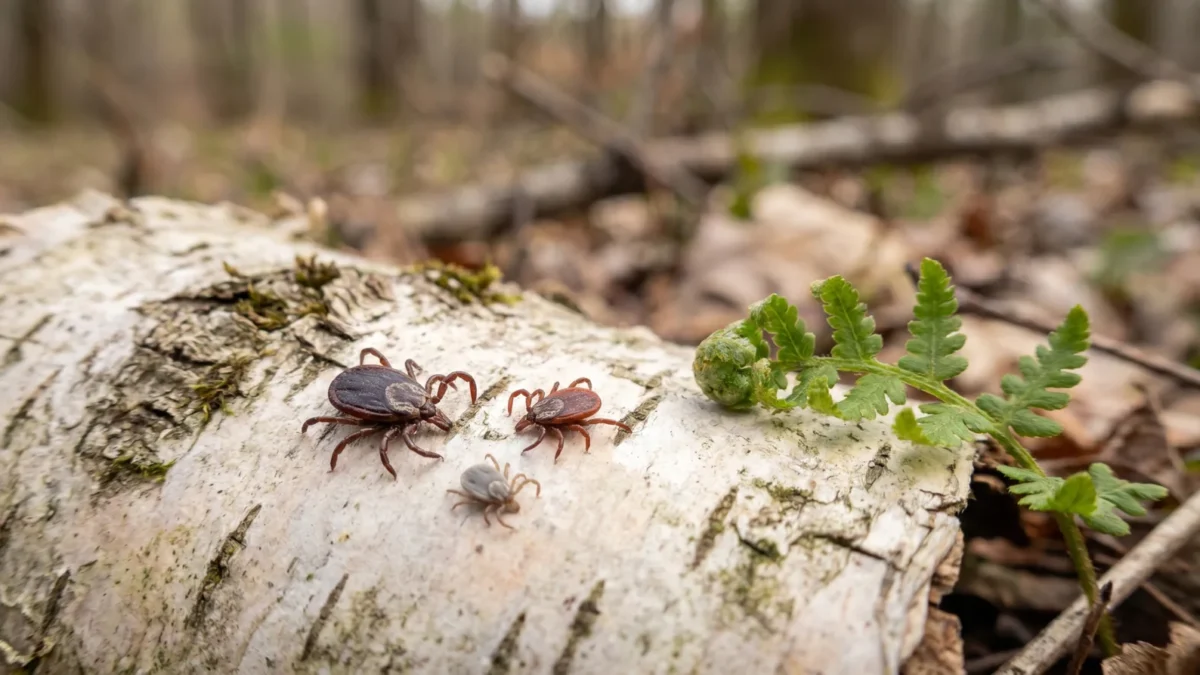
Pull a tick off your ankle after a June walk through the Camden Hills and the first question is almost always the same. What kind is this, and should I be worried? It is a fair question, because the small brown speck on your skin could be one of several species, and they do not all carry the same diseases. Knowing which one bit you changes what you watch for in the weeks that follow.
Why telling tick species apart matters in Maine and New Hampshire
Maine is home to roughly 15 tick species, according to the University of Maine Cooperative Extension Tick Lab, though most people only ever meet a handful of them. The blacklegged tick, the American dog tick, and the woodchuck tick are the ones residents run into most.
The numbers from Orono tell the story. In 2025 the UMaine Tick Lab received 5,486 ticks mailed in from all 16 of Maine’s counties and 411 towns. Blacklegged ticks and American dog ticks made up the large majority. New Hampshire sits in the same tick belt, so what shows up on one side of the Piscataqua tends to show up on the other.
Why bother learning the difference? Because a deer tick and a dog tick of the same size sit on your arm looking roughly similar to a worried eye, and only one of them spreads Lyme disease. For a deeper look at the whole picture, see our complete Maine and New Hampshire tick and Lyme guide.
The blacklegged (deer) tick: small, and the one to watch
This is the species that matters most for Lyme. The blacklegged tick (Ixodes scapularis, the one most people call a deer tick) is the carrier of Lyme disease across the northeastern United States, the CDC notes. It can also pass along anaplasmosis, babesiosis, hard tick relapsing fever, ehrlichiosis, and Powassan virus. A busy little vector.
It is also small, which is the hard part. Adult deer ticks run about the size of a sesame seed. The nymphs, active in June and early July, are roughly the size of a poppy seed. Those nymphs cause a disproportionate share of trouble precisely because they are so easy to miss in a skin crease or behind a knee. Look for the reddish-orange body, the dark legs, and the absence of any patterned markings on the back.
Local testing shows why the species earns its reputation. In the UMaine lab’s 2025 surveillance, about 45 percent of adult deer ticks and about 25 percent of nymphs carried Borrelia burgdorferi, the bacterium behind Lyme. Roughly one in four nymphs. Those are not comforting odds for a bug you can barely see.
Time is on your side, though, at least a little. A blacklegged tick generally has to stay attached for more than 24 hours before it can hand off the Lyme bacterium. That single fact is the whole argument for a daily tick check after you have been outdoors. Find it and remove it within a day and the math shifts heavily in your favor.
The American dog tick: bigger, patterned, and a different disease list
If the tick you found is noticeably larger, with whitish or gray markings on a reddish-brown body, you are probably looking at an American dog tick (Dermacentor variabilis). It is the second most common submission to the UMaine lab, and the ornate patterning on its back is the easiest tell.
Here is the reassuring part. The American dog tick does not transmit Lyme disease. Researchers at the University of Wisconsin note that even though the Lyme bacterium has turned up inside this tick, it does not pass that bacterium on to people. What it can spread is a different set of illnesses, Rocky Mountain spotted fever and tularemia among them, both of which are uncommon in the Northeast but worth a mention to your provider if symptoms follow a bite.
The lone star tick: the white-dotted newcomer pushing north
The lone star tick (Amblyomma americanum) is the species generating the most headlines, and it is the easiest of the three to identify. Adult females wear a single bright white dot on the back, the lone star that gives the tick its name. It is also an aggressive biter, far more inclined to come after a human than the other two.
The lone star can carry ehrlichiosis and other pathogens, the CDC reports, and its bite has been tied to alpha-gal syndrome, a delayed allergy to red meat. We cover that strange and growing condition in our piece on alpha-gal syndrome and the tick that triggers a meat allergy.
For now, the good news for Mainers is that lone star ticks are not yet considered established here, although they are established in other New England states. Of the 30 lone star ticks mailed to the UMaine lab in 2025, only six came from people with no recent travel outside Maine. That is a species on the move, not a species that has settled in. Worth knowing if you find a white-dotted tick after a trip south.
There is a wrinkle, though. A 2025 CDC study published in Emerging Infectious Diseases found alpha-gal cases in Maine residents in places where lone star ticks have not established, including one confirmed case that began nine days after a blacklegged tick bite. The researchers were careful to say the deer tick’s role here needs more study, but it is a reminder that the neat species-to-disease chart is still being written.
Other ticks you might find
Beyond the big three, a few oddballs turn up. The woodchuck tick (Ixodes cookei) is fairly common but rarely bites people. The squirrel tick appears now and then. And in 2025 the UMaine lab confirmed Maine’s first Asian longhorned tick, an invasive species, from a single nymph collected in Cumberland County. None of these should change how you handle a bite, but they are a sign that the state’s tick lineup keeps shifting.
What to do when you find a tick on you
Identification is step two. Step one is getting the tick off promptly and intact, then noting roughly how long it was attached. If you can recognize it as a deer tick, that is a cue to keep an eye on the bite site and your health for the next few weeks. A dog tick is lower on the worry list, and a lone star deserves a note to your provider given where we live.
Timing your outdoor caution helps too. Adult blacklegged ticks in Maine have two activity peaks, one in spring (April or May) and another in late fall (late October or early November), and they can be active any time the temperature climbs above freezing. In other words, there is no true off-season. A tick check belongs in the same mental category as kicking the mud off your boots.
Keeping ticks off you in the first place is the better play, of course. Our guide to tick repellents, comparing DEET, picaridin, and permethrin, walks through the EPA-registered options for a New England bug season.
Sources
- University of Maine Cooperative Extension Tick Lab. Tick Surveillance Program Annual Report 2025. 2026. https://extension.umaine.edu/ticks/wp-content/uploads/sites/42/2026/05/Tick-Surveillance-Program-Annual-Report-2025.pdf
- U.S. Centers for Disease Control and Prevention. How Lyme Disease Spreads. 2024. https://www.cdc.gov/lyme/causes/index.html
- U.S. Centers for Disease Control and Prevention. Where Ticks Live. 2024. https://www.cdc.gov/ticks/about/where-ticks-live.html
- CDC Emerging Infectious Diseases. Alpha-Gal Syndrome after Ixodes scapularis Tick Bite and Statewide Surveillance, Maine, USA, 2014-2023. 2025. https://pmc.ncbi.nlm.nih.gov/articles/PMC11950258/
- University of Wisconsin-Madison. The American Dog Tick/Wood Tick (Dermacentor variabilis). 2024. https://wisconsin-ticks.russell.wisc.edu/wisconsin-ticks/dermacentor-variabilis/
- LSU AgCenter. Amblyomma americanum, Lone Star Tick (Ixodida: Ixodidae). 2023. https://www.lsuagcenter.com/articles/page1666644685323
- University of Maine. UMaine Extension Tick Lab researchers confirm presence of invasive Asian longhorned tick in Maine. 2025. https://umaine.edu/news/2025/08/umaine-extension-tick-lab-researchers-confirm-presence-of-invasive-asian-longhorned-tick-in-maine/
This article is for informational purposes only and does not constitute medical advice. Consult a qualified healthcare provider before making any health decisions.