Rucking Benefits: What Weighted Walking Does, and What It Asks of Your Joints
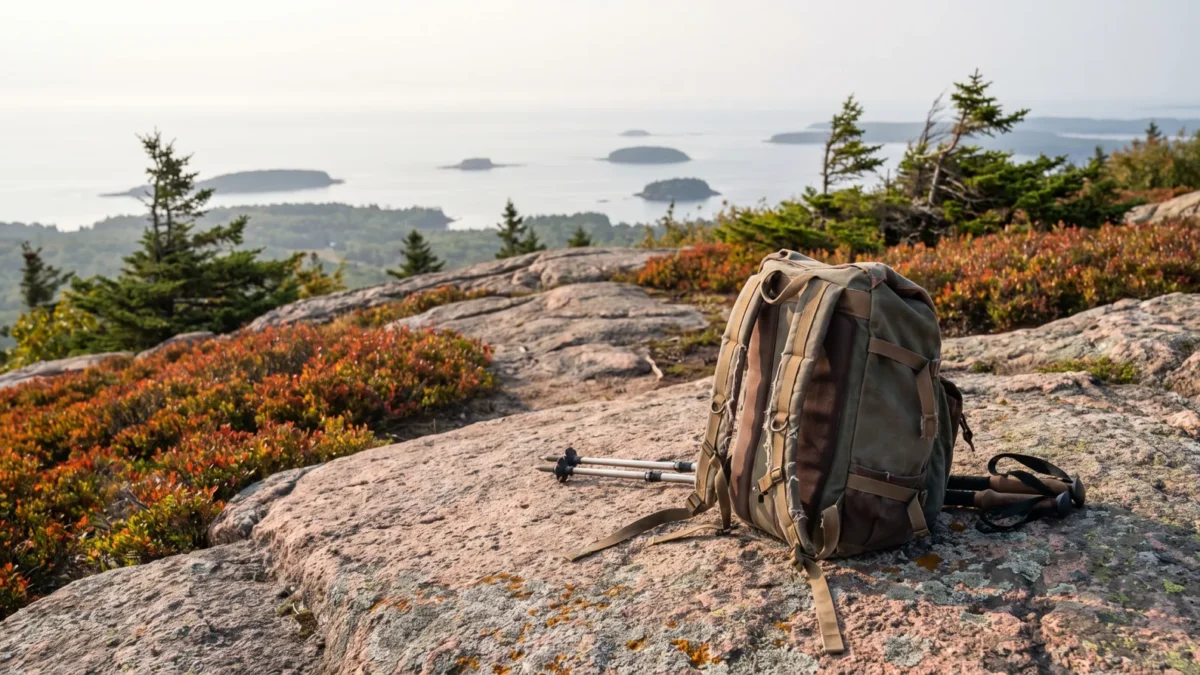
Walk the Cadillac Mountain trail on an October morning with a loaded daypack and you have already done a ruck. You just called it a hike. Rucking is walking with weight on your back, and the rucking benefits that hold up in a lab come down to one thing: carrying load raises the metabolic and muscular cost of an activity most people already do. Measured directly, metabolic rate climbs about 7.6 watts for every extra kilogram carried, and a vest of roughly 6 to 9 kg raised heart rate by about 11 beats per minute during exercise without changing stride length or cadence. The trade-off is joint load. Estimated knee contact forces rose 10.1 percent with 15 kg and 19.9 percent with 30 kg compared with walking unloaded, so weight added to your back is also weight added to your knees.
Where the rucking benefits evidence actually comes from
Almost none of it comes from studies of rucking. There is no randomized trial of civilians strapping on a pack and walking the Eastern Prom. What exists is decades of military load carriage research plus a handful of weighted vest trials, and every number below comes from one or the other.
The energy figure is the most solid piece. Huang and Kuo, in the Journal of Experimental Biology in 2014, had eight adults walk at 1.25 m/s with backpacks up to 40 percent of body weight. Metabolic energy expenditure rose about 7.6 W for each additional kilogram carried, and the ankle and knee supplied most of the extra positive work. The relationship is close to linear, so cost tracks what is in the pack.
The cardiovascular effect is real and modest. A 2022 Ergonomics study put 20 subjects in vests, 20 pounds for men and 14 for women. Oxygen uptake and energy expenditure rose, heart rate went up 11 beats per minute, and stride length and frequency did not change. Same walk. Higher price.
Maine walks more than it lifts
The state numbers make this an unusually good regional fit. In 2023, 66.1 percent of Maine adults met the 150-minute aerobic guideline, against 59.9 percent nationally. On muscle-strengthening activity twice a week, Maine fell to 38.9 percent, behind the national 41.0 percent and well behind New Hampshire’s 43.4 percent. Only 31.0 percent of Maine adults met both guidelines, against 30.0 percent nationally and 33.1 percent in New Hampshire.
CDC asks adults for 150 minutes of moderate-intensity activity a week, or 75 at vigorous intensity, plus at least two days of muscle-strengthening activity working all major muscle groups, with balance work added for older adults. It is also plain about the floor: if you cannot meet the recommendations, “be as physically active as your abilities and conditions allow. Remember that some physical activity is better than none at all.”
Whether a loaded walk counts toward the strength half is not something the guideline settles, and nothing in this research tested it. What the research shows is that load raises muscular demand at the ankle and knee during a walk you were taking anyway. If you already pay attention to what strength measures predict over a lifetime, the gap between Maine’s two columns is the interesting part.
The knee arithmetic the gear sites leave out
Lenton and colleagues, in PLoS One in 2018, estimated tibiofemoral contact forces in 21 Australian Army Reserve soldiers. Against unloaded walking, knee contact forces rose 10.1 percent at 15 kg and 19.9 percent at 30 kg. Peak medial compartment forces also rose when walking speed went from 1.53 to 1.81 m/s, so pace is its own variable. Their conclusion: soldiers carrying loads in excess of 15 kg for prolonged periods “could be at greater risk of knee MSI than those with less exposure.”
A 2023 paper in the Journal of Applied Biomechanics ran 24 young healthy adults on a treadmill unloaded, at 15 percent of body weight, then at 30 percent. First-peak contact forces and impulses rose significantly with load, and the total and lateral impulses rose disproportionally while the medial did not, a pattern the authors connect to osteoarthritis risk. Seay’s 2015 review supplies the extreme end: peak knee extension moment increased 115 percent under a 55 kg load, and US ground soldiers in Afghanistan carried loads averaging 45 kg. Worth remembering when a finding from that world gets quoted at a weekend hiker.
Maine has a particular stake here. Crude prevalence of diagnosed arthritis among Maine adults in 2023 was 32.7 percent, against 25.4 percent nationally and 28.6 percent in New Hampshire. Age-adjusted, Maine sits at 27.0 percent and the country at 22.5 percent, so an older population does not explain the whole gap.
None of which argues for sitting still. The American College of Rheumatology tells patients with osteoarthritis that “Exercise can improve your muscle strength, decrease joint pain and stiffness, and lower the chance of disability due to OA,” and points them toward a physical or occupational therapist to learn safe movements. Exercise is not the question. Which exercise, under how much load, is a question for someone who can examine your knee.
The claim the evidence does not support
Bone density is where the popular version has run furthest ahead. The INVEST in Bone Health randomized trial, published in JAMA Network Open in 2025, put 150 older adults with obesity (mean age 66.4 years, 74.7 percent women) through 12 months of weight loss alone, weight loss plus a weighted vest worn 8 hours daily, or weight loss plus supervised progressive resistance training. Total hip trabecular volumetric bone mineral density fell in every group, by 1.2 percent to 1.9 percent. The vest group did no better than weight loss alone, though a vest worn 8 hours a day is not a ruck and one trial is not the last word.
Unloaded walking does not look stronger. A 2008 meta-analysis in Bone pooled eight trials and found regular walking had no significant effect on preserving lumbar spine bone mineral density in postmenopausal women (WMD 0.007 g/cm2, 95% CI -0.001 to 0.016, P=0.09). Femoral neck results came out positive but marginal and inconsistent across studies (WMD 0.014 g/cm2, 95% CI 0.000 to 0.028, P=0.05).
Between them, those two results are the closest thing to an answer anyone has, and they point away from the bone claim rather than toward it.
What goes wrong, according to people who do this for a living
Orr and colleagues surveyed 338 Australian Army soldiers: 34 percent had sustained at least one load carriage injury. Lower limbs accounted for 61 percent, bones and joints were the most frequently injured structures at 39 percent, and endurance marching was responsible for 38 percent. Among those hurt during initial training, 52 percent went on to report a second one.
Across 401 reported load carriage injuries in Australian Defence Force personnel, the lower back, not the knee, was the most common injury site for both sexes, at 27 percent in women and 22 percent in men. Fifteen percent of injuries in female soldiers and 6 percent in males were classified as Serious Personal Injuries, and the authors suggest smaller body stature may contribute.
Terrain is the other dial, and we have plenty of it
A 2021 international review of soldier load carriage conditioning makes a point that rarely survives into consumer coverage: “speed of march and grade and type of terrain covered are factors that can be adjusted to manipulate load carriage intensity, limiting the need to adjust load weight alone.” It also describes sessions every 10 to 14 days alongside resistance and aerobic training, framed as reconditioning for injured soldiers rather than a schedule for anyone else.
Grade matters most going down. A 2024 study in Medicine & Science in Sports & Exercise found that after one bout of loaded downhill walking, maximal voluntary contraction torque in 17 participants dropped 23.7 percent immediately and was still down 19.2 percent at 48 hours. A second bout two weeks later produced a lower heart rate (145 versus 156 bpm) and lower perceived exertion.
Useful, in a region assembled out of descents. Acadia has more than 150 miles of trails, and the National Park Service describes its summit hikes as involving “lots of elevation gain, stairs, ladders, and more,” climbing from near sea level to Cadillac’s 1,530-foot summit. The Camden Hills give you steep, rooty descent much closer to the water. Mount Washington tops out at 6,288 feet, and New Hampshire State Parks routes visitors to the Observatory’s higher summits forecast and to Hike Safe, warning that “Recreationists should possess the necessary knowledge, skill, and equipment to ensure their own safety.” If you are preparing for a Presidential Range day under a heavy pack, the descent is what your quadriceps will remember two days later, whether you track that in a paper log or in heart rate variability.
Winter rearranges all of it, and exercising outdoors through a northern New England winter raises questions that have little to do with what is on your back. Which is close to the honest summary. Adding weight to a walk raises its cost, and its knee load, in ways that have been measured carefully. The gear sites have run well ahead of both.
Sources
- US Centers for Disease Control and Prevention. Nutrition, Physical Activity, and Obesity: Behavioral Risk Factor Surveillance System (dataset hn4x-zwk7). https://data.cdc.gov/d/hn4x-zwk7
- US Centers for Disease Control and Prevention. U.S. Chronic Disease Indicators (dataset hksd-2xuw). https://data.cdc.gov/d/hksd-2xuw
- US Centers for Disease Control and Prevention. Physical Activity Basics: Adults. https://www.cdc.gov/physical-activity-basics/guidelines/adults.html
- Lenton GK, et al. Tibiofemoral joint contact forces increase with load magnitude and walking speed but remain almost unchanged with different types of carried load. PLoS One. 2018;13(11):e0206859. https://pubmed.ncbi.nlm.nih.gov/30395591/
- Tibiofemoral Load Magnitude and Distribution During Load Carriage. Journal of Applied Biomechanics. 2023;39(6):432-439. https://pubmed.ncbi.nlm.nih.gov/37739402/
- Seay JF. Biomechanics of Load Carriage: Historical Perspectives and Recent Insights. Journal of Strength and Conditioning Research. 2015. https://pubmed.ncbi.nlm.nih.gov/26506175/
- Huang TW, Kuo AD. Mechanics and energetics of load carriage during human walking. Journal of Experimental Biology. 2014;217(Pt 4):605-13. https://pubmed.ncbi.nlm.nih.gov/24198268/
- Weighted vests in CrossFit increase physiological stress during walking and running without changes in spatiotemporal gait parameters. Ergonomics. 2022. https://pubmed.ncbi.nlm.nih.gov/34319864/
- Weighted Vest Use or Resistance Exercise to Offset Weight Loss-Associated Bone Loss in Older Adults: A Randomized Clinical Trial. JAMA Network Open. 2025. https://pubmed.ncbi.nlm.nih.gov/40540267/
- Martyn-St James M, Carroll S. Meta-analysis of walking for preservation of bone mineral density in postmenopausal women. Bone. 2008;43(3):521-31. https://pubmed.ncbi.nlm.nih.gov/18602880/
- Orr RM, et al. Self-reported load carriage injuries of military soldiers. International Journal of Injury Control and Safety Promotion. 2017. https://pubmed.ncbi.nlm.nih.gov/26760719/
- Orr RM, et al. Gender differences in load carriage injuries of Australian army soldiers. BMC Musculoskeletal Disorders. 2016. https://pubmed.ncbi.nlm.nih.gov/27884191/
- Soldier Load Carriage, Injuries, Rehabilitation and Physical Conditioning: An International Approach. International Journal of Environmental Research and Public Health. 2021. https://pubmed.ncbi.nlm.nih.gov/33920426/
- Neuromuscular and Metabolic Responses during Repeated Bouts of Loaded Downhill Walking. Medicine & Science in Sports & Exercise. 2024;56(2):277-286. https://pubmed.ncbi.nlm.nih.gov/37703332/
- American College of Rheumatology. Osteoarthritis patient information. https://rheumatology.org/patients/osteoarthritis
- National Park Service. Acadia National Park, hiking. https://www.nps.gov/acad/planyourvisit/hiking.htm
- New Hampshire State Parks. Mount Washington State Park. https://www.nhstateparks.org/visit/state-parks/mount-washington-state-park.aspx
This article is for informational purposes only and does not constitute medical advice. Consult a qualified healthcare provider before making any health decisions.