The Indoor Humidity Level That Keeps Mold Down in a New England Winter
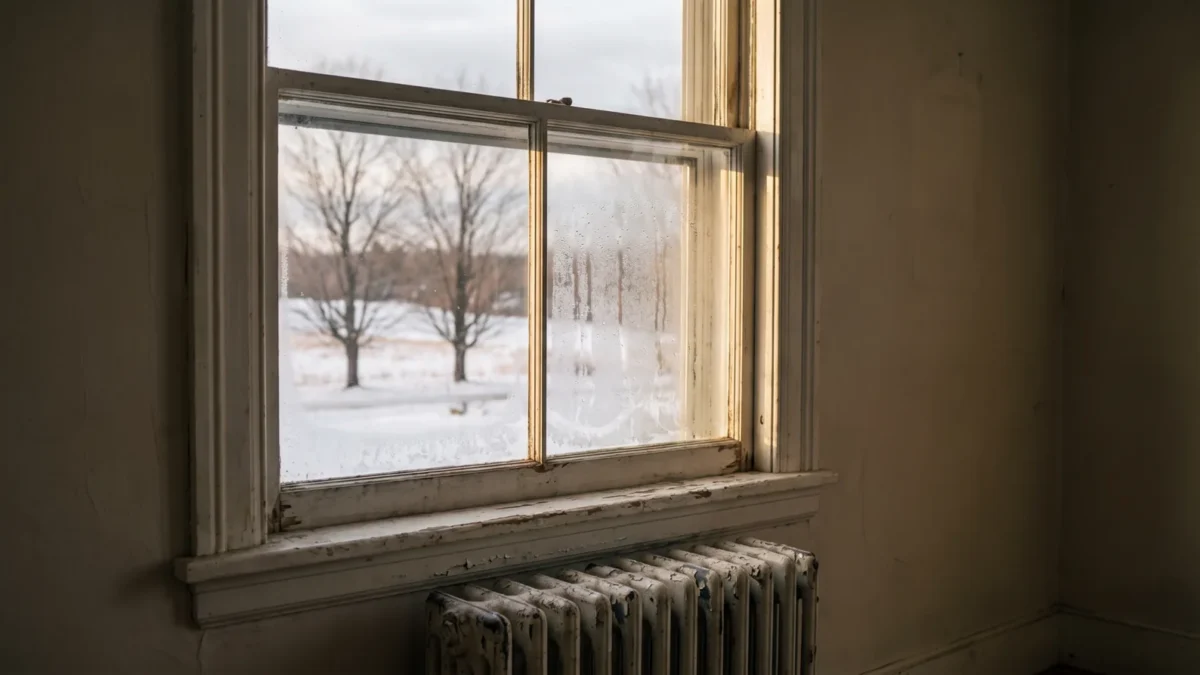
A cold snap settles in, the furnace runs all night, and by morning every north-facing window in the house is beaded with water. That is usually when somebody starts searching for what their indoor humidity level should be. The answer from the US EPA is 30 to 50 percent relative humidity, and never above 60 percent, the range that keeps mold from taking hold. In a cold climate during the heating season, ENERGY STAR narrows that to 30 to 40 percent, because warm indoor moisture condenses on cold glass and exterior walls long before the room air feels damp. The US CDC says it more plainly: keep humidity as low as you can, no higher than 50 percent, all day long.
Four sources, four different indoor humidity level ranges
EPA’s mold guide sets the outer boundary: keep indoor humidity below 60 percent relative humidity, “ideally between 30 and 50 percent.” The CDC’s mold page is tighter, and reads as a daily habit rather than a target, applied to the whole day rather than the hours you happen to check.
ENERGY STAR, run jointly by EPA and the Department of Energy, agrees that 30 to 50 percent is the general optimum, then adds the cold-climate exception: during the heating season in colder climates, levels should sit between 30 and 40 percent to prevent window condensation. University of Minnesota Extension goes lower again, treating relative humidity above 50 percent as the point where moisture problems begin, and calling 25 percent in winter to 50 percent in summer healthy and comfortable for people, and better for the house.
Then comes the outlier. A 1986 review in Environmental Health Perspectives by Arundel and colleagues looked at humidity from the human side rather than the building side, and concluded that most adverse health effects caused by relative humidity would be minimized between 40 and 60 percent. Dust mite populations bottom out below 50 percent and peak near 80, and most species of fungi cannot grow unless relative humidity climbs past 60. The authors were direct about the consequence: their range “would require humidification during winter in areas with cold winter climates.” The ranges overlap without agreeing, and a single narrow band quoted at you is somebody picking a side.
One house, two opposite problems, six months apart
NOAA’s 1991 to 2020 normals put Portland’s January mean temperature at 24.0 degrees F, with a mean minimum of 15.6. Concord, New Hampshire runs colder, a January mean of 22.3 and a mean minimum of 12.9. Air that cold holds almost no water, so heating it to something livable drops the relative humidity through the floor. The house goes dry. And the windows still run, because the glass stays near outdoor temperature and the air touching it cools below its dew point. Minnesota Extension lists winter window condensation as a symptom of excess moisture, alongside mildew, peeling paint and dust mites.
By July, Portland’s normal mean is 70.4 degrees and the house has flipped. Warm humid air drifts into a basement whose slab and walls are still cool from the earth. The Maine Indoor Air Quality Council is blunt about the result: a basement with an uninsulated slab or uninsulated wall surfaces is at significant risk of a mold problem, because summer heat and humidity cause condensation on any uninsulated surface in contact with the cold earth.
That council is also why Maine residents get a seasonal answer instead of a national one. Maine CDC publishes no mold guidance of its own. Its Indoor Safety page sends anyone asking about mold straight to the Maine Indoor Air Quality Council, whose recommendation splits the year in half: “Maintain the humidity level between 30% in the winter and 50% in the summer to prevent mold growth.” No furnace manufacturer’s page tells you that, and it is the most useful sentence in the subject for a house in Bangor or Berlin. For the wider view, see our guide to environmental health in Maine and New Hampshire.
Where the water is actually coming from
Humidity is an outcome, not a cause. Minnesota Extension names the usual indoor suspects: humidifiers, houseplants, stored firewood, and damp soil under basements and crawl spaces. Firewood stacked in a warm cellar is an underrated one around here.
The bigger volumes arrive from outside. In a one inch rain, 1,250 gallons of water fall on the roof of a 2,000 square foot house, and the Extension’s minimum is one downspout per 50 linear feet of roof eave. Grading and gutters do more for a damp Maine basement than any appliance will.
There is also a summer fix that feels right and makes things worse. If condensation is the basement problem, do not ventilate with warm humid outside air, because it condenses on cool walls and floors. The Extension is equally careful about dehumidifiers: running one reduces the symptoms of humidity and odor, but is not a permanent or complete solution.
The winter humidifier question has no clean answer
Here is the honest tension. Arundel’s health-side range of 40 to 60 percent implies running a humidifier through a New England January. ENERGY STAR’s heating-season range of 30 to 40 implies the opposite, and the Extension’s winter figure of 25 percent is lower again. Very dry air is uncomfortable, and standing water on a window sash every morning is how paint fails and mold starts. Extension also lists household humidifiers as a moisture source.
What settles it is the house, not a number from an article. Condensation on the glass is the feedback signal. If it shows up, the air is carrying more moisture than that envelope can hold at that outdoor temperature, whatever the meter reads.
Why any of this matters for breathing
The evidence on dampness is unusually consistent. A meta-analysis by Fisk and colleagues, covering the studies behind the Institute of Medicine report, found central odds ratio estimates from 1.34 to 1.75 and concluded that building dampness and mold are associated with roughly 30 to 50 percent increases in a variety of respiratory and asthma-related outcomes. A later review by Mendell and colleagues found dampness or mold consistently associated with asthma development and exacerbation, wheeze, cough, shortness of breath, bronchitis and allergic rhinitis, in allergic and non-allergic people alike, with evidence strongly suggesting causation of asthma exacerbation in children.
The population arithmetic is large. EPA researchers estimated that 21 percent of current US asthma cases, about 4.6 million, are attributable to dampness and mold exposure at home, at a national cost of $3.5 billion a year in 2004 dollars. Maine CDC reports that one in nine Mainers currently has asthma, more than 150,000 people, and that poorly controlled asthma contributes to roughly 2,700 emergency department visits, 200 hospitalizations and 13 deaths in the state each year. Winter is already hard on Maine lungs for other reasons, including the respiratory infections that circulate once everyone moves indoors.
Buy the cheap meter, skip the mold test
EPA describes a humidity meter as a small, inexpensive instrument, $10 to $50. That is the whole cost of knowing where you stand instead of guessing from how the air feels. If you want those readings alongside others, we looked at several units in our review of home air quality monitors.
Testing for mold itself is a different story. CDC does not recommend it, because health effects vary between individuals and there are no standard thresholds for acceptable mold levels in homes. Mendell’s review reached a parallel conclusion, that current evidence does not support measuring specific indoor microbiologic factors to guide health-protective actions. If you can see it or smell it, the finding is already in.
Two EPA numbers are worth carrying instead. Dry wet or damp materials within 24 to 48 hours of a leak or spill and in most cases mold will not grow, which makes the weekend after a burst pipe more decisive than anything later. And EPA’s do-it-yourself boundary is a moldy area under about 10 square feet, roughly three feet by three.
The sealed season is also radon season
Everything that traps winter moisture traps other things too. Maine CDC states that at least 25 percent of homes tested in any part of the state have radon problems, that levels are typically higher in winter, and that the heating season is the best time to test. Short term tests of under four days ask you to keep the house in “closed house condition” for 12 hours beforehand, roughly how a Maine house sits anyway from December through March.
The winter checklist runs together. Watch the windows, keep a meter somewhere central, test for radon while the house is shut, and stay alert to combustion byproducts from the stove or furnace, covered in our piece on carbon monoxide and wood smoke during the heating season. If a radon test comes back high, the fix has a known price range, laid out in our look at what radon mitigation systems cost. Humidity is the one item you can read for ten dollars and start correcting the same afternoon.
Sources
- US EPA. A Brief Guide to Mold, Moisture and Your Home. https://www.epa.gov/mold/brief-guide-mold-moisture-and-your-home
- US CDC. About Mold and Health. https://www.cdc.gov/mold-health/about/index.html
- ENERGY STAR (US EPA and US Department of Energy). Dehumidifiers. https://www.energystar.gov/products/dehumidifiers
- University of Minnesota Extension. Controlling moisture problems in your home. https://extension.umn.edu/garden-and-home/home-maintenance/caring-for-a-home/controlling-moisture-problems-in-your-home
- University of Minnesota Extension. Moisture in basements: causes and solutions. https://extension.umn.edu/garden-and-home/home-maintenance/caring-for-a-home/moisture-in-basements-causes-and-solutions
- Maine Indoor Air Quality Council. Mold. https://www.maineindoorair.org/mold/
- Maine CDC. Indoor Safety. https://www.maine.gov/dhhs/mecdc/healthy-living/health-and-safety/indoor-safety
- Maine CDC. Radon Frequently Asked Questions. https://www.maine.gov/dhhs/mecdc/healthy-living/health-and-safety/indoor-safety/radon/radon-frequently-asked-questions
- Maine CDC. Asthma. https://www.maine.gov/dhhs/mecdc/diseases-conditions/chronic-conditions/asthma
- NOAA National Centers for Environmental Information. US Climate Normals, monthly 1991-2020 (Portland, ME station USW00014764; Concord, NH station USW00014745). https://www.ncei.noaa.gov/access/us-climate-normals/
- Arundel AV, Sterling EM, Biggin JH, Sterling TD. Indirect health effects of relative humidity in indoor environments. Environ Health Perspect. 1986 Mar;65:351-61. https://pubmed.ncbi.nlm.nih.gov/3709462/
- Fisk WJ, Lei-Gomez Q, Mendell MJ. Meta-analyses of the associations of respiratory health effects with dampness and mold in homes. Indoor Air. 2007 Aug;17(4):284-96. https://pubmed.ncbi.nlm.nih.gov/17661925/
- Mudarri D, Fisk WJ. Public health and economic impact of dampness and mold. Indoor Air. 2007 Jun;17(3):226-35. https://pubmed.ncbi.nlm.nih.gov/17542835/
- Mendell MJ, Mirer AG, Cheung K, Tong M, Douwes J. Respiratory and allergic health effects of dampness, mold, and dampness-related agents: a review of the epidemiologic evidence. Environ Health Perspect. 2011 Jun;119(6):748-56. https://pubmed.ncbi.nlm.nih.gov/21269928/
This article is for informational purposes only and does not constitute medical advice. Consult a qualified healthcare provider before making any health decisions.