Browntail Moth: The Rash, the Breathing Trouble, and When the Hairs Are Worst
Maine Forest Service crews flew the coast in the spring of 2021 and mapped 172,870.5 acres of browntail moth defoliation, then went back in the fall and found another 26,849.5. That was the top of the outbreak. Three years later the same surveys turned up around 2,000 acres, and this August the agency reported the midcoast decline still holding. Good news, and also the reason people get caught out, because the caterpillars are the visible half of this problem and the hairs are the half that stays behind.
What the hairs do to skin and airways
The caterpillar is easy to identify once you know it. Maine CDC describes it as up to an inch and a half long, brown, with a broken white stripe down each side and two red or orange spots toward the hind end. What matters is the coat. NHBugs, the joint program run by UNH Extension, New Hampshire’s forestry and agriculture agencies and federal partners, describes browntail hairs as barbed and carrying toxins that create rashes on human skin.
Maine CDC says contact can cause a localized skin rash lasting a few hours to several days, and that certain people get a more severe form that runs for a few weeks. There is no specific treatment. The peer-reviewed description is blunter: a 2021 study in Environmental Entomology characterizes browntail outbreaks as causing severe dermatitis in the majority of people who encounter the hairs, and respiratory distress in many.
Two clarifications for the kitchen table. The rash is not contagious, and the Maine CDC fact sheet says so plainly: it does not spread from one person to another. The severe end of the reaction, though, is a real emergency. The same fact sheet tells people to call 9-1-1 for trouble breathing, trouble swallowing, or swelling of the mouth, tongue or throat.
None of this is new science. De Jong and colleagues characterized the mechanism in a four-part series in Archives of Dermatological Research between 1975 and 1977, down to electron microscopy of the setae themselves.
Nobody has to touch a caterpillar
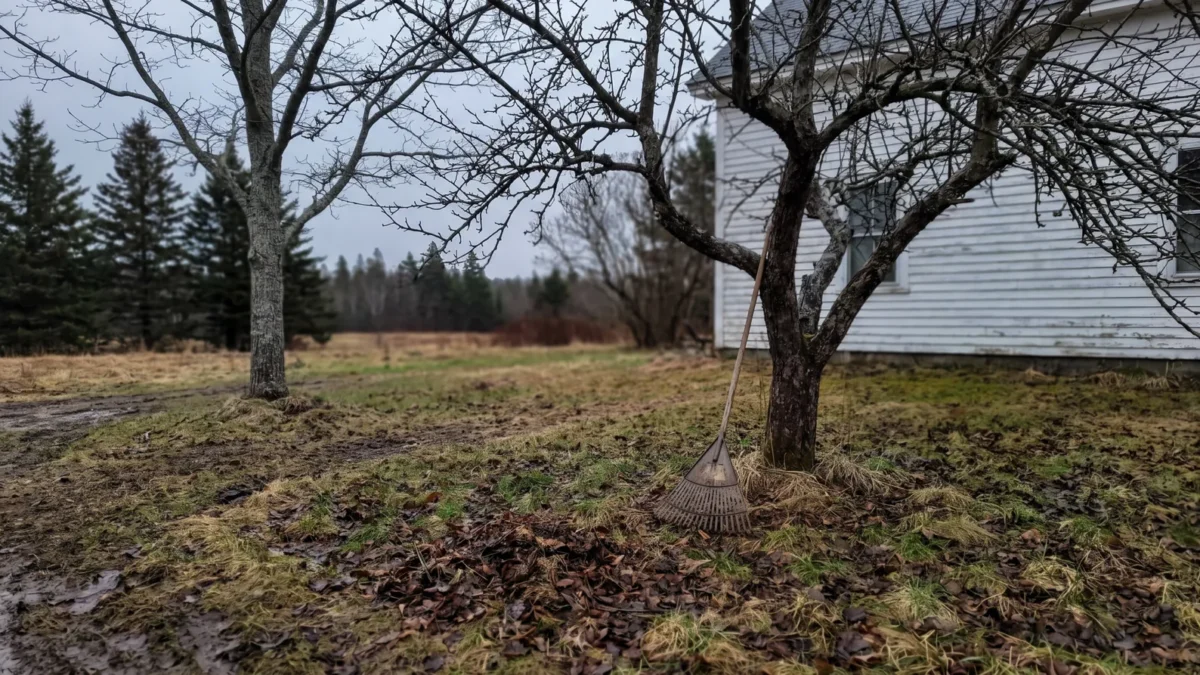
This is the piece people miss. The University of Maine’s forest entomology lab puts it directly: because the hairs go airborne when the caterpillars shed their exoskeletons, direct contact with the caterpillars is not a prerequisite for serious symptoms. A lawn chair will do it. So will an afternoon of raking.
Which is why Maine Forest Service guidance reads the way it does. The agency says the greatest risk of exposure runs between April and July, that the hairs go airborne whenever they are disturbed, and that yard work in infested areas belongs on wet days. It warns specifically against leaf blowers and lawnmowers on dry days, efficient machines for putting an old caterpillar hair into a neighbor’s eye.
The caterpillars are active from mid-April until early October, and only the caterpillars, their pupal cocoons and their shed skins carry toxic hairs. Maine Forest Service says the hairs on the adult moths are not toxic and do not cause a rash, though an adult can pick up a few leaving a cocoon. White moths at a porch light in July signal a local population rather than a hazard.
On a dry, breezy afternoon in May, exposure in an infested neighborhood can read as ordinary seasonal misery. Itchy eyes, a scratchy throat. Anyone who has worked through a New England pollen season knows the feeling, which is exactly why browntail gets misfiled.
The hairs outlast the caterpillar by years
One fact reorganizes the rest. Maine CDC states that browntail hairs remain toxic in the environment for up to three years, losing strength over time. Maine Forest Service is more emphatic in the footnote to its own life cycle chart: “Toxin in hairs is extremely stable (3+ yr); exposure most likely in dry conditions.”
So the caterpillar’s calendar and the hazard’s calendar are two different documents. The insect keeps a tidy year: winter webs September to April, feeding larvae April to June, pupae June to July, adults and eggs July to August, then a shorter second feeding period into September. The hairs keep no calendar at all. They sit in leaf litter, in bark crevices, in the back corner of a shed.
Put practically, a Brunswick or Bath dooryard that had a heavy caterpillar year in 2024 can still hand somebody a rash while they rake it in 2026, long after the state has called populations low. It is also why the Forest Service brochure tells people removing winter webs to protect eyes, skin and airway, since the point of that job is contact with previous seasons’ hairs. Browntail belongs with the other slow-moving environmental health risks across Maine and New Hampshire that outlast the season you notice them in.
An outbreak measured in acres
The moth arrived in the late 1800s in Somerville, Massachusetts, most likely on a shipment of roses from Europe. By 1915 its North American range covered roughly 150,000 square kilometers. Then it collapsed, receding by the 1960s to relic populations on outer Cape Cod and a few islands in Casco Bay. That remnant came back. After the 1989 resurgence, Maine defoliation stayed under 2,000 hectares for years, peaked above 4,300 hectares in 2003, and passed 10,000 hectares in 2016.
University of Maine researchers describe populations exploding to 100-year highs in 2015, producing roughly 250,000 acres of hardwood defoliation from an insect that feeds on over 50 species of woody hosts. Forest Service aerial surveys carry it from there: 153,680 acres in 2020, then 2021’s peak of 198,773 unique acres once survey overlap is subtracted, and the first outbreak year with mapped defoliation in Oxford and Hancock counties. By 2024 the early summer flights found only around 2,000 acres, a drop the agency attributed partly to pathogen pressure following a wet prior year.
Geographically the moth sits in patches along the coast and up to 60 miles inland, from the western Maine border to the New Brunswick border, with the greatest concentrations in midcoast Maine and the capital region.
Wet springs are doing the work
The collapse was not luck, or not entirely. That 2021 Environmental Entomology study examined 24 years of defoliation and found two predictors that held up: the preceding spring’s precipitation, which pushed defoliation down, and the previous late summer and early fall temperatures, which pushed it up.
The mechanism is a fungus. Wet springs drive epizootic outbreaks of Entomophaga aulicae, which tears through caterpillar populations, while warm falls let more caterpillars reach maturity before winter. The authors also noted that climate trends indicate continued increases in fall temperatures since the resurgence, which is the uncomfortable half of the finding. Wet springs are suppressing the moth now. The fall side of the equation is trending the other way.
Where 2026 landed
The Forest Service’s May report was unusual. Caterpillars were not documented emerging until April 29, about two weeks later than normal and the latest date of emergence since weekly monitoring began five years ago. Populations were expected to stay low except in a few areas with higher numbers, namely Androscoggin, Cumberland, Hancock and Oxford counties. By August the picture held, with defoliation still declining in midcoast areas and a few localized pockets left in southern Maine, mainly on the western shores of Sebago Lake.
Low is not gone, though. The Forest Service notes that every year since 1994 Maine has seen pockets of high populations and damage amounting to at least 400 acres, and says flatly that we cannot eradicate browntail moths. New Hampshire is watching the edge of the same problem. NHBugs calls browntail a serious human health risk and reports that it has spread west and south to the New Hampshire border, advising residents to remove and destroy nests between November and April.
The law that makes Maine different
Maine holds by far the largest browntail population in the country, and it is the only state running a dedicated public health response to a caterpillar. Under Title 22, section 1444, the director of the Maine CDC can declare a browntail infestation a public health nuisance, on the director’s own initiative or by petition from municipal officers. That declaration does one specific thing: it lets a municipality spend public municipal funds on private land. It does not provide access to additional state funds or services. Petitions filed between January 1 and August 31 expire that December 31, while those filed September 1 through December 31 run a year longer.
State guidance on treatment is narrow. The Maine CDC fact sheet says to have trees treated before the end of May, and Maine restricts pesticide use within 250 feet of marine waters, which takes a good deal of shoreline off the table in the counties where the moth concentrates. For the rash, the state lists cool baths with baking soda or oatmeal, hydrocortisone cream, calming lotions, and over-the-counter allergy products for mild respiratory symptoms. That is a description of what people do, not a prescription. Anything past a mild rash is a conversation with a clinician.
The reasonable posture here in 2026 is neither alarm nor amnesia. Populations are down. Hairs from the last big year are still in the yard. Rake on a damp day, keep the blower off the leaf pile in June, and follow the Forest Service’s advice on eye, skin and airway protection before cutting a web out of an apple tree in February. For the wider set of seasonal exposures in the region, our Maine and New Hampshire environmental health guide covers the rest of the ground.
Sources
- Maine Center for Disease Control and Prevention. Browntail Moth. http://www.maine.gov/dhhs/mecdc/infectious-disease/epi/vector-borne/browntail-moth/index.shtml
- Maine Center for Disease Control and Prevention. Browntail Moth Fact Sheet. 2019. https://www.maine.gov/dhhs/mecdc/sites/maine.gov.dhhs.mecdc/files/Browntail-Moth-FS.pdf
- Maine Forest Service. Browntail Moth Frequently Asked Questions. https://www.maine.gov/dacf/mfs/forest_health/invasive_threats/browntail_moth_faqs.htm
- Maine Forest Service. Browntail Moth Life Cycle. https://www.maine.gov/dacf/mfs/forest_health/documents/browntail_moth_life_cycle.pdf
- Maine Forest Service. Browntail Moth (Euproctis chrysorrhoea). http://www.maine.gov/dacf/mfs/forest_health/invasive_threats/browntail_moth_info.htm
- Maine Forest Service. Knock Out Browntail brochure. https://www.maine.gov/dacf/mfs/forest_health/documents/browntail_moth_brochure.pdf
- Maine Forest Service. Forest Insect & Disease Conditions Report, 2021 Issue 7. October 29, 2021. https://content.govdelivery.com/accounts/MEDACF/bulletins/2f9a3bb
- Maine Forest Service. Forest Insect & Disease Conditions Report, 2024 Issue 5. October 9, 2024. https://content.govdelivery.com/accounts/MEDACF/bulletins/3bb0486
- Maine Forest Service. Forest Insect & Disease Conditions Report, 2026 Issue 1. May 22, 2026. https://content.govdelivery.com/accounts/MEDACF/bulletins/4188319
- Maine Forest Service. Forest Insect & Disease Conditions Report, 2026 Issue 3. August 3, 2026. https://content.govdelivery.com/accounts/MEDACF/bulletins/4228aed
- Boyd KS, Drummond F, Donahue C, Groden E. Factors Influencing the Population Fluctuations of Euproctis chrysorrhoea (Lepidoptera: Erebidae) in Maine. Environmental Entomology. 2021. https://www.maine.gov/dacf/mfs/forest_health/documents/BTM_ClimateEnvirEnt2021.pdf
- University of Maine School of Biology and Ecology. Browntail Moth Research at the University of Maine, 2022 Update. https://sbe.umaine.edu/wp-content/uploads/sites/92/2022/05/Browntail-Moth-Research-at-the-University-of-Maine_2022-Update.pdf
- NHBugs (UNH Extension, NH Division of Forests & Lands, NH Department of Agriculture, Markets & Food, US Forest Service, APHIS). Browntail Moth. https://www.nhbugs.org/damaging-insects-diseases/browntail-moth
- de Jong MC, Bleumink E, Nater JP, Hoedemaeker J, Jongebloed WL. Investigative studies of the dermatitis caused by the larva of the brown-tail moth, Euproctis chrysorrhoea, parts I to IV. Archives of Dermatological Research. 1975 to 1977. https://pubmed.ncbi.nlm.nih.gov/1200705/ , https://pubmed.ncbi.nlm.nih.gov/1275552/ , https://pubmed.ncbi.nlm.nih.gov/911191/ , https://pubmed.ncbi.nlm.nih.gov/911192/
This article is for informational purposes only and does not constitute medical advice. Consult a qualified healthcare provider before making any health decisions.