Early Ice and Cold Water: Why the Riskiest Days Sit at Each End of Winter
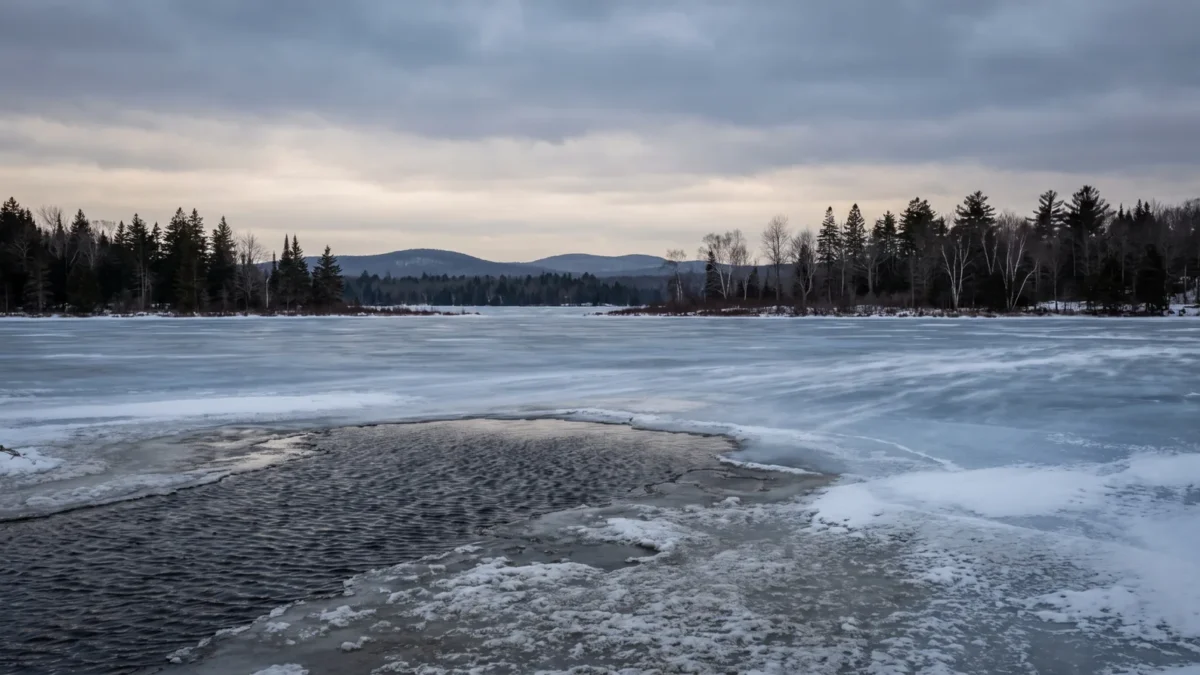
A handful of ponds along the Maine and New Hampshire line carry a shoreline in each state. Same water, same freeze. Walk out from the Maine side and the state’s official guidance says four inches of new clear ice will hold a person on foot. Walk out from the New Hampshire side and the number is six. Both agencies are trying to keep you alive, and the two inches between them are the most useful thing you can learn about ice all winter.
Two states, one lake, two numbers
Maine’s Department of Inland Fisheries and Wildlife keeps a thickness table for new, clear ice. Under four inches, stay off. Four inches for ice fishing or recreational activities on foot. Five to seven for a snowmobile or ATV. Eight to twelve for most cars or small pickups, and twelve to fifteen for a medium-sized truck. The same page opens with a sentence the table cannot soften: ice is never 100 percent safe.
New Hampshire Fish and Game runs stricter. It asks for a minimum of six inches of hard ice before individual foot travel and eight to ten inches for a snow machine or ATV, and it credits that rule of thumb to the US Army Cold Regions Research and Engineering Laboratory in Hanover. Maine’s table carries no such attribution, and there’s no federal ice thickness standard sitting behind either state.
On a border pond, use the stricter figure. But arguing over two inches pulls attention from what actually kills people, which is the first sixty seconds after the ice gives way.
The word doing the work is “clear”
Maine’s four inches describes new, clear ice, and that qualifier carries more weight than the number. The same page warns that white ice, or snow ice, is only about half as strong. Blue to clear ice is the strongest. Light gray to dark black means melting ice, and the instruction there is to stay off. Mottled or slushy rotten ice weakens from the center outward, which is hard to read from shore. The agency’s mnemonic is easier to keep in your head than the table: thick and blue, tried and true. Thin and crispy, way too risky.
New Hampshire supplies the other half of the problem. Thick ice does not always mean safe ice, because ice can be thick without being strong, depending on what the weather has been doing. Weak ice forms when a warming trend breaks down the surface into slush that then refreezes. The state’s advice about warm spells runs one line: don’t go on the ice during thaws.
And a single measurement tells you nothing about the next hundred yards. Maine’s ice fishing guidance tells anglers to cut several test holes with a chisel or auger, and to stay away from rock piles, inlets and outlets, and anywhere water could be moving, since ice runs thinner there. Anyone who spends a season fishing through the ice in Maine does this by reflex. It’s worth borrowing if you’re crossing only once.
What the first minute does to you
Hypothermia gets the headline. It shouldn’t have top billing.
The National Weather Service describes cold shock as gasping for breath and rapid breathing during the first two to three minutes or more in the water. The gasp can be triggered by water as warm as 77 degrees, and the agency is explicit that cold shock is just as severe and dangerous between 50 and 60 degrees as it is in colder water. A controlled study in Frontiers in Psychology found the response peaks in the first 60 to 90 seconds and then subsides, and is thought to be maximally provoked somewhere between roughly 41 and 59 degrees.
The uncomfortable part is the upper end of that range. Fifty-five degree water sounds survivable when you read about it on shore in July, and it sets off the same reflex.
You lose your hands before you lose your heat
The second stage arrives fast too. The Weather Service says loss of muscular control in the arms, legs, hands and feet can be felt within seconds of entering cold water, and that self-rescue or staying afloat without assistance becomes virtually impossible once it does. Hypothermia, by that same agency’s definition, doesn’t begin until core body temperature drops to 95 degrees, which takes considerably longer.
That ordering isn’t a new finding. Michael Tipton’s 1989 review in Clinical Science concluded that the cold shock response can kill or seriously incapacitate someone long before general hypothermia develops, and is probably responsible for the majority of annual open-water immersion deaths. A 2026 review in the Journal of Applied Physiology goes further, reporting that epidemiological data challenge the prevailing assumption that hypothermia is the primary mechanism of death. It describes four stages: cold shock triggered within seconds of immersion, swimming failure as peripheral neuromuscular cooling impairs motor function at near-normal core temperatures, hypothermia, then circum-rescue collapse. Gordon Giesbrecht described a similar sequence in a 2001 prehospital review, naming that last stage as a dramatic worsening that can occur before, during or after a rescue.
A 2016 review in Physiology adds a useful distinction. Immersion means your airway is above the water. Submersion means it isn’t. That review lists cold shock, physical incapacitation and hypovolemia as precursors of collapse and submersion, the mechanism by which someone who never intended to be in the water ends up under it.
Water temperature matters here more than people expect. A review of British Columbia’s commercial fishing industry counted 130 fishermen who died from immersion between 1976 and 2002. All of those deaths occurred in water below about 63 degrees, and 95 percent in water below roughly 59.
Why both ends of the season carry the risk
Maine’s own boating safety guidance names the shoulder seasons outright, noting that cold water temperatures, particularly in spring and fall, increase the risk of hypothermia. It adds a line any northern Mainer will recognize, that northern Maine holds on to winter as long as it can and often feels like winter well into spring.
New Hampshire defines its ice fishing season by condition instead of calendar: it begins with safe ice and ends when ice becomes unsafe. Anglers may reach small ponds as early as December if the ice is safe, while lake trout waters carry a fixed season of January 1 through March 31. That first framing is the honest one. A date has no opinion about whether the ice will hold you.
The calendar has been shifting anyway. The USGS analyzed ice-out records from 29 New England lakes with 64 to 163 years of data behind them, 22 of those in Maine, four in New Hampshire and three in Massachusetts. Between 1850 and 2000, ice-out moved 9 days earlier in northern and mountainous New England, primarily northern and western Maine, and 16 days earlier in more southerly locations, implying late winter and early spring warming of about 2.6 degrees. That work measures ice-out only, so it says nothing about when ice arrives. What it does say is that the melting end starts sooner. A March thaw softens ice from the center out and turns groomed snow to slush in the same week, which brings its own set of trail hazards and manners.
Those records are a Maine institution in their own right. The oldest in the region belongs to Sebago Lake, in 1807. Moosehead’s dates were tracked because steamship transportation depended on them, Richardson Lake’s because of the log drives, and one family has kept ice-out dates on Damariscotta and West Grand Lakes across three generations. Two centuries of people writing down a date each spring turned into a climate record.
Habituation is real, and it isn’t a permit
One line of research complicates the picture. A 2024 systematic review and meta-analysis found the cold shock response habituates after about four repeated cold water immersions, with pooled reductions of 14 beats per minute in heart rate and 8 breaths per minute in respiratory frequency across 17 study groups. The gasp gets smaller with repetition.
That finding sits underneath the cold plunge groups gathering at New Hampshire lakes on winter mornings, though be careful about what it means. Blunting a reflex in a planned, supervised immersion with people standing a few feet away is a different situation from going through thin ice alone in a snowmobile suit, two hundred yards out. The research documents an adaptation. It doesn’t hand anyone a permit.
If the ice goes
Maine’s self-rescue instruction is short enough to memorize. Don’t panic. Spread your arms out on the unbroken ice. Kick hard to lift your body up onto the ice, then roll to safety rather than standing. New Hampshire adds a detail worth knowing: move or swim back toward the spot where you fell in, where you know the ice was solid. It also recommends ice picks worn around the neck or kept in an accessible pocket, which solves the problem of gripping wet ice with hands that have stopped answering.
For anyone watching from shore, Maine’s sequence is PREACH, REACH, THROW, ROW, GO, and the final word comes with a condition: a non-professional should not go out on the ice. That line is doing a lot of work.
Back to the border pond. If you’re standing at the edge doing arithmetic about whether four inches or six is the real number, you’ve already answered a better question, which is whether to be out there at all. Ice is never 100 percent safe. Maine put that sentence at the top of the page for a reason.
Sources
- Maine Department of Inland Fisheries and Wildlife. Ice Safety Tips. https://www.maine.gov/ifw/programs-resources/outdoor-safety/ice-safety-tips.html
- Maine Department of Inland Fisheries and Wildlife. Ice Fishing Guide. https://www.maine.gov/ifw/fishing-boating/fishing/ice-fishing-guide.html
- Maine Department of Inland Fisheries and Wildlife. Boating Safety Tips. https://www.maine.gov/ifw/programs-resources/outdoor-safety/boating-safety-tips.html
- New Hampshire Fish and Game. Stay Safe on the Ice. https://www.wildlife.nh.gov/get-outside/stay-safe-ice
- New Hampshire Fish and Game. Ice Fishing. https://www.wildlife.nh.gov/fishing-new-hampshire/ice-fishing
- National Weather Service. Cold Water Hazards and Safety. https://www.weather.gov/safety/coldwater
- Tipton MJ. The initial responses to cold-water immersion in man. Clinical Science (London). 1989. https://pubmed.ncbi.nlm.nih.gov/2691172/
- Leuci L, Melau J, Messina A, Tipton M, Carenzo L. Beyond hypothermia: mechanisms of death, rescue, and prevention in cold water immersion. Journal of Applied Physiology. 2026. https://pubmed.ncbi.nlm.nih.gov/42532024/
- Barwood MJ et al. Acute Anxiety Predicts Components of the Cold Shock Response on Cold Water Immersion. Frontiers in Psychology. 2018. https://pmc.ncbi.nlm.nih.gov/articles/PMC5904285/
- Barwood MJ et al. Habituation of the cold shock response: A systematic review and meta-analysis. Journal of Thermal Biology. 2024. https://pubmed.ncbi.nlm.nih.gov/38211547/
- Brooks CJ, Howard KA, Neifer SK. How much did cold shock and swimming failure contribute to drowning deaths in the fishing industry in British Columbia 1976-2002? Occupational Medicine. 2005. https://pubmed.ncbi.nlm.nih.gov/15871996/
- Bierens JJ, Lunetta P, Tipton M, Warner DS. Physiology Of Drowning: A Review. Physiology (Bethesda). 2016. https://pubmed.ncbi.nlm.nih.gov/26889019/
- Giesbrecht GG. Prehospital treatment of hypothermia. Wilderness & Environmental Medicine. 2001. https://pubmed.ncbi.nlm.nih.gov/11294552/
- US Geological Survey. Historical Changes in Lake Ice-Out Dates as Indicators of Climate Change in New England, 1850-2000. Fact Sheet 2005-3002. https://pubs.usgs.gov/fs/2005/3002/
- Hodgkins GA. Historical Ice-Out Dates for 29 Lakes in New England, 1807-2008. USGS Open-File Report 2010-1214. https://pubs.usgs.gov/of/2010/1214/
This article is for informational purposes only and does not constitute medical advice. Consult a qualified healthcare provider before making any health decisions.