Greens Powders: Do the Label Promises Survive Scrutiny?
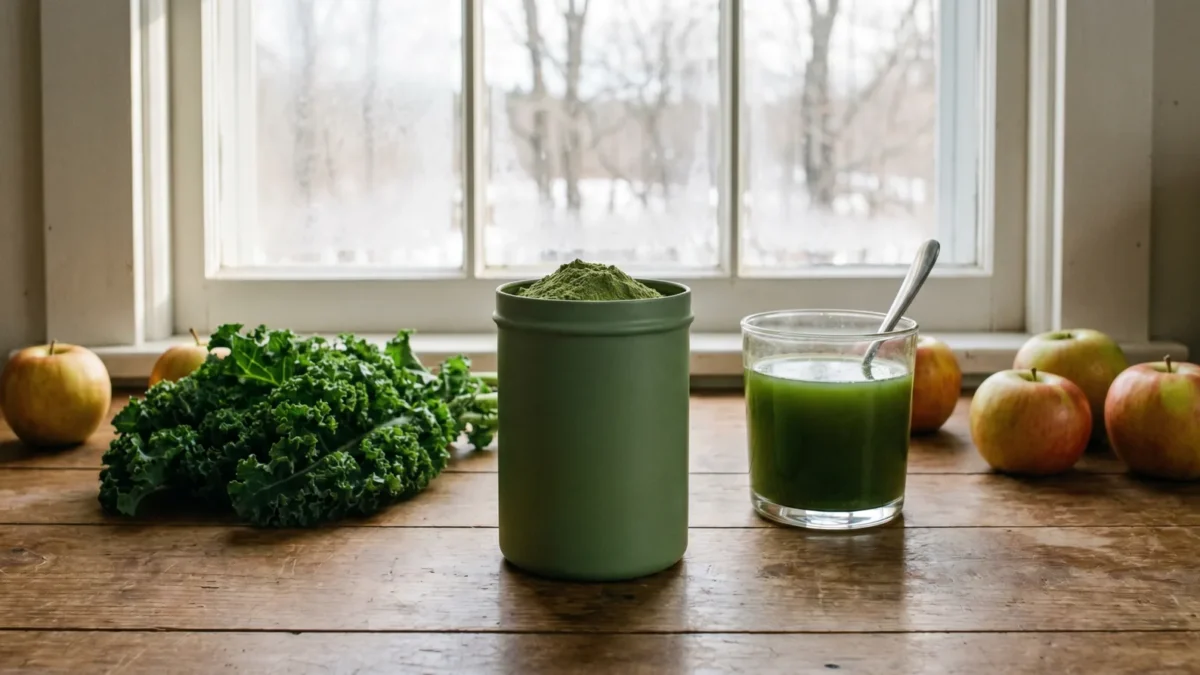
Walk into any kitchen in Portland or Berlin in late February and the produce situation is grim. The farm stands closed in October, the grocery kale looks tired, and the idea of eating two or three cups of vegetables a day feels like a chore you keep postponing. That gap is exactly what greens powders are sold to fill. Scoop, stir, done. The question is whether the canister on your counter actually delivers what the marketing says, or whether you are paying for a scoop of expensive hope.
What you are actually buying
A greens powder is a dried, milled mix of plant ingredients: leafy greens, algae like spirulina or chlorella, grasses, sometimes fruit, fiber, probiotics, and a long tail of botanicals. The pitch is simple. One scoop stands in for the vegetables you did not eat.
It is worth knowing how lightly this category is regulated. The NIH Office of Dietary Supplements is blunt about it: unlike prescription drugs, there are no provisions in the law for the FDA to approve dietary supplements for safety or effectiveness before they reach the consumer. The manufacturer is the one responsible for making sure the product is safe and that the label claims are truthful. Once a product is on the shelf, the FDA has to prove it is unsafe before it can pull it. So the burden sits with the buyer, not the agency.
The proprietary blend problem
Here is where most greens powders get slippery. Flip a canister over and you will often see a “proprietary blend” with an impressive list of 40 or 50 ingredients and a single total weight for the whole mix.
Federal labeling rules (21 CFR 101.36) let companies do this. Ingredients in a blend must be listed in descending order by weight, and the total weight of the blend has to appear, but the amount of each individual ingredient does not. The Department of Defense’s Operation Supplement Safety puts it plainly for consumers: only the total combined amount in the blend must be given, not the specific amount of each ingredient.
That sounds like a technicality. It is not. A 2023 paper in the Journal of Nutrition, co-authored by researchers from the NIH Office of Dietary Supplements and the FDA, spelled out the consequence. For a proprietary blend, you get the names of the ingredients and the total weight, but not the amounts, which means you cannot calculate intakes or check whether an ingredient is present at the dose used in clinical trials. In supplement-world slang, this is “fairy dusting.” A company can sprinkle in a pinch of a trendy mushroom or berry, print it on the label, and let it ride near the bottom of the list where the real quantity might be milligrams. The only way to know what is genuinely in a particular product, per Operation Supplement Safety, is laboratory testing.
If decoding ingredient panels feels like a second job, our guide on how to read supplement labels walks through the parts that matter.
What the research shows, and what it does not
The honest answer: studies on the actual canisters of greens you can buy are thin. Much of the evidence companies lean on comes from research on encapsulated fruit-and-vegetable juice powder concentrates, which are not the same thing as a loose scoop of greens.
One example gets cited a lot. A 2013 randomized, double-blind, placebo-controlled trial in the British Journal of Nutrition followed 42 women over eight weeks. Those who took an encapsulated juice powder concentrate alongside exercise saw oxidized LDL drop by about 12 percent, along with lower inflammatory markers and better skin microcirculation. Real findings. But the study used a specific encapsulated product, paired it with exercise, did not test loose greens powders, and never claimed the product could replace whole produce. Read carefully, it supports the idea that concentrated plant compounds can do something measurable. It does not crown the powder on your shelf.
A scoop is not a serving
This is the part the marketing tends to skip. A greens powder is not nutritionally equal to eating vegetables, and the clearest tell is fiber.
National Geographic’s reporting notes you might get roughly 2 grams of fiber in a scoop. The daily target, per Harvard Health, is about 25 grams for women and 38 grams for men. So a scoop covers a sliver of the day’s fiber and skips the rest of what whole food brings. As Harvard puts it, supplements do not provide the range of fibers, vitamins, minerals, and other compounds that whole foods do. A registered dietitian at Cleveland Clinic is just as direct: you never want powdered greens to take the place of eating real fruits and vegetables, because produce should be the foundation of your diet.
The numbers behind the Maine convenience pitch are real, to be fair. Using 2019 CDC survey data, only 11.9 percent of Maine adults met the daily fruit recommendation and 10.9 percent met the vegetable target, both close to the dismal national figures. Most of us fall short. A powder can be a sensible add-on for someone in that gap. It just cannot be the whole plan. Federal guidance is consistent on this point: supplements are meant to add to the diet, not replace the variety of foods a healthy diet depends on.
Quality and contamination
“Natural” is not the same as risk-free. Plants pull metals out of the soil they grow in, so plant-based supplements can carry detectable lead and cadmium. A 2025 peer-reviewed assessment in the journal Biology tested adaptogenic herbal supplements and found contamination with lead, cadmium, mercury, and nickel, with a majority of the products failing toxicological safety criteria. Those were adaptogen products, not greens powders specifically, but the soil-uptake pathway applies to any concentrated plant product.
And supplements as a whole are not harmless. A 2015 analysis in the New England Journal of Medicine estimated about 23,000 U.S. emergency department visits a year tied to dietary supplements. That is not a reason to panic over a green smoothie. It is a reason to check for independent verification.
This is where third-party testing earns its keep. A USP Verified or NSF Certified mark means an outside lab confirmed that what is printed on the label is actually in the canister, screened for heavy metals like lead, mercury, arsenic, and cadmium, and audited the factory. For a category where the law lets companies hide their doses, that outside check is one of the few signals worth trusting.
Who might reasonably consider one
If you live somewhere the local growing season runs short, struggle to hit your vegetable intake, and want a convenient supplement on top of (not instead of) real food, a greens powder can have a place. Look for a third-party certification, read the panel instead of the front, and treat a proprietary blend with 50 ingredients as a flag, not a feature. If hydration is your real question, our electrolyte powders ranked breakdown is a better starting point than a greens scoop.
Worth it? For the right person, as a supplement, sometimes. As a replacement for the kale and apples on the counter, no.
Sources
- NIH Office of Dietary Supplements. Dietary Supplements: What You Need to Know. 2023. https://ods.od.nih.gov/factsheets/WYNTK-Consumer/
- U.S. Food and Drug Administration. Questions and Answers on Dietary Supplements. 2022. https://www.fda.gov/food/information-consumers-using-dietary-supplements/questions-and-answers-dietary-supplements
- Electronic Code of Federal Regulations (eCFR). 21 CFR 101.36 – Nutrition labeling of dietary supplements. 2024. https://www.ecfr.gov/current/title-21/chapter-I/subchapter-B/part-101/subpart-C/section-101.36
- Operation Supplement Safety, U.S. Department of Defense. Proprietary Blends: What Does This Mean? 2023. https://www.opss.org/article/proprietary-blends-what-does-mean
- The Journal of Nutrition (PMC). Perspectives on the Use of Proprietary Blends in Dietary Supplements. 2023. https://pmc.ncbi.nlm.nih.gov/articles/PMC10196566/
- CDC Morbidity and Mortality Weekly Report. Adults Meeting Fruit and Vegetable Intake Recommendations – United States, 2019. 2022. https://www.cdc.gov/mmwr/volumes/71/wr/mm7101a1.htm
- British Journal of Nutrition (PMC). Supplementation with a juice powder concentrate and exercise decrease oxidation and inflammation, and improve the microcirculation in obese women: randomised controlled trial data. 2013. https://pmc.ncbi.nlm.nih.gov/articles/PMC3821373/
- Harvard Health Publishing. Should I be eating more fiber? 2022. https://www.health.harvard.edu/blog/should-i-be-eating-more-fiber-2019022115927
- Cleveland Clinic. Powdered Greens: Do They Really Work? 2023. https://health.clevelandclinic.org/do-powdered-greens-work
- National Geographic. Do super greens powders actually work? Here’s what the science says. 2024. https://www.nationalgeographic.com/health/article/super-greens-health-effects-benefits
- U.S. Pharmacopeia (USP). Dietary Supplements Verification Program. 2024. https://www.usp.org/verification-services/dietary-supplements-verification-program
- NSF. Dietary Supplement and Vitamin Certification. 2024. https://www.nsf.org/consumer-resources/articles/supplement-vitamin-certification
- Biology (Basel) (PMC). Heavy Metal Contamination in Adaptogenic Herbal Dietary Supplements: Experimental, Assessment and Regulatory Safety Perspectives. 2025. https://pmc.ncbi.nlm.nih.gov/articles/PMC12650394/
- New England Journal of Medicine (Geller et al.). Emergency Department Visits for Adverse Events Related to Dietary Supplements. 2015. https://pubmed.ncbi.nlm.nih.gov/26465986/
This article is for informational purposes only and does not constitute medical advice. Consult a qualified healthcare provider before making any health decisions.