Mountain Biking Maine: Carrabassett and Beyond
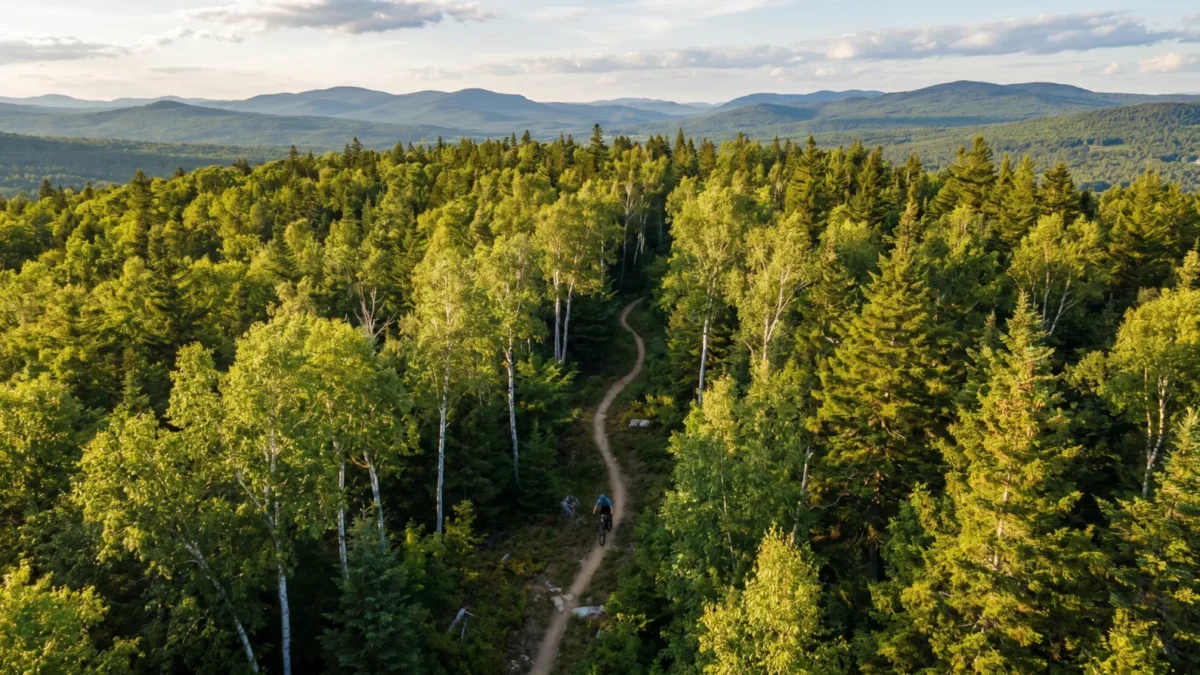
Drive Route 27 north into Maine’s Northwestern Mountains, past the Sugarloaf turnoff, and you reach a stretch of woods that has quietly become one of the better mountain biking destinations in the East. The Carrabassett Valley trail network spans more than 80 miles of cross-country trail, roughly 22 miles of it newly built or rebuilt, and it did not happen by accident. The local NEMBA chapter (the Carrabassett Region branch of the New England Mountain Bike Association) built it hand in hand with the town of Carrabassett Valley.
Why Maine became a real riding destination
The hub sits at the Sugarloaf Outdoor Center off Route 27, where 35 miles of trail fan out into the forest. If that sounds like a lot to take on, it is not the only way in. The Narrow Gauge Pathway runs more than 6 miles of smooth crushed gravel along the Carrabassett River, following an old railroad bed. Flat, forgiving, and scenic. You can ride it on almost any bike.
That mix matters. A trail system that only serves expert riders stays empty most of the week. Carrabassett was designed for a range of skill levels, which is part of why it draws families, weekend riders, and people who picked up a bike for the first time at 45.
What riding actually does for your body
Mountain biking is a serious cardiovascular workout, even when it does not feel like one. In a 2024 study of an official 70-kilometer cross-country marathon, riders burned roughly 2,500 calories over a race that lasted close to four hours. That is endurance work on the level of a long trail run, with your legs, hips, and core all in it.
Here is the part that surprises people. Even the downhill, the part that looks like coasting, keeps your heart working. A study in the Journal of Sports Sciences measured riders during downhill mountain biking and found their heart rates averaged around 80 percent of maximum, with more than 65 percent of the descent spent at an intensity tied to real gains in health-related fitness. You are not resting on the way down. You are gripping, bracing, and steering, and your body knows it.
For the federal exercise math, this counts. The CDC says adults need at least 150 minutes of moderate activity a week, or 75 minutes of vigorous activity, plus muscle-strengthening work on two or more days. A couple of real rides covers the aerobic side and a good chunk of the strength side at once.
Easier on the joints than pounding pavement
If your knees have started filing complaints, this is the case for trading some of your running miles for riding. Running drives up the loading forces on your lower joints in a big way. A 2024 study in JBMR Plus found that running increased joint forces compared with walking by 83 percent at the hip, 134 percent at the knee, and 94 percent at the ankle. Cycling does not load the joints like that, because you are not landing your full body weight on each step.
That is why Harvard Health lists cycling among the best aerobic choices for people with knee osteoarthritis, alongside walking and swimming, and why the Arthritis Foundation calls biking a low-impact, joint-friendly option. You still get the cardio. Your cartilage gets a break.
It may even pay off over decades. A 2024 study drawing on the Osteoarthritis Initiative tracked more than 2,600 adults (average age 64) and found that people with a history of bicycling were 17 percent less likely to have frequent knee pain and 21 percent less likely to show signs of osteoarthritis on imaging. The riders who kept it up across more stages of life did best, with a 43 percent lower risk among those who biked through all four life periods studied.
The longevity case
The benefits are not confined to your knees. A 2021 systematic review in Sports Medicine pooled 17 studies covering nearly half a million people and found that those who cycled the most had a 23 percent lower risk of dying from any cause and a 24 percent lower risk of dying from cardiovascular disease, compared with those who cycled the least. The pattern held in a dose-response way, meaning more cycling tracked with lower risk, not a single magic threshold.
Trade the gym treadmill for a forest you actually want to be in, and you are far more likely to keep showing up. That consistency is the whole point. If you also like to move on foot, the same logic carries over to a good trail run in the Camden Hills, where the recovery side of training gets its due.
Starting out without getting hurt
Begin where the Narrow Gauge Pathway begins: flat, smooth, no surprises. Build your handling on terrain that forgives a wobble before you point yourself down anything technical. The 35 miles at the Sugarloaf Outdoor Center will still be there when you are ready.
Take the injury data seriously, because it is blunt. A 10-year review of U.S. national injury records found that falling off the bike was the most common way riders got hurt, responsible for nearly 63 percent of injuries, and the upper body took the brunt. Fractures were the most common diagnosis. None of that means the sport is reckless. It means the crashes that happen are usually falls, and falls get less likely as your skills catch up to the trail.
Wear a helmet. Not as a formality. A meta-analysis of 40 studies covering more than 64,000 injured cyclists found that helmet use was linked to roughly a 51 percent drop in head injuries, and the protection was strongest for the serious and fatal ones, around 65 to 69 percent lower odds. A good fit does more for you than almost anything else you can buy.
Maine has more groomed singletrack than most riders realize, and Carrabassett is only the headline act. Start on the gravel, respect the descents, buckle the helmet. The woods do the rest.
Sources
- Maine Office of Tourism (Visit Maine). Mountain Biking in Carrabassett Valley. 2024. https://visitmaine.com/articles/mountain-biking-in-carrabassett-valley/
- Town of Carrabassett Valley, Maine. Mountain Bike Trails – Carrabassett NEMBA. 2024. https://carrabassettvalley.gov/partnerships/mountain-bike-trails-carrabassett-nemba/
- MHSalud. Determinants of physical performance and physiological responses during an official cross-country marathon of mountain-biking (XCM-MTB). 2024. https://www.scielo.sa.cr/scielo.php?script=sci_arttext&pid=S1659-097X2024000100050
- Journal of Sports Sciences. Physiological demands of downhill mountain biking. 2012. https://www.tandfonline.com/doi/full/10.1080/02640414.2012.718091
- JBMR Plus. Lower limb joint loading during high-impact activities: implication for bone health. 2024. https://pmc.ncbi.nlm.nih.gov/articles/PMC11481284/
- Harvard Health Publishing. Walking, cycling, and swimming are best exercises for knee osteoarthritis. 2024. https://www.health.harvard.edu/bones-and-joints/walking-cycling-and-swimming-are-best-exercises-for-knee-osteoarthritis
- Arthritis Foundation. Biking is Great for Your Joints. 2023. https://www.arthritis.org/health-wellness/healthy-living/physical-activity/other-activities/biking-exercise-arthritis
- Medicine and Science in Sports and Exercise. Bicycling over a Lifetime Is Associated with Less Symptomatic Knee Osteoarthritis: Data from the Osteoarthritis Initiative. 2024. https://pubmed.ncbi.nlm.nih.gov/38600648/
- Sports Medicine (Springer). Association of Cycling with Risk of All-Cause and Cardiovascular Disease Mortality: A Systematic Review and Dose-Response Meta-analysis of Prospective Cohort Studies. 2021. https://link.springer.com/article/10.1007/s40279-021-01452-7
- Centers for Disease Control and Prevention (CDC). Adult Activity: An Overview, Physical Activity Basics. 2023. https://www.cdc.gov/physical-activity-basics/guidelines/adults.html
- Orthopaedic Journal of Sports Medicine. Sex- and Age-Specific Analysis of Mountain Biking Injuries: A 10-Year Review of National Injury Data. 2025. https://pmc.ncbi.nlm.nih.gov/articles/PMC11780658/
- International Journal of Epidemiology (Oxford Academic). Bicycle injuries and helmet use: a systematic review and meta-analysis. 2017. https://academic.oup.com/ije/article/46/1/278/2617198
This article is for informational purposes only and does not constitute medical advice. Consult a qualified healthcare provider before making any health decisions.