Snowshoeing for Fitness: A Winter Cardio You’ll Actually Do
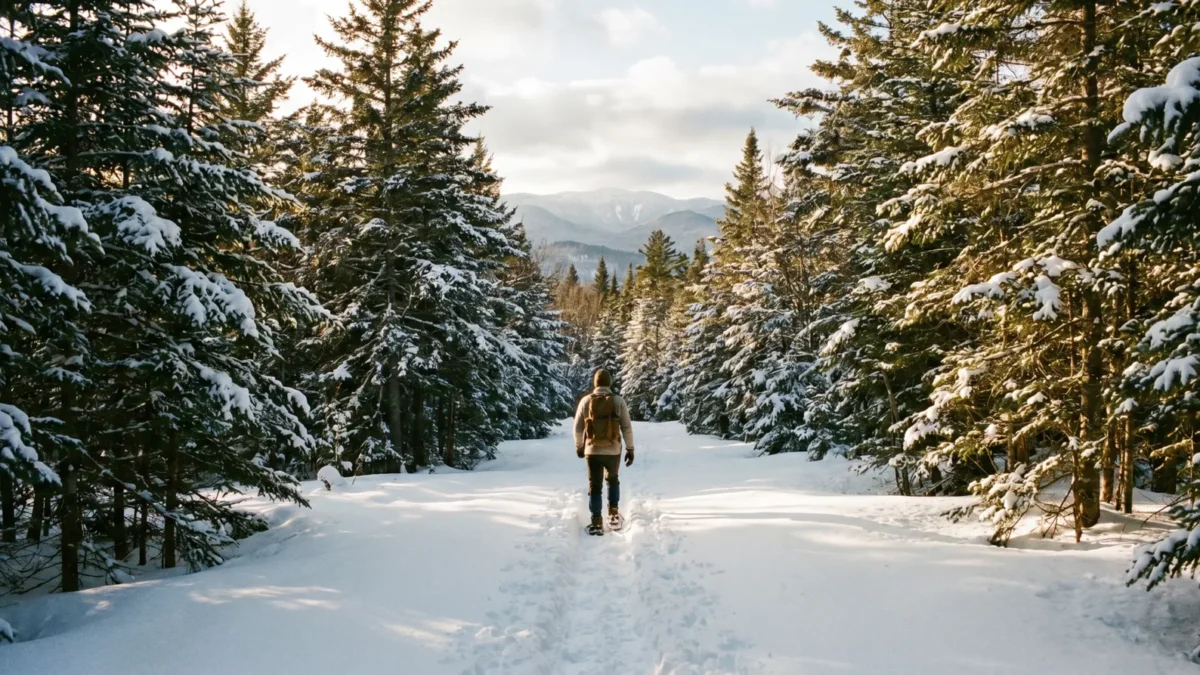
The treadmill membership you bought in November is collecting dust by mid-January. Meanwhile there are two feet of snow in the backyard and a state park ten minutes down the road with groomed trails waiting. Snowshoeing is the rare winter workout that solves both problems at once, and the energy numbers behind it are better than most people expect.
The cardio New Englanders actually stick with
Plenty of winter exercise plans die because they ask too much. Snowshoeing asks very little. You strap a frame to your boots, you walk, and the snow does the rest of the work by adding flotation and resistance to a movement you already know. There’s no lift ticket, no lesson, no balance learning curve like you’d face on skis or skates.
That low barrier matters in a region where winter runs long. Maine keeps hundreds of miles of groomed cross-country ski and snowshoe trails, according to the Maine Office of Tourism, and dedicated snowshoe routes exist at spots like Bradbury Mountain State Park, Mount Blue State Park, and Acadia National Park. The activity scales to whatever you’ve got. A slow shuffle counts. So does a hard climb up a ridge.
How many calories snowshoeing really burns
Here is where it gets interesting. The 2024 Adult Compendium of Physical Activities, the standard reference researchers use to rate how hard activities are, lists snowshoeing at moderate effort as 5.3 METs and at vigorous effort as 10.0 METs. For context, anything from 3.0 to 5.9 METs counts as moderate intensity and 6.0 and up counts as vigorous. So a brisk session pushes you into the same aerobic territory as running.
Translate that into calories. Using the standard MET formula, a 150-pound adult burns roughly 380 calories an hour snowshoeing at moderate effort and around 710 calories an hour at vigorous effort. Heavier bodies and harder terrain push those figures up from there.
And those estimates may be conservative. A University of Vermont study of ten habitually active adults found that common estimates of snowshoeing’s energy cost understate the real demand by more than 50 percent. The same study found that bumping your speed up by just 1 mph at a slow pace, going from 2 to 3 mph, roughly doubled energy expenditure. Small effort, big return.
What changes the calorie count
Snow conditions do a lot of the talking. Breaking trail through fresh powder is brutal compared with the same walk on a packed path. The Vermont researchers measured it: snowshoeing packed snow at 2.95 mph produced the same physiological response as plowing through unpacked snow at only 2.04 mph. At higher effort, packed snow at 3.97 mph matched unpacked snow at 2.87 mph. The deeper and softer the snow, the harder you work to cover less ground.
Your gear shifts the math too. A 2003 study in Ergonomics compared snowshoe binding designs in powder and found that a fixed toe-cord style drove higher oxygen consumption and heart rate than a rotating, pivoting design. A separate U.S. Army study tied energy cost closely to a snowshoe’s mass relative to its surface area. Lighter shoes with pivoting bindings make a given outing easier on your body. None of this means you need expensive equipment, only that the design affects how much you sweat.
Where it fits your week, and how to do it safely
Federal guidelines, reflected by the CDC, call for adults to get at least 150 minutes of moderate-intensity aerobic activity per week, or 75 minutes of vigorous activity, plus muscle-strengthening on two or more days. Snowshoeing can fill that whole aerobic quota on its own. Two solid weekend outings, and you’re done. Go hard enough to hit vigorous intensity and you reach the 75-minute floor even faster.
Cold-weather workouts come with a short safety list, courtesy of the American Heart Association. Layer up, starting with a moisture-wicking fabric against your skin rather than cotton, then add fleece and a thin waterproof shell. Drink water even when you don’t feel thirsty, because thirst isn’t a reliable signal in the cold. And know the signs of hypothermia: shivering, clumsiness, confusion, slurred speech. The AHA notes that older adults and children face higher risk.
If you want to build a broader winter routine, snowshoeing pairs well with other snow sports. Compare its demands against cross-country skiing in Bethel, or fold it into a fuller plan for winter exercise across northern New England.
Where to go
The snow cooperates here. Maine averages roughly 50 to 80 inches a year along the coast, from about 49 inches in Kennebunkport to nearly 79 in Newcastle, with Portland around 69. Head inland and the numbers climb past 100 inches, with Moosehead Lake near 108 and Rangeley over 120. That’s a multi-month season for most of us in Maine and New Hampshire.
Start close to home. The state park system maintains snowshoe-friendly trails, and many cross-country ski centers welcome snowshoers on dedicated routes. Bradbury Mountain is an easy first outing. Mount Blue and Acadia reward a longer drive. The point is that you don’t have to travel far or spend much to get a real workout outside, on a winter morning, on snow that’s free.
Sources
- Compendium of Physical Activities. Winter Activities (2024 Adult Compendium). 2024. https://pacompendium.com/winter-activities/
- Journal of Strength and Conditioning Research. The energy expenditure of snowshoeing in packed vs. unpacked snow at low-level walking speeds. PubMed. 2002. https://pubmed.ncbi.nlm.nih.gov/12423193/
- Ergonomics. Energy cost and physiological responses of males snowshoeing with rotating and fixed toe-cord designs in powdered snow conditions. PubMed. 2003. https://pubmed.ncbi.nlm.nih.gov/12775486/
- Work. Energy cost during locomotion across snow: a comparison of four types of snowshoes with snowshoe design considerations. PubMed. 2002. https://pubmed.ncbi.nlm.nih.gov/12441581/
- Centers for Disease Control and Prevention. Adult Activity: An Overview, Physical Activity Basics. 2023. https://www.cdc.gov/physical-activity-basics/guidelines/adults.html
- U.S. Department of Health and Human Services (ODPHP). Physical Activity Guidelines for Americans, 2nd edition. 2018. https://odphp.health.gov/sites/default/files/2019-09/Physical_Activity_Guidelines_2nd_edition.pdf
- American Heart Association. How to Stay Active in Cold Weather. 2024. https://www.heart.org/en/healthy-living/fitness/getting-active/how-to-stay-active-in-cold-weather
- Current Results (NOAA/NWS-derived climate normals). Average Annual Snowfall Totals in Maine. 2024. https://www.currentresults.com/Weather/Maine/annual-snowfall.php
- Maine Office of Tourism. Winter in Maine. 2024. https://visitmaine.com/seasons-in-maine/winter-in-maine/
- Maine Dept. of Agriculture, Conservation & Forestry (DACF). Bradbury Mt. State Park Trail Conditions & Activities. 2024. https://www.maine.gov/dacf/parks/trail_activities/bradbury_trail_conditions.shtml
- Maine Trail Finder. Mount Blue State Park, Snowshoe Trails. 2024. https://www.mainetrailfinder.com/trails/trail/mount-blue-state-park-snowshoe-trails
This article is for informational purposes only and does not constitute medical advice. Consult a qualified healthcare provider before making any health decisions.