Food Sources of Vitamin D in a Maine Diet
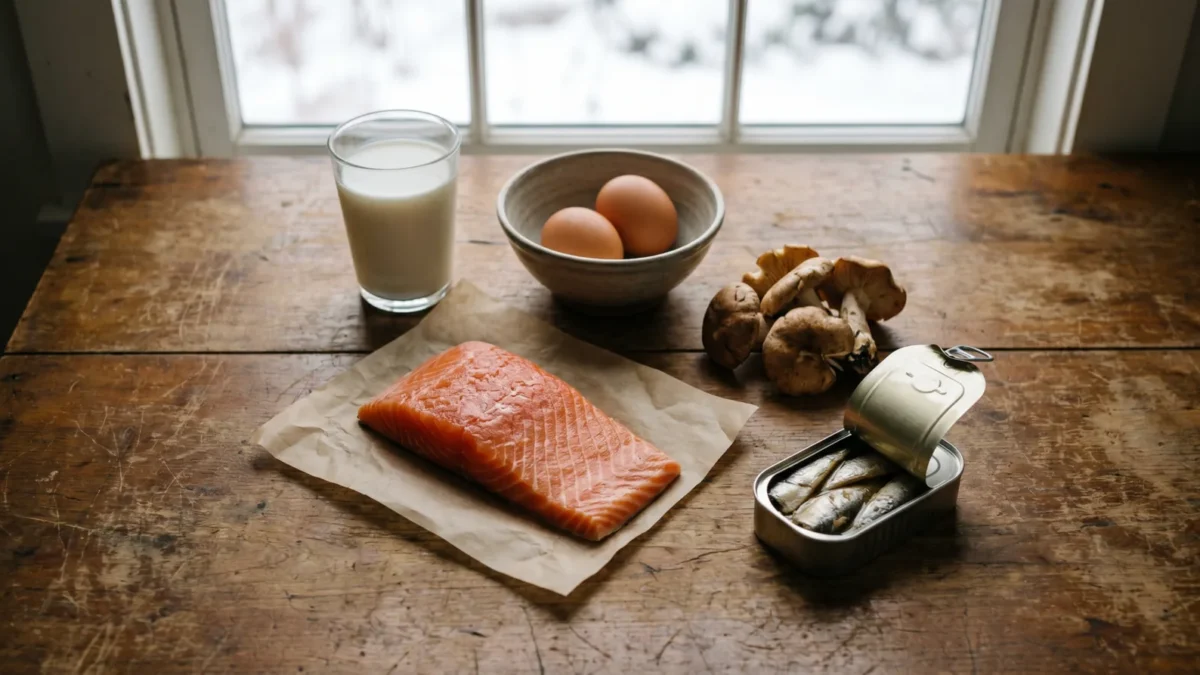
By late March, a lot of Mainers have gone five or six months without making much vitamin D of their own. At our latitude, winter sun sits too low to trigger the skin reaction that produces it, so the body leans harder on whatever shows up at dinner. The problem is that food was never a generous source to begin with. Most plates, even good ones, come up short.
Why a Maine winter puts the weight on food
The shortfall here is not theoretical. A University of Maine study in Orono followed 23 local girls aged 9 to 11 and tracked their blood levels across a full year. Published in the Journal of the American Dietetic Association in 2005, it found that serum 25-hydroxyvitamin D, the marker doctors use to gauge status, dropped an average of 28 percent from September to March. Almost half the group, 11 of the 23, were insufficient at some point during the year.
When skin production stalls for months at a stretch, the food on your table starts to matter more than it does for someone in Georgia. So it is worth knowing which foods carry real amounts and which are mostly hype. For the bigger regional picture, including sun and testing, see our guide to vitamin D in northern New England.
Fatty fish: the best natural source on a Maine plate
If any whole food earns a spot here, it’s oily fish. The NIH Office of Dietary Supplements names fatty fish and fish liver oils among the best natural sources of vitamin D, and the numbers back it up. A 3-ounce serving of rainbow trout carries about 645 IU. The same size piece of sockeye salmon runs around 570 IU. Mackerel and canned tuna chip in too.
Put that next to the recommended dietary allowance and it looks promising. NIH sets the adult RDA at 600 IU per day, rising to 800 IU after age 70. One smart serving of trout nearly covers a younger adult’s daily target on paper. Maine’s working waterfront makes this easier than it is in a lot of states. Fresh fish is not a novelty here.
Wild versus farmed: the gap most people miss
Here is where the label on the fish counter actually changes the math. An analysis in the Journal of Steroid Biochemistry and Molecular Biology measured vitamin D3 in salmon and found wild fish averaged 988 IU per 3.5-ounce serving. Farmed salmon averaged 240 IU for the same portion, roughly a quarter as much.
And the spread is wide even within those groups. A 2019 review in Nutrients reported wild Atlantic salmon ranging from about 9.4 micrograms per 100 grams in North Sea fish to 18.5 in Baltic Sea fish. Farmed Atlantic salmon from Norway, the Faroe Islands, and Scotland ran from 2.3 to 7.3 micrograms per 100 grams, and the farmed numbers tracked directly with how much vitamin D3 the producers added to the feed. Two fillets that look identical in the case can deliver very different amounts. Diet and origin do the deciding.
Cod liver oil, the old Yankee standby
Generations of New England kids got a spoonful of this, and the chemistry explains why. Cod liver oil is one of the most concentrated dietary sources going. USDA data puts a single tablespoon at 1,360 IU, more than twice the adult RDA in one dose. It is technically a food rather than a pill, though almost nobody eats it by the spoon anymore. If you want a sense of how the supplement versions stack up on a label, our fish oil label guide walks through what to read.
Fortified milk and plant milks
Most Americans don’t get their vitamin D from anything that naturally contains it. They get it from foods someone fortified on purpose. NIH ODS notes that nearly all of the U.S. fluid milk supply is voluntarily fortified to about 120 IU per cup. Under FDA rules, fortifying milk is optional, but when a producer adds vitamin D, it has to supply 400 IU per quart.
Plant milks have largely followed suit. Soy, almond, and oat beverages are commonly fortified to levels comparable to dairy, which makes a bowl of cereal with milk a quiet contributor. Not a large one, but a steady one across a winter.
Eggs, cereal, and the small stuff
A few foods add a little without carrying the day. One large egg has about 44 IU, almost all of it in the yolk, so the whites-only habit skips the part that counts. Many fortified breakfast cereals add roughly 80 IU per serving. These are real amounts. They are also small ones, the kind that add up only when several land on the same plate over the same day.
Mushrooms: the one non-animal source
Vegetarians and vegans have exactly one whole-food option, and it comes with a catch. Mushrooms are fungi, not plants, and they’re the only common non-animal food that makes vitamin D. But standard mushrooms grown in the dark hold almost none, under 40 IU per 100 grams.
The trick is ultraviolet light. A 2018 review in Nutrients describes how UV exposure after harvest sends vitamin D in mushrooms way up. NIH lists UV-exposed raw white mushrooms at about 366 IU per half-cup, which moves them from trivial to genuinely useful. Some grocery mushrooms are now treated this way and labeled accordingly. A plain button mushroom from a dark growhouse is not the same food.
Doing the honest math at a Maine table
Add it up and a picture forms. A piece of wild salmon, a glass of fortified milk, an egg, and a side of UV mushrooms can stack into a respectable day. Build the same meal around farmed fish and a couple of small contributors, and you land well short of even the basic RDA.
And there’s a harder ceiling worth naming. The fish researchers pointed out that most experts put the target closer to 1,000 IU per day for someone getting no sun at all, which describes a Maine resident in January pretty well. Even wild salmon, at about 988 IU per serving, sits just under that line. Their conclusion was blunt: fish alone generally won’t meet the requirement. Food can carry a Mainer a long way through the dark months. Whether it carries you all the way is a question worth taking to your own doctor, with a blood test rather than a guess.
Sources
- NIH Office of Dietary Supplements. Vitamin D – Health Professional Fact Sheet. National Institutes of Health. 2024. https://ods.od.nih.gov/factsheets/VitaminD-HealthProfessional/
- USDA Agricultural Research Service. FoodData Central (cod liver oil). U.S. Department of Agriculture. 2024. https://fdc.nal.usda.gov/
- Lu Z, et al. An Evaluation of the Vitamin D3 Content in Fish: Is the Vitamin D Content Adequate to Satisfy the Dietary Requirement for Vitamin D? Journal of Steroid Biochemistry and Molecular Biology (PMC). 2007. https://pmc.ncbi.nlm.nih.gov/articles/PMC2698592/
- Jakobsen J, Smith C, et al. Vitamin D in Wild and Farmed Atlantic Salmon (Salmo Salar): What Do We Know? Nutrients (PMC). 2019. https://pmc.ncbi.nlm.nih.gov/articles/PMC6566758/
- Cardwell G, et al. A Review of Mushrooms as a Potential Source of Dietary Vitamin D. Nutrients (PMC). 2018. https://pmc.ncbi.nlm.nih.gov/articles/PMC6213178/
- U.S. Food and Drug Administration / eCFR. 21 CFR 131.110 Milk. eCFR. 2024. https://www.ecfr.gov/current/title-21/chapter-I/subchapter-B/part-131/subpart-B/section-131.110
- Sullivan SS, et al. Adolescent girls in Maine are at risk for vitamin D insufficiency. Journal of the American Dietetic Association (PubMed). 2005. https://pubmed.ncbi.nlm.nih.gov/15942551/
This article is for informational purposes only and does not constitute medical advice. Consult a qualified healthcare provider before making any health decisions.