Wild Parsnip and Giant Hogweed: The Burn That Needs Sunlight to Appear
The burn shows up Tuesday. You were mowing the ditch on Sunday. That gap is the reason a wild parsnip burn gets blamed on almost anything except the plant that caused it. A wild parsnip burn is not a rash you get from touching the leaves. The sap carries furocoumarins, compounds that make skin react to ultraviolet light, so the contact itself is painless and the redness and blistering usually appear 24 to 48 hours later, in streaks and drips that trace exactly where the sap ran. Maine’s Department of Agriculture, Conservation and Forestry advises washing exposed skin with soap and water, keeping it out of direct sunlight for at least 48 hours, and consulting a medical professional if a rash develops.
Sunlight is the second half of the injury
Dermatologists call this phytophotodermatitis. A 2021 review in the journal Dermatitis is precise about what the reaction needs: a plant-derived furocoumarin, plus ultraviolet A light. Psoralen is the most common of those furocoumarins, and it turns up at varying levels across many unrelated species. Sap on your forearm in the dark is chemistry waiting on a second reagent. Daylight supplies it.
A 2024 review in the journal Life describes phytophotodermatitis as non-allergic contact dermatitis, driven by direct toxic effects rather than by the immune system, and names both giant hogweed and wild parsnip among the phototoxic plants. If you’ve spent New England summers learning to identify poison ivy, oak and sumac, file this one separately. Same season, same trail edge, different machinery.
The timing is what fools people. A 2026 case report and literature review in Archives of Plastic Surgery describes redness appearing 24 to 48 hours after exposure and progressing to blistering, with severe exposures peaking around 72 hours. The rash, the authors write, “frequently shows a linear pattern correlating with plant contact.” That’s why these burns look drawn on with a marker. A 2024 case report in Cureus puts onset within 24 hours and names UVA at 320 to 400 nanometers as the trigger.
Under the surface it starts earlier still. An experimental study using undiluted lemon peel juice on rats and eight minutes of summer sunlight found the first signs of skin-cell death at 24 hours and blistering within the epidermis by 48 hours, while visible redness appeared only after 48 hours. The damage runs ahead of the evidence for it.
A wild parsnip burn is the likelier one in Maine and New Hampshire
Giant hogweed gets the headlines, and it earns them. It’s the 15-foot plant with the purple-blotched stem, a federal noxious weed under the Plant Protection Act, so importing it or moving it across state lines without a permit is illegal. It came to the United States in 1917 as an ornamental, native to the Caucasus Mountains. Maine’s invasive plants field guide rates it VERY INVASIVE and notes a single plant can set 5,000 to 100,000 seeds, after the three to five years it needs to reach flowering.
Maine DACF also says plainly that giant hogweed “is found sporadically throughout Maine, but is not a common plant,” and the state field guide gives its status as localized. Across the river, a July 2018 UNH Cooperative Extension post reported that “There are currently no known locations of it in New Hampshire,” and that several sites eradicated about a decade earlier had shown no return under monitoring.
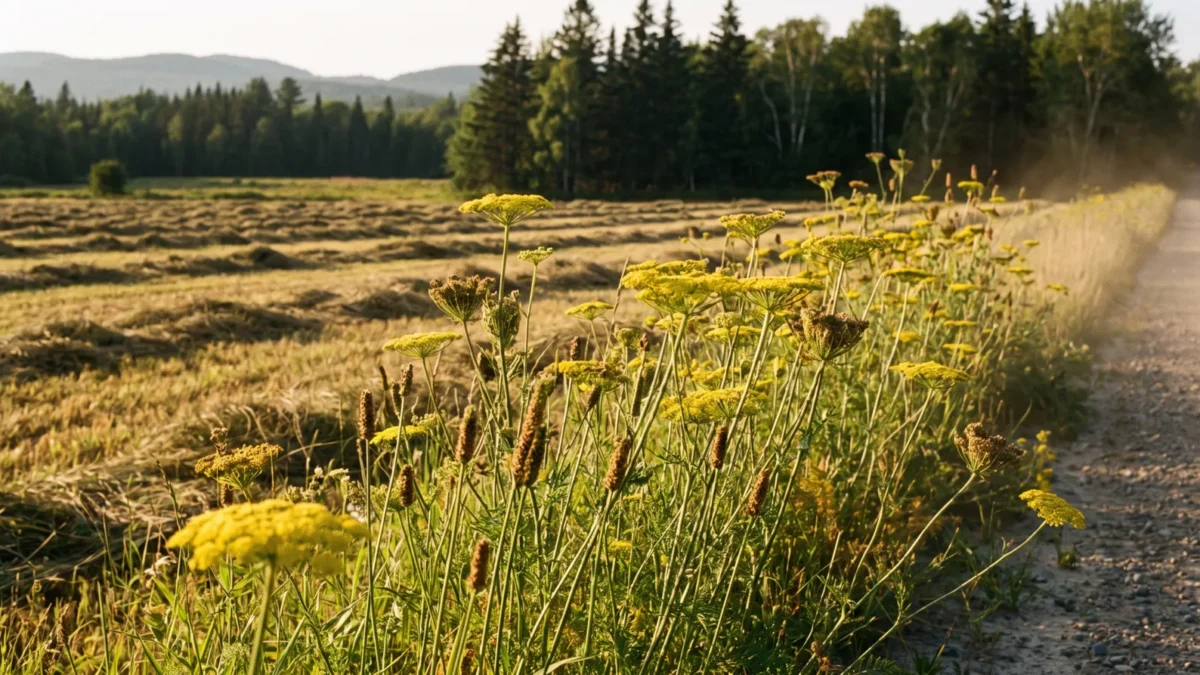
Wild parsnip is the opposite story. Maine’s field guide lists its status in Maine as widespread, with habitat given as disturbed sites, roadsides, waste areas, agricultural fields and streambanks, and notes that it’s shade intolerant. Another way of saying it lives exactly where we mow and drive. Native Plant Trust’s Go Botany records Pastinaca sativa in all six New England states, Maine and New Hampshire included, and notes the foliage can irritate skin in the presence of sunlight. Maine’s field guide, meanwhile, rates wild parsnip’s invasiveness as UNCLEAR. So the plant likeliest to burn a Mainer is not the one the state ranks as its worst botanical actor.
Four plants, one mechanism, wildly different sizes
Anyone who forages knows the discipline: identify on a cluster of features, never on one. Same habit that keeps people from carrying home a jack-o’-lantern mushroom instead of a chanterelle. Maine DACF publishes a hogweed look-alike sheet, and several plants on it share the sunlight problem.
Wild parsnip stands 2 to 5 feet tall, with grooved, hollow stems and yellow flowers. DACF states that it “produces sap containing chemicals that can cause human skin to react to sunlight, resulting in burns, rashes or blisters.”
Giant hogweed reaches 10 to 15 feet when flowering, with hollow stems 2 to 4 inches across marked by dark reddish-purple blotches, and it flowers from mid-June to late July. The state classes it as an invasive perennial and a public health hazard. Its clear watery sap, DACF writes, “has toxins that cause photo dermatitis,” producing painful burning blisters “that may leave purple or black scars,” and eye contact “can cause temporary or permanent blindness.”
Cow parsnip is the native one, 5 to 8 feet tall, running a milder version of the same reaction. DACF says it “can cause a blistery rash in sensitive individuals” and that its sap “may sensitize the skin so that it is very easily sunburned.”
Queen Anne’s lace (1 to 4 feet) and wild lettuce (up to 6 feet) close out the sheet, and DACF gives them the same line: contact with sap can cause a dermatitis reaction which is aggravated by exposure to sun. Two plants nobody in New England thinks twice about.
The string trimmer is the exposure event
Brushing past an intact plant is one thing. Cutting it is another. Maine DACF is blunt here: “Be aware that skin and eye protection are critical when mowing or cutting. Mowers and string trimmers release sap from the foliage and stems that can end up on your skin.” A spinning line turns a stationary plant into a spray.
Two details sharpen that. The 2024 Life review reports the sap’s toxic properties can persist on exposed clothing for several hours, so shedding a sleeve at lunchtime isn’t necessarily the end of the contact. And potency isn’t fixed through the summer: the same review cites work across six plants in the carrot family finding the content of photosensitizers such as coumarins can differ up to tenfold before and after flowering.
Equipment is also part of why the plant is where it is. Maine’s field guide notes wild parsnip spreads along transportation corridors, with seed moved by vehicles, mowers and other equipment, and commonly carried in mulch hay and straw. Wind does most of the dispersing, surface water next. So the road shoulders and old field margins you’re clearing in July are the same margins you’ll be moving through in November, when hunting season changes how those corridors get used.
What Maine’s guidance actually says
The state’s first-aid language, published on its giant hogweed page, is short. Thoroughly wash exposed skin with soap and water. Keep exposed skin protected from direct sunlight for at least 48 hours. If a rash develops, consult a medical professional. For sap in the eyes, consult a medical professional.
Read that for what it is: steps a state agency publishes for someone who already has sap on their skin, not a promise about how a reaction turns out and not a treatment plan. DACF says hogweed blisters “may leave purple or black scars” and puts no clock on them. Nobody else worth citing does either.
Whose plant is it
In Maine, control of giant hogweed falls to the property owner, and DACF warns the seed “can remain dormant in the soil for years,” so a cleared patch is a multi-year commitment rather than a weekend of work. Neither wild parsnip nor giant hogweed appears on Maine’s Do Not Sell Plant List, though both sit on the state’s advisory list of non-native plants found to pose a threat to habitats and natural resources.
New Hampshire residents who think they’ve found giant hogweed were asked, in that 2018 UNH Extension post, to send pictures to the UNH Cooperative Extension Education Center at answers@unh.edu. Given how rare the plant has been there, a photograph costs nothing and will usually turn up the far more likely cow parsnip standing in a wet ditch.
For the rest of us the practical version is short enough to carry out to the yard. Know what the yellow umbel at the edge of the hayfield is. Cover your arms before the trimmer starts. And if sap gets on your skin, remember the reaction runs on the sun’s schedule, not the plant’s.
Sources
- Maine Department of Agriculture, Conservation & Forestry, Horticulture Program. Giant Hogweed Control and Safety Information. https://www.maine.gov/dacf/php/horticulture/gianthogweed.shtml
- Maine Department of Agriculture, Conservation & Forestry. Giant Hogweed Identification Information (Look-a-Likes). https://www.maine.gov/dacf/php/horticulture/hogweedlookalikes.shtml
- Maine Department of Agriculture, Conservation & Forestry. Got Pests? Weeds: Giant Hogweed. https://www.maine.gov/dacf/php/gotpests/weeds/giant-hogweed.htm
- Maine Natural Areas Program. Maine Invasive Plants Field Guide: Wild Parsnip (Pastinaca sativa). https://www.maine.gov/dacf/mnap/features/invasive_plants/pastinaca_sativa.pdf
- Maine Natural Areas Program. Maine Invasive Plants Field Guide: Giant Hogweed (Heracleum mantegazzianum). https://www.maine.gov/dacf/mnap/features/invasive_plants/heracleum.pdf
- Maine Natural Areas Program. Maine Invasive Plants fact sheet index and Do Not Sell Plant List. https://www.maine.gov/dacf/mnap/features/invasive_plants/invsheets.htm
- UNH Cooperative Extension. Two Invasive Plants to Look Out For: Tree of Heaven and Giant Hogweed. July 10, 2018. https://extension.unh.edu/blog/2018/07/two-invasive-plants-look-out-tree-heaven-giant-hogweed
- Native Plant Trust, Go Botany. Pastinaca sativa (wild parsnip). https://gobotany.nativeplanttrust.org/species/pastinaca/sativa/
- USDA National Invasive Species Information Center. Giant Hogweed. https://www.invasivespeciesinfo.gov/terrestrial/plants/giant-hogweed
- Ellis CR, et al. Psoralen-Induced Phytophotodermatitis. Dermatitis, 2021. https://pubmed.ncbi.nlm.nih.gov/33273237/
- New Insights Concerning Phytophotodermatitis Induced by Phototoxic Plants. Life (Basel), 2024. https://pmc.ncbi.nlm.nih.gov/articles/PMC11355232/
- Severe Phytophotodermatitis Caused by Mulberry Tree: A Case Report and Literature Review. Archives of Plastic Surgery, 2026. https://pmc.ncbi.nlm.nih.gov/articles/PMC12858321/
- Unique Acute Phytophotodermatitis Reaction and a Visual Diagnostic Guide. Cureus, 2024. https://pmc.ncbi.nlm.nih.gov/articles/PMC11131436/
- Transmission Electron Microscopy of the Preclinical Phase of Experimental Phytophotodermatitis. Clinics (Sao Paulo), 2008. https://pmc.ncbi.nlm.nih.gov/articles/PMC2664235/
This article is for informational purposes only and does not constitute medical advice. Consult a qualified healthcare provider before making any health decisions.