Sea Kayaking the Maine Coast: A Beginner’s On-Water Guide
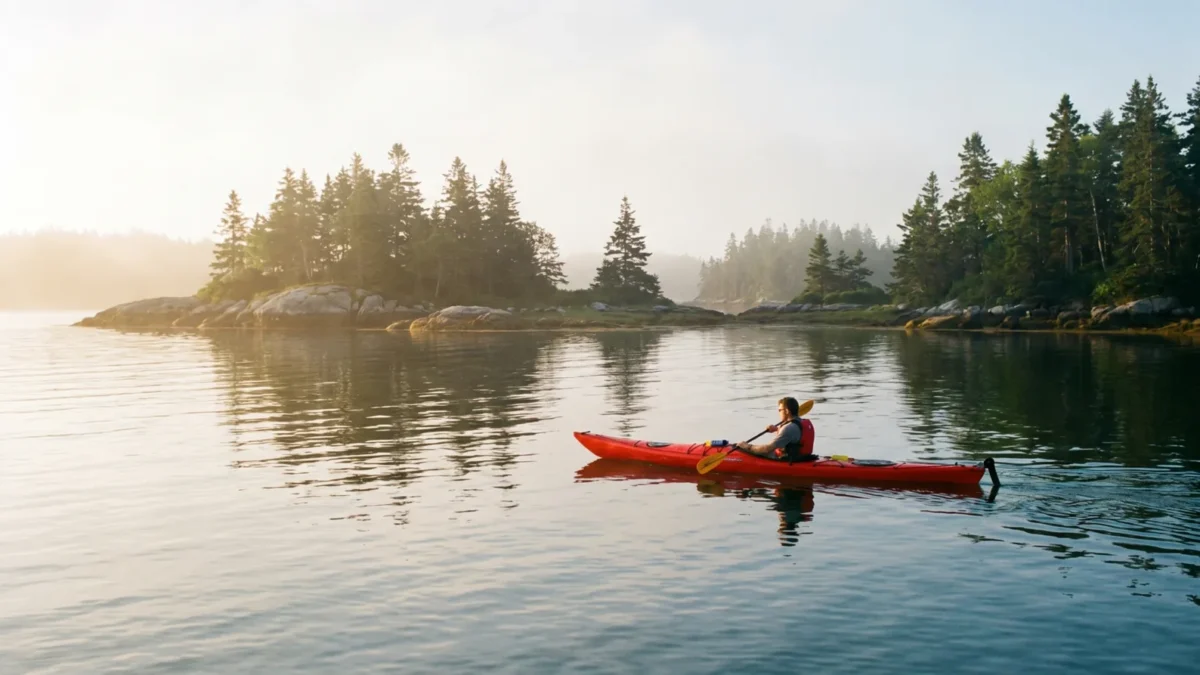
Slide a kayak off a granite ramp on a still July morning in Casco Bay and the water looks harmless. It glints, it barely moves, and the islands sit close enough to feel like a short hop. That calm surface is the part beginners get wrong. The ocean here can be welcoming and genuinely dangerous at the same time, and the danger is not usually the waves.
The water is colder than the air, all summer
This is the fact that surprises people who learned to paddle on a warm lake. Even in the best weeks of the year, the ocean off Maine stays cold. The National Park Service lists water under 55 degrees Fahrenheit as one of the hazards of paddling off Acadia, alongside tides, rough seas, and fog. Near-shore temperature normals from the National Weather Service office in Gray back that up. Around Portland and Casco Bay the water runs about 56 degrees in June, 61 in July, and 62 in August. Up at Bar Harbor it is colder still, around 55 in June and 59 in July.
Those numbers feel abstract until you are in it. Anything in that range is cold enough to set off what physiologists call the cold shock response.
Cold shock, and the first minute that decides everything
When you fall into cold water, your body reacts before your brain gets a vote. Research in the Journal of Applied Physiology describes the sequence: a sudden involuntary gasp, then fast uncontrollable breathing your conscious mind cannot easily override. If your head is under during that first gasp, you can inhale water. That is why cold shock, not hypothermia, is the early killer.
It gets worse for your breath. Cold water sharply cuts how long you can hold it. One study found average breath-hold time in 41-degree water dropped from 45 seconds to under 10. A 2018 study in Frontiers in Psychology also found that anxiety makes the gasp response stronger, which is one more reason to practice calm before you ever need it.
The Canadian Safe Boating Council teaches a memory aid called 1-10-1. Roughly one minute to get your breathing under control. About ten minutes of useful movement before your hands and arms stop cooperating. Around one hour, even in icy water, before hypothermia takes your consciousness. The order matters. Most people who get in trouble do so in that first minute, panicking, not in the last.
The life jacket is not optional gear
If 1-10-1 has a single takeaway, it is this. You only get those minutes if you stay at the surface, and the thing that keeps you there is a life jacket you are already wearing. The U.S. Coast Guard’s 2024 boating report found that where the cause of death was known, 87 percent of people who drowned were not wearing one. Four out of five boating deaths happened on boats under 21 feet, the size range that includes every kayak.
Maine law is blunt about it. Every person aboard a kayak, canoe, or paddleboard needs a Coast Guard-approved wearable life jacket. As of January 1, 2026, the state raised its mandatory wear age, so every child 12 and under has to wear one whenever the boat is underway. A jacket clipped to the deck behind you does nothing when you are in the water gasping.
Where a beginner should actually start
Here is the part worth saying plainly. The Park Service considers ocean kayaking off Acadia to be for experienced paddlers only. The tidal swing there can reach twelve feet, fog rolls in fast, and the agency’s own advice is that beginners join a guided tour run by one of the private companies in Frenchman Bay rather than head out alone. That is not them being cautious for liability. It is honest.
A guided trip gets you instruction, gear that fits, and someone watching the weather and the tide chart for you. Sheltered, protected water is the right classroom. If a flat lake feels more your speed to build confidence first, a session of paddleboarding on Sebago Lake trains a lot of the same balance and core control. So does cold-aware open-water swimming, which teaches the single most useful coastal skill of all: staying calm when the water bites.
One more rule of the road out there. Federal guidelines say keep at least 150 feet from seals, in the water and hauled out on the rocks. They are wildlife, not a photo op.
Why it is worth the trouble
None of this is meant to talk you out of it. Sea kayaking is real exercise. The 2024 Adult Compendium of Physical Activities rates moderate paddling at about 5 METs, well into the moderate-intensity zone, and flat-water racing far higher. A morning on the water counts toward the 150 weekly minutes of moderate activity the CDC recommends, the same activity it links to lower rates of heart disease, type 2 diabetes, depression, and anxiety.
You get all that while sitting low among the islands, watching an eider paddle past at eye level. Learn the cold-water facts, wear the jacket, start with a guide, and the Maine coast becomes one of the best places in the country to do it.
Sources
- U.S. National Park Service. Boating – Acadia National Park. National Park Service. 2025. https://www.nps.gov/acad/planyourvisit/boating.htm
- NOAA National Weather Service, Gray/Portland ME. Near Shore Water Temperature Normals – Maine and New Hampshire. NOAA. 2024. https://www.weather.gov/gyx/water_temperature_normals.html
- Tipton M, et al. Respiratory responses to cold water immersion: neural pathways, interactions, and clinical consequences awake and asleep. Journal of Applied Physiology (American Physiological Society). 2006. https://journals.physiology.org/doi/full/10.1152/japplphysiol.01201.2005
- Barwood M, et al. Acute Anxiety Predicts Components of the Cold Shock Response on Cold Water Immersion. Frontiers in Psychology (PMC). 2018. https://pmc.ncbi.nlm.nih.gov/articles/PMC5904285/
- Canadian Safe Boating Council. 1-10-1 Principle. Canadian Safe Boating Council. 2023. https://csbc.ca/1-10-1-principle/
- U.S. Coast Guard. 2024 Recreational Boating Statistics (COMDTPUB P16754.38). U.S. Coast Guard. 2025. https://www.uscgboating.org/library/accident-statistics/Recreational-Boating-Statistics-2024.pdf
- Maine Department of Inland Fisheries and Wildlife. Boating Safety Tips. Maine Department of Inland Fisheries and Wildlife. 2026. http://www.maine.gov/ifw/programs-resources/outdoor-safety/boating-safety-tips.html
- Compendium of Physical Activities (Arizona State University). 2024 Adult Compendium of Physical Activities. Journal of Sport and Health Science (PMC). 2024. https://pmc.ncbi.nlm.nih.gov/articles/PMC10818145/
- U.S. Centers for Disease Control and Prevention. Benefits of Physical Activity. CDC. 2024. https://www.cdc.gov/physical-activity-basics/benefits/index.html
- NOAA Fisheries. Marine Life Viewing Guidelines: Guidelines and Distances. NOAA Fisheries. 2024. https://www.fisheries.noaa.gov/topic/marine-life-viewing-guidelines/guidelines-and-distances
This article is for informational purposes only and does not constitute medical advice. Consult a qualified healthcare provider before making any health decisions.