Open-Water Swimming in Maine’s Lakes and Coast
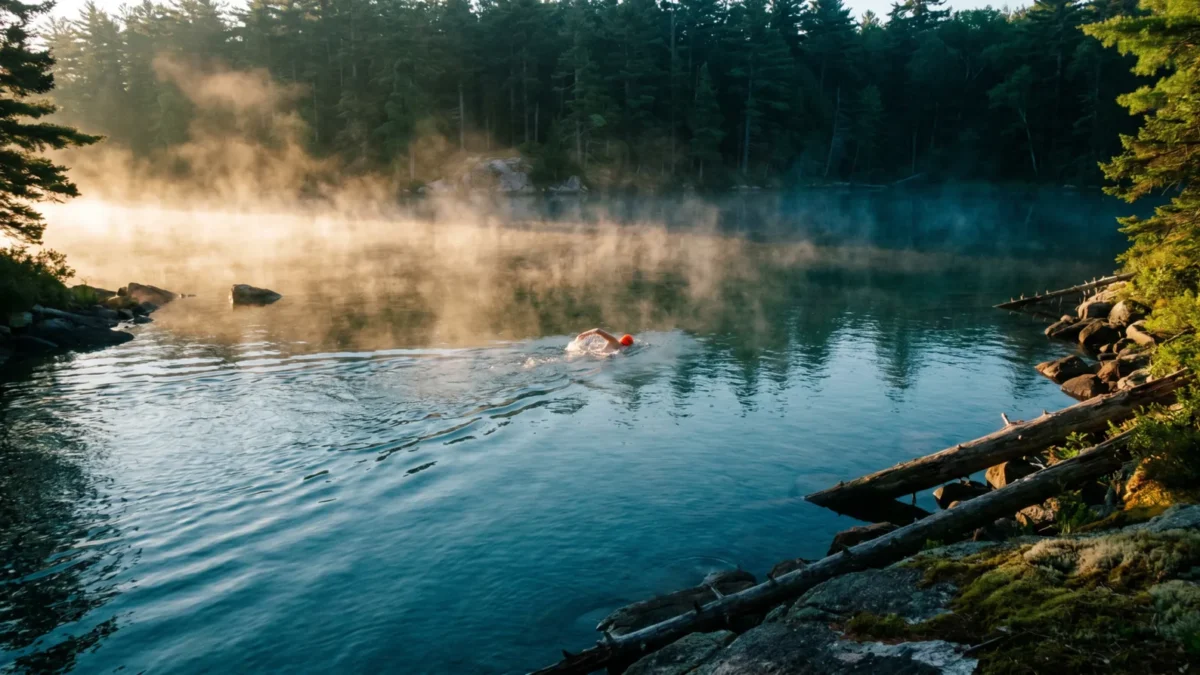
By the Fourth of July the air over Sebago Lake can sit in the low 80s and the surface water feels almost warm. Drop a few feet below that and the lake tells a different story. Even in midsummer the water under the thermocline often stays in the 40s Fahrenheit, and the coast is colder still. That gap between how the water looks and how it behaves is what makes open-water swimming in Maine worth understanding before you wade out past your knees.
Why Maine water is colder than it looks
Sebago is the warmest big lake most of us swim in, and its surface still tops out modestly. Summer surface temperatures run roughly 68 to 75 degrees F, peaking around the low 70s in July, according to monitoring data tracked by the Portland Water District. Pleasant for a dip. Not warm.
The ocean is a different animal. The Gulf of Maine averaged 51.3 degrees F in 2025, its 15th-warmest year on record, and it is warming at 0.84 degrees F per decade, almost triple the global ocean rate, per the Gulf of Maine Research Institute. Warming, yes. But still cold enough to be dangerous to anyone who jumps in without thinking about it.
Cold water shock: the first minute is the worst
The real hazard in cold water is not slow hypothermia. It is what happens in the first few seconds. HM Coastguard warns that water at or below about 15 degrees C (59 F) triggers an involuntary gasp, often followed by hyperventilation that is very hard to control. Maine ocean water sits below that threshold most of the year, and so does deeper lake water.
That gasp is the problem. If your face is underwater when it hits, you breathe in water. Research in the Journal of Applied Physiology found the cold shock response peaks around 30 seconds in and starts to settle after roughly a minute, with heart rate and breathing spiking sharply at first. Your breath-hold time collapses too, from the usual minute or so down to just a few seconds in water below 15 degrees C. That is exactly why you ease in instead of diving, and why panic, not the cold itself, does most of the early damage.
The 1-10-1 rule, and its limits
Cold-water physiologist Dr. Gordon Giesbrecht boiled the timeline down to three numbers: roughly 1 minute to get your breathing under control, about 10 minutes of useful movement before your hands and arms stop cooperating (what experts call cold incapacitation), and around 1 hour before hypothermia takes over. Most cold-water drownings happen in those first two stages, not from hypothermia.
Useful, but the National Center for Cold Water Safety cautions that 1-10-1 is a rule of thumb, not a promise. Cold shock can kill within seconds, and your strength fades steadily rather than dropping off a cliff at minute ten. Treat the numbers as a warning, not a countdown clock you can trust.
If you do get into trouble, the advice goes against instinct. HM Coastguard says to lean back, spread your arms and legs, and resist the urge to thrash. Floating buys the minute it takes for cold shock to pass. The RNLI says the same: roll onto your back, hold your tow float if you have one, then call for help once your breathing settles.
Gear, the buddy rule, and acclimatizing
None of this means staying on shore. It means a few habits experienced swimmers treat as non-negotiable. The RNLI’s open-water guidance: enter slowly so your body adjusts, never jump or dive in cold, wear a brightly colored cap so boats and your buddy can see you, carry a tow float, and swim with someone. Casco Bay and the lakes both have boat traffic, so being visible is not optional.
Your body also adapts faster than you would guess. A 2024 systematic review in the Journal of Thermal Biology found the cold shock response blunts after only about four immersions, and earlier work in the Journal of Physiology found those gains stick around for months. A few short, careful cold-water sessions early in the season genuinely make you safer later. As for the health perks, keep expectations honest: a 2022 University College London review of more than 100 studies linked cold swimming to brown-fat activation and better insulin sensitivity but called the evidence inconclusive. Swim because you like it, and treat any metabolic bonus as a maybe.
Where Mainers actually swim
Sebago and the quieter coastal coves are where most people start, and there is a deep local tradition to lean on. The Peaks to Portland swim crosses 2.4 miles of Casco Bay from Peaks Island to the East End Beach, a route people have swum since the 1920s. In 2025 it drew more than 240 swimmers, supported by 150 kayakers and 60 volunteers, in water cold enough to trigger cold shock. That support flotilla is the point: nobody swims that crossing alone.
The same cold-water caution applies on the water as in it, worth a read before you launch a boat in our guide to sea kayaking the Maine coast. And after a hot summit hike, a careful cold plunge is its own reward, covered in our roundup of New Hampshire swimming holes for post-hike recovery. Respect the cold, ease in, bring a friend, and Maine’s water is one of the best things about living here.
Sources
- HM Coastguard. Safety spotlight: Sea swimming and cold water shock. HM Coastguard (UK government). 2024. https://hmcoastguard.uk/safety-spotlight-sea-swimming-and-cold-water-shock
- Royal National Lifeboat Institution. Open Water Swimming Safety Advice And Tips. RNLI. 2025. https://rnli.org/safety/choose-your-activity/open-water-swimming
- Tipton M, et al. Respiratory responses to cold water immersion: neural pathways, interactions, and clinical consequences awake and asleep. Journal of Applied Physiology (American Physiological Society). 2006. https://journals.physiology.org/doi/full/10.1152/japplphysiol.01201.2005
- National Center for Cold Water Safety. Cold Shock: Gasping, Hyperventilation and Sudden Drowning Explained. 2023. https://www.coldwatersafety.org/cold-shock
- Cold Water Boot Camp / Dr. Gordon Giesbrecht. 1/10/1. 2010. http://www.coldwaterbootcamp.com/pages/1_10_60v2.html
- National Center for Cold Water Safety. The 1-10-1 Myth: Dangerous Cold Water Misinformation Debunked. 2023. https://www.coldwatersafety.org/1-10-1-myth
- Barwood M, et al. Habituation of the cold shock response: A systematic review and meta-analysis. Journal of Thermal Biology (PubMed). 2024. https://pubmed.ncbi.nlm.nih.gov/38211547/
- Tipton M, et al. Permanence of the habituation of the initial responses to cold-water immersion in humans. Journal of Physiology (PubMed). 2000. https://pubmed.ncbi.nlm.nih.gov/11072768/
- University College London / EurekAlert! An icy swim may cut bad body fat, but further health benefits unclear. 2022. https://www.eurekalert.org/news-releases/965315
- Gulf of Maine Research Institute. 2025 Gulf of Maine Temperature Report. GMRI (NOAA data). 2025. https://www.gmri.org/stories/2025-gulf-of-maine-temperature-report/
- Portland Water District. Sebago Lake Monitoring Buoy. 2025. https://www.pwd.org/sebago-lake-monitoring-buoy/
- Central Maine / Kennebec Journal. First-time Peaks to Portland swimmers find success in frigid waters. 2025. https://www.centralmaine.com/2025/07/26/first-time-peaks-to-portland-swimmers-find-success-in-frigid-waters/
- YMCA of Southern Maine. Swim for Kids: Peaks to Portland. 2025. https://www.ymcaofsouthernmaine.org/swimforkids
This article is for informational purposes only and does not constitute medical advice. Consult a qualified healthcare provider before making any health decisions.