Heating Season Air: Carbon Monoxide, Wood Smoke, and Tight Houses
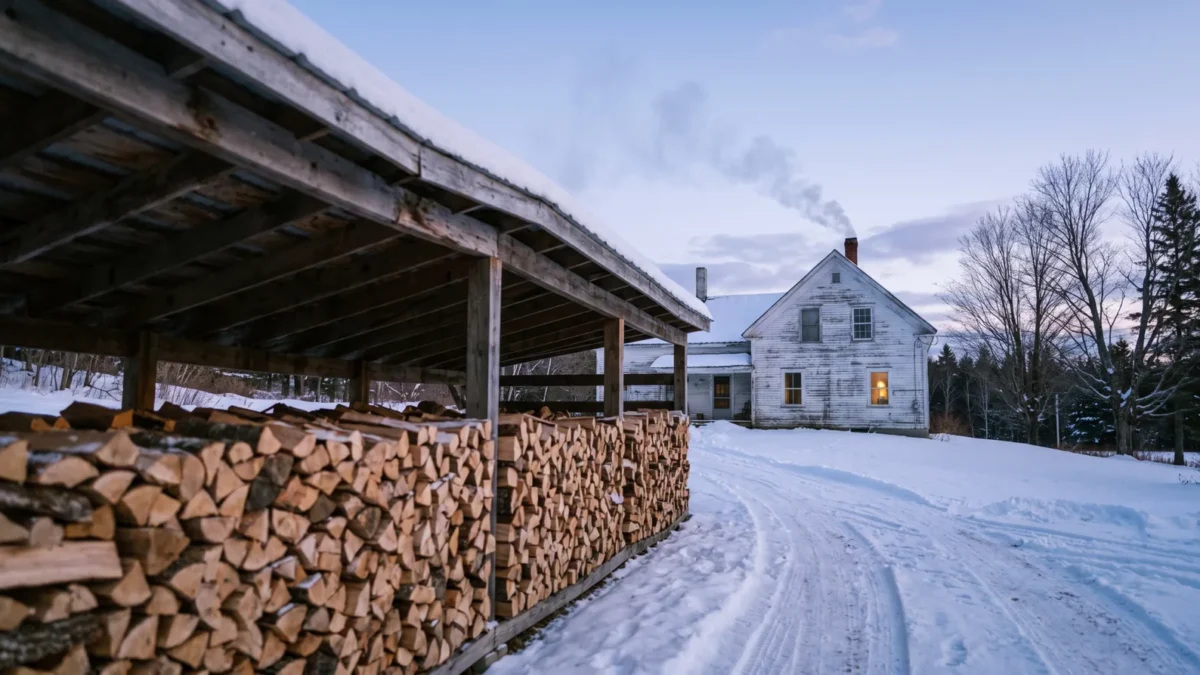
A cord of green red oak weighs about 4,886 pounds. Air dried, the same cord weighs 3,350. The gap, roughly 1,536 pounds, is water, and all of it has to boil off inside the firebox before the wood underneath will burn cleanly. The Maine Forest Service is blunt about the penalty: burning wood green can waste up to half of its energy. What wet wood costs you in heat is easy to notice. What it does to the air in the room takes longer to see.
Heating season in Maine and New Hampshire is the biggest indoor air event of the year, and it runs for months.
Two states that burn a lot of things indoors
In the Census Bureau’s 2024 American Community Survey, 59,610 of Maine’s 615,235 occupied housing units, 9.7 percent, listed wood as their primary heating fuel. Only Vermont is higher, at 10.6 percent. New Hampshire ranks sixth at 5.2 percent. Wood is only part of it. Maine also has the highest share of households heating primarily with fuel oil or kerosene of any state, 50.2 percent, with New Hampshire second at 37.1.
They do it in old buildings. Of Maine’s 764,713 housing units, 26.4 percent were built in 1949 or earlier, against 15.7 percent nationally, and just over half of the state’s housing predates 1980. New Hampshire’s pre-1950 share is 21.3 percent. Old houses leak, which historically diluted whatever the appliances put out. Many are now being air sealed, and that dilution is no longer free. Heavy combustion inside aging housing that is being tightened is the setup behind everything below, and it sits inside a wider regional environmental health picture.
Carbon monoxide, and why it peaks in January
Nationally, more than 400 people die each year from unintentional carbon monoxide poisoning unrelated to fires, more than 100,000 visit an emergency department and more than 14,000 are hospitalized, according to the US Centers for Disease Control and Prevention. The symptoms it lists are headache, dizziness, weakness, upset stomach, vomiting, chest pain and confusion. That list doubles as a description of a bad winter virus, which is most of the danger.
The timing is not random. A CDC surveillance study covering 2005 through 2018 found that across all four data sources it examined, unintentional poisonings were most often reported during winter, notably in January and December. Cases unrelated to fires accounted for 74 percent of emergency department visits. Children aged 0 to 9 had the highest reported ED visit rate, while adults over 80 carried the highest hospitalization and death rates.
The EPA’s list of household sources runs longer than most people expect: back-drafting from furnaces, gas water heaters, wood stoves and fireplaces, leaking chimneys, unvented kerosene and gas space heaters, generators, and exhaust drifting in from an attached garage. A flue that is improperly sized, blocked, disconnected or leaking is a common reason a stove back-drafts.
Maine has already lived the extreme version. After the January 1998 ice storm, four emergency departments in the hard-hit interior of the state identified 100 carbon monoxide poisoning cases from 42 separate exposure incidents in two weeks. Gasoline generators were the source in 30 of those incidents, kerosene heaters in 8, propane heaters in 4. One person died. Five were transferred for hyperbaric oxygen. The strongest risk factor for poisoning was where the generator sat: in a basement, or in an attached structure such as a garage.
Maine’s alarm law does not reach every house
Maine law does not require a carbon monoxide alarm in every home, which is not what most residents assume.
Under Title 25, Section 2468 of the Maine Revised Statutes, a person who acquires a single-family dwelling or a multiapartment building by sale or exchange after October 31, 2009 has to install carbon monoxide detectors within 30 days of acquisition or occupancy, whichever comes later, and certify at closing that they will. The statute also covers rentals, new construction, multifamily buildings and additions that add a bedroom.
Now notice what is missing. An owner-occupied single-family house that has not changed hands or been altered since 2009 falls outside the statute, and plenty of Maine’s oldest housing is exactly that. The houses the law does not reach are not the low-risk ones.
Maine CDC guidance fills the gap. It tells residents to place alarms close to all sleeping areas, to have the chimney checked and cleaned at least once a year, and to use kerosene heaters only with room doors open and windows open at least an inch. Suspected exposures go to the Northern New England Poison Center at 1-800-222-1222.
Wood smoke is a different problem
A stove can vent perfectly and still put fine particles into the room every time the door swings open. The EPA identifies fine particulate matter, PM2.5, as the biggest health threat in wood smoke, capable of worsening asthma symptoms and triggering asthma attacks, heart attacks, stroke, irregular heart rhythms and heart failure. Wood smoke also carries four toxic air pollutants the agency names specifically: benzene, formaldehyde, acrolein and polycyclic aromatic hydrocarbons. The agency also flags children, older adults and outdoor workers as most exposed.
Northern New England has its own measurements. Researchers sampled 137 homes for seven days each between 2014 and 2016, drawing participants from the New Hampshire Birth Cohort Study. Median indoor PM2.5 came in at 6.65 micrograms per cubic meter. Homes running a wood stove during monitoring showed black carbon 61.5 percent higher (95% CI: 11.6, 133.6), and PM2.5 20.6 percent higher, though that second estimate was not statistically significant. The neighborhood signal was sharper: PM2.5 ran 45.2 percent higher (95% CI: 6.2, 98.5) in homes in census blocks where more than 30 percent of houses heat primarily with wood, against blocks under 15 percent. Your neighbors’ chimneys turn up in your living room.
Within the homes themselves, older stoves, stoves that were not EPA certified, and wet or mixed wood all tracked with higher concentrations, black carbon most of all. What your own rooms are doing is a measurement question, and affordable indoor air quality monitors have made it answerable.
Measuring is not fixing, though. The KidsAIR randomized trial followed 461 children under five in rural wood-heated homes in Alaska, Montana and the Navajo Nation across 14,636 child-weeks, recording 61 lower respiratory tract infections. The odds of infection were 1.45 times higher (95% CI: 1.02, 2.05) for each increase of 25 micrograms per cubic meter in mean indoor PM2.5. Yet neither the portable air filtration arm nor the education arm reduced infections or indoor PM2.5 meaningfully against the control. A filter in the corner did not solve it.
What “seasoned” does not tell you
The lever with the most evidence behind it is the wood itself, and the vocabulary is slippery. New Hampshire DES says outright that “seasoned” is the least well defined term in the firewood trade, and that buyers should assume wood sold that way is not ready to burn without further drying. The department’s threshold is a moisture content of 20 percent or less, and it puts the drying time for green wood at 6 to 12 months depending on species and conditions.
The Maine Forest Service sorts firewood into three bands: green is 50 to 36 percent moisture content, seasoned is 36 to 20 percent, and dry is under 20 percent. Seasoned, in Maine’s own classification, tops out right about where New Hampshire says burnable begins. The service also cautions that wood cut, split and stacked outdoors over a single summer may dry down to the outside moisture content but seldom below 20 percent.
Tightening the house changes the arithmetic
Air sealing and insulation are the right call for a cold-climate house, and the research does not argue otherwise. What it says is that the ventilation you pair them with decides how the indoor air turns out.
A field study of 514 homes weatherized through the federal Weatherization Assistance Program in 2009 and 2010 found that the work, as performed at the time, could produce small but statistically significant increases in some indoor contaminants, specifically radon and humidity, while also reducing exposure to high carbon monoxide levels in some homes. Note the direction there. Tightening a house did not push carbon monoxide up. The useful takeaway is narrower: a weatherized house is a different building from the one you last tested, so radon testing belongs on the after side of the job as well as the before.
The ventilation half has been tested directly. A randomized trial compared homes weatherized under two standards, 39 built to ASHRAE 62-1989 and 42 to the newer ASHRAE 62.2-2010. Average total airflow under the newer standard was nearly double, 79 cubic feet per minute against 39. Volatile organic compounds, formaldehyde and carbon dioxide all came out significantly lower in those homes, and humidity ran about half that of the older-standard group. Children in both groups had fewer headaches, less eczema and fewer skin allergies after weatherization. The houses improved either way. They improved further with air moving through them on purpose.
None of this argues against a wood stove. Maine and New Hampshire have burned wood a long time and will keep at it. It argues for treating the stove as a combustion appliance with a maintenance calendar. A chimney checked and cleaned every year. Alarms near the bedrooms whether or not the statute covers your house. Wood you have confirmed is dry rather than wood somebody called seasoned. And a generator that never runs in a basement or an attached garage.
Sources
- U.S. Census Bureau. American Community Survey 1-Year Estimates, Table B25040 (House Heating Fuel), 2024. data.census.gov
- U.S. Census Bureau. American Community Survey 1-Year Estimates, Table B25034 (Year Structure Built), 2024. data.census.gov
- Maine Center for Disease Control and Prevention, Environmental and Occupational Health Programs. Carbon Monoxide (CO) fact sheet. maine.gov
- Maine Revised Statutes, Title 25, Section 2468. Carbon monoxide detectors. legislature.maine.gov
- U.S. Centers for Disease Control and Prevention. About Carbon Monoxide Poisoning. cdc.gov
- Annals of Emergency Medicine. Morbidity and Mortality of Unintentional Carbon Monoxide Poisoning: United States 2005 to 2018 (2023). pubmed.ncbi.nlm.nih.gov
- The Journal of Emergency Medicine. Daley WR et al., An outbreak of carbon monoxide poisoning after a major ice storm in Maine (2000). pubmed.ncbi.nlm.nih.gov
- U.S. Environmental Protection Agency. Carbon Monoxide’s Impact on Indoor Air Quality. epa.gov
- U.S. Environmental Protection Agency. Burn Wise: Wood Smoke and Your Health. epa.gov
- Journal of Exposure Science and Environmental Epidemiology. Residential wood stove use and indoor exposure to PM2.5 and its components in Northern New England (2020). pubmed.ncbi.nlm.nih.gov
- Environmental Health Perspectives. Efficacy of Air Filtration and Education Interventions on Indoor Fine Particulate Matter and Child Lower Respiratory Tract Infections among Rural U.S. Homes Heated with Wood Stoves (2022). pubmed.ncbi.nlm.nih.gov
- New Hampshire Department of Environmental Services. Burning Dry Firewood Saves Money and Improves Air Quality (Nov 12, 2021). des.nh.gov
- Maine Forest Service, Maine Department of Agriculture, Conservation and Forestry. Green and Seasoned Firewood Comparison Values (Dec 2016) and Tips for Burning Firewood in Your Home. maine.gov
- Indoor Air. Francisco PW et al., Impacts of weatherization on indoor air quality: A field study of 514 homes (2018). pubmed.ncbi.nlm.nih.gov
- Indoor Air. Ventilation, indoor air quality, and health in homes undergoing weatherization (2017). pubmed.ncbi.nlm.nih.gov
This article is for informational purposes only and does not constitute medical advice. Consult a qualified healthcare provider before making any health decisions.