Radon Testing in Maine: Why One in Three Homes Tests High
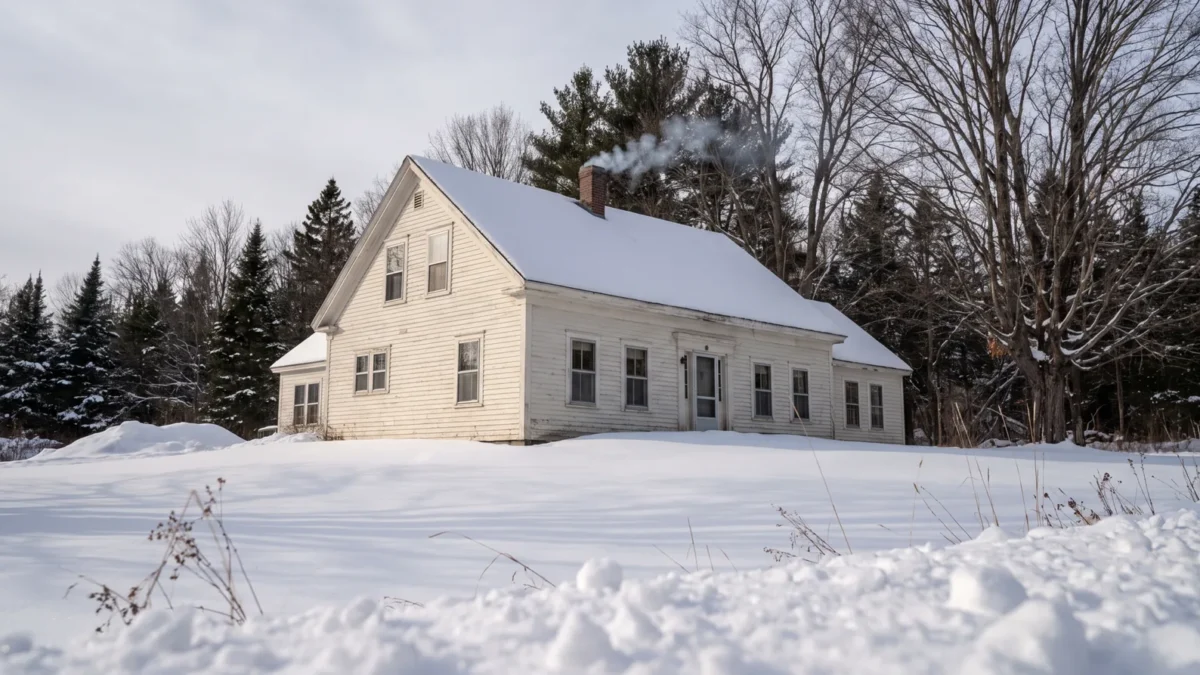
Sometime in the next few weeks, most houses in Maine will close up for the season. Storm windows come down, the last of the screens goes out to the barn, and the furnace or the woodstove takes over. That closing up is the reason the state’s own radon advice points at winter instead of at some tidy spring cleaning weekend. Maine CDC tells residents to run a short term radon test during the heating season, in the lowest livable level of the house, because that is when levels here tend to run highest. It is a Maine specific instruction, and the window is open now.
What the Maine numbers actually say
Radon is a colorless, odorless gas produced by the natural decay of uranium in soil and rock. It works its way up through the ground and into buildings through the parts of a foundation nobody thinks about, and once inside it can build up. EPA measures it in picocuries per liter of air, written pCi/L, and puts ordinary outdoor air at about 0.4 pCi/L. The average American home sits around 1.3 pCi/L, and nearly 1 out of every 15 homes nationwide tests high.
Maine does not look like that. Maine CDC reports that 1 out of every 3 homes in the state has a high radon level, and puts the statewide average at 5.9 pCi/L. That is more than four times the national indoor average. It is also not the story of one unlucky corner of the state. Radon problems have been found in all parts of Maine, and at least 25 percent of the homes tested in any part of the state come back with a problem.
The health end of this is why anyone bothers. EPA calls radon the second leading cause of lung cancer in the United States and attributes about 21,000 lung cancer deaths a year to it, while the National Cancer Institute puts the range at 15,000 to 22,000. Maine CDC’s own estimate for this state is roughly 310 new radon induced lung cancer cases and 165 deaths each year. For a state this size, that is a large number attached to something nobody can see or smell.
The geology story is probably not the one you have heard
Ask around and somebody will tell you it is the granite. Maine ledge, Maine radon, case closed. The state’s own answer is less tidy and more useful. Maine CDC says houses on all types of surfaces have radon problems, and that in Maine the houses with the worst radon problems are the ones sitting on sand and gravel, not the ones on ledge.
Which means you cannot read your risk off your driveway. Maine CDC describes many instances of a house testing over 100 pCi/L right next door to a house testing under 4. Same road, same bedrock, same soil, completely different result, because the number depends on how one particular foundation meets the ground and how one particular house moves air. A neighbor’s clean test is not your test. Radon is one of several places where Maine ground and Maine water shape household health in ways a national article will miss, and the broader landscape is laid out in our guide to environmental health in Maine and New Hampshire.
A regional pattern does show up at the county scale. On EPA’s Map of Radon Zones, Zone 1 counties are the ones with a predicted average indoor screening level above 4 pCi/L, and Zone 2 counties fall between 2 and 4. Most Maine counties are mapped Zone 1. Across the border in New Hampshire, only Carroll County is Zone 1 and the rest are Zone 2. That map was built for planning at the county scale, though, and the house to house spread above is exactly why it cannot stand in for a test at your own address.
Why the heating season is the state’s testing window
Maine CDC is direct about the timing. Radon levels are typically higher in the winter, and the best time to test is during the heating season. A house sealed against a January night, with a furnace or a stove running, does not behave like the same house in July with the windows open.
So closed house conditions are built into the protocol. A short term kit measures for 2 to 7 days. All doors and windows have to be closed for 12 hours before the test starts and stay closed for its duration, although entering and exiting the house normally is fine. And the kit goes in the lowest livable level, which is the part of the house Maine CDC directs you to test.
Winter is also when the rest of a home’s indoor air gets more crowded, which is worth handling in the same weekend. Combustion appliances and woodstoves bring their own checklist, and we walk through that in our piece on carbon monoxide and wood smoke during heating season.
What a test costs, and who is allowed to run it
The Maine Health and Environmental Testing Laboratory sells kits directly through the state’s online test store. A short term radon air kit is $40.00. A radon water kit is $42.00. For a homeowner, that is the entire barrier to entry.
Under Maine law, a homeowner or occupant may test their own home. The rule changes when the property is for sale, and then the test has to be performed by a person registered with the state. That is not the same thing as a required test, and the difference matters. Maine does not mandate a radon test in every home sale. What it does require is disclosure: radon appears on the list of hazardous materials a seller must disclose in a residential real estate transfer, under Title 33, Section 173.
Renters have a separate statute. Title 14, Section 6030-D requires testing by a person registered with DHHS, requires written disclosure to tenants of the date and results of the most recent test and whether mitigation was performed, and gives either party the right to terminate the lease on 30 days’ notice when a test shows radon at 4.0 picocuries per liter of air or above. The law also sets a repeating interval, with retesting every 10 years thereafter when a tenant requests it. If you rent in Maine and have never seen a radon disclosure, that is a fair question to put to your landlord.
Well water is a second test, not the same test
Radon in air and radon in water are measured on different scales, and Maine treats them as separate questions. For indoor air, the state advises taking action to reduce levels at 4 pCi/L and considering action between 2 and 4. For well water, Maine’s advisory level is 4,000 pCi/L, and treatment should be considered more strongly as levels approach 10,000.
The two are connected. Maine CDC’s rule of thumb is that every 10,000 pCi/L of radon in well water adds roughly 1 pCi/L to the home’s indoor air, which is how a water problem turns into an air problem every time somebody runs a shower. Maine CDC lists radon among the contaminants private well owners should test for every 3 to 5 years, alongside arsenic and uranium. If you are ordering one well test, order the set. Arsenic has its own regional story worth knowing, and we cover it in our guide to arsenic in Maine and New Hampshire private wells.
What the number means when it comes back
Four is the line. EPA’s lifetime risk table, which Maine CDC reproduces, estimates about 62 lung cancers per 1,000 current smokers exposed at 4 pCi/L, and about 7 per 1,000 people who never smoked. Maine CDC adds the piece that usually gets skipped: a person who smokes and is exposed to high radon is 9 times more likely to develop lung cancer than someone who does not smoke. The same reading does not carry the same weight in every household.
If a test comes back high, the fixes are established and mostly mechanical. Maine CDC calls active sub slab depressurization the most common and most effective air mitigation system, meaning a system that draws soil gas out from beneath the foundation and sends it outdoors rather than into the house. A heat recovery ventilation system reduces radon by about 50 percent, which makes it a partial answer instead of a complete one. On the water side, aeration systems can remove 95 to 99 percent of radon, while granular activated carbon reduces it by 85 to 95 percent. Which approach fits a given house is a conversation for a qualified contractor, not something to pick off a web page.
Then retest. Maine CDC recommends every 3 to 5 years for a home with no history of high radon, and again after any significant renovation or event that disturbs the surrounding soil and bedrock. Homes that already have a mitigation system are on a shorter clock, every 2 years.
The short version
One in three Maine homes tests high, and the state average is more than four times the national one. The gas is invisible, the risk lands hardest on people who smoke, and no amount of studying your ledge or asking your neighbor will tell you where your own house sits. What settles it is a $40 kit, correctly placed, run for a few days in a house that is already shut against the cold. Maine CDC has already said when to do it and where to put it. The rest is ordering the thing.
Sources
- Maine Center for Disease Control and Prevention. Radon In Maine (fact sheet). Maine DHHS. https://www.maine.gov/dhhs/mecdc/sites/maine.gov.dhhs.mecdc/files/Radon%20In%20Maine.pdf
- Maine Center for Disease Control and Prevention. Radon Health Risk (fact sheet). Maine DHHS. https://www.maine.gov/dhhs/mecdc/sites/maine.gov.dhhs.mecdc/files/Radon%20Health%20Risk.pdf
- Maine Center for Disease Control and Prevention. Radon Testing (fact sheet). Maine DHHS. https://www.maine.gov/dhhs/mecdc/sites/maine.gov.dhhs.mecdc/files/Radon%20Testing.pdf
- Maine Center for Disease Control and Prevention. Radon Frequently Asked Questions. Maine DHHS. https://www.maine.gov/dhhs/mecdc/healthy-living/health-and-safety/indoor-safety/radon/radon-frequently-asked-questions
- Maine Health and Environmental Testing Laboratory. Radon (state radon program page). Maine DHHS. https://www.maine.gov/dhhs/mecdc/services/maine-public-health-laboratory/environmental-chemistry/radiochemistry-and-radon-testing/radon
- Maine Center for Disease Control and Prevention. Radon Mitigation Systems (fact sheet). Maine DHHS. https://www.maine.gov/dhhs/mecdc/sites/maine.gov.dhhs.mecdc/files/Radon%20Mitigation%20Systems.pdf
- Maine Center for Disease Control and Prevention. Private Well Water. Maine DHHS. https://www.maine.gov/dhhs/mecdc/healthy-living/health-and-safety/drinking-water-safety/private-well-water
- Maine Health and Environmental Testing Laboratory. Online Water and Radon Test Kit Store. State of Maine. https://apps1.web.maine.gov/cgi-bin/WebShop/public/index?store_id=10/
- Maine Revised Statutes, Title 14, Section 6030-D. Radon testing in residential rental property. Maine Legislature. https://legislature.maine.gov/statutes/14/title14sec6030-D.html
- Maine Revised Statutes, Title 33, Section 173. Disclosure of hazardous materials, residential real estate transfers. Maine Legislature. https://legislature.maine.gov/statutes/33/title33sec173.html
- U.S. Environmental Protection Agency. A Citizen’s Guide to Radon (EPA 402/K-12/002). EPA. https://www.epa.gov/sites/default/files/2016-12/documents/2016_a_citizens_guide_to_radon.pdf
- U.S. Environmental Protection Agency. Map of Radon Zones, Maine and New Hampshire sheets. EPA. https://www.epa.gov/sites/production/files/2014-08/documents/maine.pdf
- U.S. Environmental Protection Agency. Health Risk of Radon (includes the National Cancer Institute radon fact sheet range). EPA. https://www.epa.gov/radon/health-risk-radon
This article is for informational purposes only and does not constitute medical advice. Consult a qualified healthcare provider before making any health decisions.