Chanterelle Look-Alikes: The Maine Mushrooms That Send People to the ED
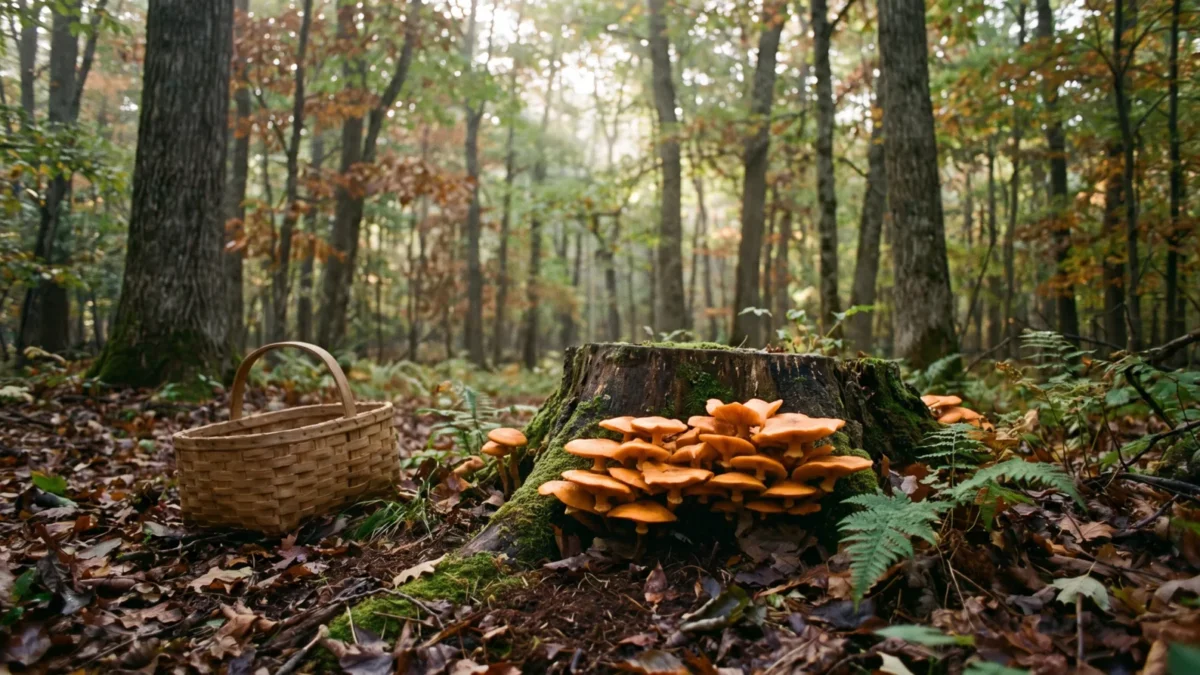
By August 9, 2021, the Northern New England Poison Center had already taken more than 40 mushroom-poisoning calls from New Hampshire alone, inside the range it normally logs across a full year (35 to 49). The main chanterelle look-alikes in Maine and New Hampshire are the jack-o’-lantern mushroom (Omphalotus illudens) and the false chanterelle (Hygrophoropsis aurantiaca). The poison center, which serves Maine, New Hampshire and Vermont from its base in Portland, says a jack-o’-lantern mistaken for a golden chanterelle is the single most common case of mistaken mushroom identity it handles. Jack-o’-lanterns have thin, sharp-edged true gills and grow in dense clusters on wood. Chanterelles have blunt, forked ridges and come up singly from soil. No written description, this one very much included, substitutes for an expert looking at the mushroom in your hand.
The two chanterelle look-alikes that actually come up
Start with the one the poison center names. Omphalotus illudens fruits in summer and fall, and a state wildlife field guide describes it growing “in large clusters at the base of trees, on stumps, or on buried wood.” Chanterelles, in that same guide, are “smooth or have blunt ridges, not gills” and “grow singly on the forest floor (not in clusters on wood).” Two signals, then: what the underside looks like, and what the mushroom is coming out of.
The false chanterelle is the other name that surfaces in every identification thread. It is worth learning as a look-alike, and it is worth noticing which mushrooms the poison center actually flags. Its list of toxic species common in this region runs jack-o’-lantern, lilac brown bolete (Tylopilus eximius), false morel (Gyromitra esculenta) and pigskin puffballs (Scleroderma species), with certain amanitas and Boletus sensibilis added on its A-to-Z page. Hygrophoropsis aurantiaca is not on it. Plenty of foraging sites say the false chanterelle makes people sick. None of the state, federal or peer-reviewed sources consulted here does.
What the regional poison center actually handles
The Northern New England Poison Center manages nearly 30,000 potential human poisonings a year across the three states. Mushrooms are a small slice of that, and the pattern inside the slice is specific: foraging mistakes are the second most common cause of serious mushroom poisonings it sees, behind intentional ingestion of psychedelic mushrooms.
Its director, Dr. Karen Simone, told New Hampshire Public Radio that the center normally takes “between 35 to 49 calls about mushroom poisonings from New Hampshire annually,” and split those cases into two groups: people who never tried to identify what they ate, and “people who were pretty sure that they were picking chanterelles or king bolites or other mushrooms, and they just weren’t identifying them properly.” The second group is what this article is about. The center publishes no per-state, per-substance figures, so there is no equivalent Maine number to quote.
National data puts the risk in proportion. From 1999 to 2016, US poison centers logged 133,700 mushroom exposures, about 7,428 a year. Most were unintentional, most caused no harm or only minor harm, and 62 percent involved children under 6. About 39 cases a year caused major harm and 2.9 a year were fatal, mostly from cyclopeptide-producing mushrooms. The authors concluded that “misidentification of edible mushroom species appears to be the most common cause and may be preventable through education.”
What a jack-o’-lantern does
NAMA identifies the toxins as the sesquiterpenes illudin M and illudin S, and describes the usual course: “generally, one to three hours after a meal, the victim will suffer nausea (90% of cases) and vomiting (73% of cases),” with recovery “usually rapid with most victims recovered within 12 hours.” An older belief held muscarine responsible; NAMA notes the symptom pattern does not match classical muscarine poisoning.
The published case series is small and old but consistent with that. Fourteen people ate jack-o’-lanterns; 8 vomited, 5 had diarrhea, 2 reported weakness, and “recovery was complete within 18 hours.” A state field guide is blunter: “Eating the jack-o’-lantern will make you very sick for a few days. You won’t die, but you might wish you had.”
None of that is a safety rating. Fourteen adults recovering inside a day says nothing certain about a small child, an older adult, or anyone badly dehydrated before help arrives. The timing also runs against intuition. The poison center’s guidance is that most harmful mushrooms are stomach irritants whose symptoms “will usually show up within 30 minutes, but may take longer,” while “more dangerous mushrooms may take 6 hours or more to cause symptoms” and can stop the kidneys or liver. Fast sickness is miserable. Slow sickness is what worries a toxicologist.
The mushrooms that actually kill people in this country are amatoxin producers, not jack-o’-lanterns. In an 11-year review of national poison data covering 2008 through 2018, 8,953 mushroom exposures were reported, 148 met criteria for suspected cyclopeptide poisoning, and 13 of those died, a mortality rate of 8.8 percent.
The glow is not a field test
Jack-o’-lanterns are famous for glowing in the dark, and the tip gets passed around as though it settles the question. The state field guide hedges it twice: the mushrooms are “said to be bioluminescent,” and “the gills of fresh specimens may sometimes give off a faint greenish glow at night.” Said to be. May sometimes. Nothing establishes the reverse either, that a mushroom which fails to glow is a chanterelle.
The biology is genuinely interesting, which is probably why the shortcut spreads. A 2024 review counted 132 known species of bioluminescent fungi, more than double the 64 recognized 15 years earlier, with the lineage containing Omphalotus accounting for 18. Interesting is not diagnostic. The same goes for the other field tricks in circulation, smell and taste tests included.
Maine and New Hampshire went opposite directions
The two states have moved apart on wild mushrooms. Maine’s Wild Mushroom Harvesting Certification Program, 22 MRSA section 2175, is off the books: the Revisor of Statutes page for that section now reads “(REPEALED),” citing PL 2021, c. 125, section 1. New Hampshire went the other way. UNH Extension states that “in 2022, the New Hampshire law requiring licensing of wild mushroom harvesters and distributors became effective,” and the state health department says applicants “must first successfully complete a course in safe wild mushroom identification and harvesting practices.”
For somebody picking a few mushrooms for their own kitchen, the land rules matter more than the licensing history. On Maine’s Public Lands, the Bureau of Parks and Lands lists berry picking, fiddlehead picking and mushroom collecting among the activities needing no permit. The same page draws a line right after it: gathering “is only allowed on Maine’s Public Lands, not on Maine State Parks and Historic Sites which do not allow gathering or collecting of any kind.” Know which one you are standing on.
Even the chanterelles are still being renamed
A wrinkle sits under every tidy field description, this one included. The poison center writes the golden chanterelle as Cantharellus cibarius, the classic European name. UNH Extension’s chanterelle photograph for New Hampshire is labeled Cantharellus enelensis, a species described as new to science only in 2017, from Newfoundland and Labrador. A 2023 Mycologia study of the southern Appalachians described another new species, raised a southeastern taxon to species rank, and reported three species there for the first time.
Eastern North American chanterelle taxonomy is still moving, in other words. That is not a reason to stay out of the woods, but it is a reason to distrust any source that talks about “the” chanterelle as one settled thing with one settled set of impostors. UNH Extension puts the broader version plainly: “the majority of wild mushrooms have never been tested for toxicity,” and “some that are extremely poisonous may look similar to safely edible species.”
What keeps people out of the emergency department
UNH Extension’s advice is to learn identification from mycologists rather than from social media, and that is about as far as any well-sourced body will go. There is no beginner’s test in this material, nothing you can run on a tailgate to clear a basket. There is a mushroom in your hand, and there is somebody who has spent years looking at that species.
If somebody has already eaten something questionable, call the poison center rather than waiting to see what develops. Of the people who call the center from home, 9 out of 10 are handled with advice over the phone and never need a hospital or a doctor’s office. NAMA also runs a mushroom poisoning case registry the public can report to, and asks that gastrointestinal-only cases be filed, not just the severe ones.
Chanterelles are still worth learning, and our guide to fall foraging in Maine covers what the region’s wild mushrooms and berries bring nutritionally. Mushrooms are not the only things in these woods people get wrong: see our guides to poison ivy, oak and sumac in New England and to wild parsnip and giant hogweed. Certainty about a species is earned, not assumed.
Sources
- Northern New England Poison Center. “Foraging for mushrooms can be risky.” October 8, 2019. https://www.nnepc.org/regional-news/foraging-for-mushrooms-can-be-risky
- Northern New England Poison Center. “Mushrooms” (poison index entry). https://www.nnepc.org/poisons/m/mushrooms
- Northern New England Poison Center. “About the NNEPC.” https://www.nnepc.org/about
- New Hampshire Public Radio. “New England Poison Control Center Staying Busy Due To Abundance Of Mushrooms.” August 9, 2021. https://www.nhpr.org/nh-news/2021-08-09/new-england-poison-control-center-staying-busy-due-to-abundance-of-mushrooms
- Brandenburg WE, Ward KJ. “Mushroom poisoning epidemiology in the United States.” Mycologia. 2018;110(4):637-641. https://pubmed.ncbi.nlm.nih.gov/30062915/
- French AL, Garrettson LK. “Poisoning with the North American Jack O’Lantern mushroom, Omphalotus illudens.” Journal of Toxicology: Clinical Toxicology. 1988;26(1-2):81-88. https://pubmed.ncbi.nlm.nih.gov/3290510/
- North American Mycological Association. “Mushroom Poisoning Syndromes.” https://namyco.org/mushroom-poisoning-syndromes/
- Missouri Department of Conservation. Field guide: jack-o’-lantern. https://mdc.mo.gov/discover-nature/field-guide/jack-o-lantern
- Perry BA, Desjardin DE, Stevani CV. “Diversity, Distribution, and Evolution of Bioluminescent Fungi.” Journal of Fungi (Basel). 2024;11(1):19. https://pubmed.ncbi.nlm.nih.gov/39852438/
- De Olano J, et al. “Current fatality rate of suspected cyclopeptide mushroom poisoning in the United States.” Clinical Toxicology (Philadelphia). 2021;59(1):24-27. https://pubmed.ncbi.nlm.nih.gov/32237919/
- Maine State Legislature, Revisor of Statutes. Maine Revised Statutes Title 22, section 2175 (REPEALED). https://legislature.maine.gov/statutes/22/title22sec2175.html
- Maine Bureau of Parks and Lands (DACF). “Hunting, Fishing and Gathering.” https://www.maine.gov/dacf/parks/hunting_fishing/gathering.shtml
- UNH Extension (Mary Choate). “Foraged Mushrooms Safety and Quality.” October 16, 2023. https://extension.unh.edu/blog/2023/10/foraged-mushrooms-safety-quality
- New Hampshire Department of Health and Human Services. Wild Harvested Mushroom Licensing.
- Swenie RA, Matheny PB. “Chanterelles of the southern Appalachian Mountains.” Mycologia. 2023;115(1):44-68. https://pubmed.ncbi.nlm.nih.gov/36469755/
- Thorn RG, Kim JI, Lebeuf R, Voitk A. “The golden chanterelles of Newfoundland and Labrador.” Botany. 2017.
This article is for informational purposes only and does not constitute medical advice. Consult a qualified healthcare provider before making any health decisions.