Poison Ivy Identification in New England: What It Looks Like in Every Season
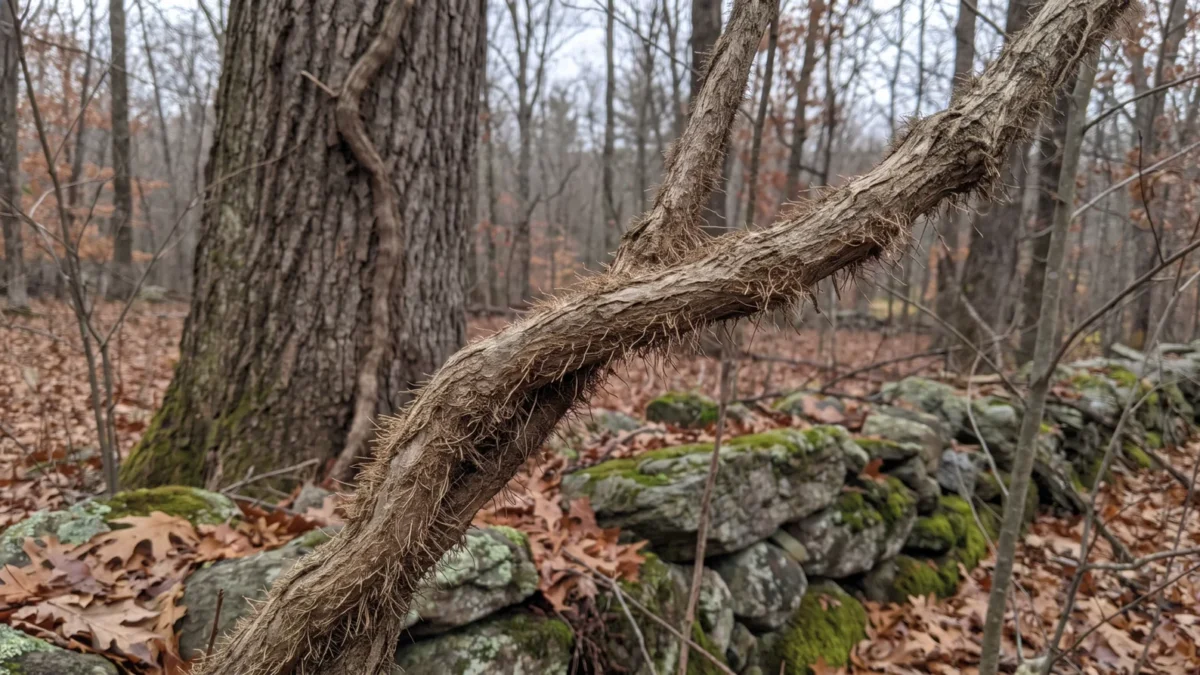
Every winter, someone in southern Maine clears brush along a stone wall and comes inside with a rash on both forearms, certain there wasn’t a leaf on anything they touched. They’re right about the leaves. Poison ivy identification is a year-round skill in New England, because the National Park Service notes that a dormant plant reduced to sticks and roots still contains the same amount of urushiol as it does in summertime. In leaf, the plant has compound leaves made of three leaflets, and the middle leaflet sits on a noticeably longer stalk than the two beside it. Leaflet edges range from smooth to toothed to lobed, often varying on the same plant. Leaves come out purplish red in May and early June, glossy green through summer, then orange-red to wine-red in fall, though plants growing in shade frequently skip the bright color. Older plants climb by aerial rootlets that give the stem a hairy, ropelike look, and in February that hairy rope is the whole plant.
What poison ivy identification actually comes down to
The old line about leaves of three is where most people stop, and UNH Cooperative Extension calls it misleading on its own. What separates poison ivy is the stalk. In the fact sheet Maine’s Board of Pesticides Control hands out, written by Cornell Cooperative Extension, the middle leaflet attaches by a longer stalk, called a petiolule, while the two side leaflets sit on very short ones.
Then stop trying to match edges. The Cornell sheet says margins can be toothed, lobed or entirely smooth, and that shape and toothing vary between leaflets on the same stem. Leaflets run two to four inches long and come to a point, says Maine’s own weed page, which describes a woody perennial growing as an erect or trailing shrub, or as a vine.
The same plant, four different looks
Spring is the easiest season to walk past it. New leaves unfold purplish to reddish in May and early June. By summer they’re bright green and shiny, with what the Cornell sheet calls a varnished appearance. Small yellow or green flowers open in June and July.
Fall is when a patch announces itself. In sunny spots the leaves turn vivid orange-red to wine-red, exactly the color everyone is scanning for on a walk timed around peak foliage. In shade it often stays plain green and tells you nothing.
The berries hang on. The Cornell sheet describes a whitish to dull greenish-yellow fruit about a fifth of an inch across, ridged lengthwise, resembling a peeled orange. Maine’s Got Pests page calls them white berries. They’re set by September and often stay on the low leafless stems all winter, one of the few identification features left in January.
Winter is when people get caught
A leafless poison ivy vine on a tree trunk looks like a rope nobody bothered to take down. Aerial rootlets grip the bark the whole length of the stem, giving it a fuzzy outline. The Park Service says these vines climb high and can put on a trunk 15 centimeters across, and the Cornell sheet gives heights of 20 to 33 feet. Other vines climb the same trunks, so look for the rootlets.
The dormancy myth is the one that does damage. The Cornell sheet takes it head on: the belief that you can only catch poison ivy when the leaves are out is not true, because a reaction can occur year round from contact with stems and roots in winter. A dead plant isn’t a safe plant either.
How long the oil stays active depends on who you ask. CDC’s NIOSH says urushiol can remain active on the surface of objects for up to five years. The sheet Maine distributes says over a year on dead plants and objects, and UNH says a year or more on stems and roots. So work gloves, a chainsaw handle, a dog’s coat or the boots by the mudroom door can all cause trouble long after the job. NIOSH also puts the threshold low, estimating that an amount of urushiol smaller than a grain of salt causes a rash in 80 to 90 percent of adults.
Where it grows in Maine and New Hampshire
The most specific spot any agency names here is in Acadia National Park, where the Park Service says poison ivy is uncommon overall but can be found in popular visitor use areas such as along the Ocean Path south of Thunder Hole. The same page puts it on coastal dunes, above the rocky shore, and in open sunny places like roadsides and trails, plus clearings and fence rows. Maine’s weed page adds fields, pastures, farms and yards.
It belongs here. Go Botany, run by the Native Plant Trust, records Toxicodendron radicans as native and indigenous, present in all six New England states and growing as a liana, a woody plant with a vine-like growth form. Calling it invasive gets the plant wrong. The Park Service treats it as a native with a job: more than 60 species of birds eat its fruit and spread the seed.
A six-year experiment at Duke Forest in North Carolina, published in PNAS in 2006, found that poison ivy grew under higher atmospheric carbon dioxide at a rate exceeding most other woody species, and that those plants produced a more allergenic form of urushiol. That was North Carolina, though, and no monitoring data shows the plant spreading measurably in Maine or New Hampshire.
The look-alikes, and the one that isn’t here
Poison oak is not a New England problem. Go Botany records only three Toxicodendron species in the region: radicans, rydbergii and vernix. Eastern poison oak isn’t among them, so the familiar national trio doesn’t describe a Maine trailhead.
Toxicodendron rydbergii is the sibling worth recognizing. Go Botany describes a small straggling shrub without aerial roots that never takes a viny form, present in all six states. Same three leaflets. No rope on the tree.
Poison sumac is real here. UNH Extension writes that it grows almost exclusively in swamps and bogs, and Go Botany classes it as an obligate wetland species. It carries large compound leaves with smooth edges on red leaf stems, which is the split from the far more common staghorn sumac and its serrated leaves. Tiny white flowers in June become waxy green berries that turn white in fall. Same urushiol, and the UNH author has watched it spread past swamp borders in her area, since birds move the seed.
The rest of the list is short. UNH names dewberry and black raspberry, both of which have thorns that poison ivy never does, plus wild sarsaparilla and Virginia creeper. It’s the discipline foragers use with chanterelles and the jack-o-lantern mushroom: learn one reliable feature and check it every time.
When a summer rash isn’t a plant at all
There’s a wrinkle specific to Maine. From April through August, a rash picked up at a woods edge may have nothing to do with a plant. The Maine Forest Service reports that browntail moth caterpillar hairs cause a skin rash similar to poison ivy, and trouble breathing in sensitive people. The hairs can be airborne or settled on surfaces in infested areas, and symptoms last from a few hours to several weeks.
Geography narrows it. The moth turns up in patches along the coast and up to 60 miles inland, heaviest in mid-coastal Maine and the capital region. The state advises staying out of badly infested areas and holding off on leaf blowers and mowers between April and August, and warns that hairs can linger up to three years after caterpillars were on a property.
It isn’t a plant rash and shouldn’t be filed as one. Maine has other outdoor skin hazards that get misidentified the same way, including the burns wild parsnip and giant hogweed leave.
What the sources say about contact
The Northern New England Poison Center, in Portland and serving Maine, New Hampshire and Vermont, corrects two stubborn myths. The oil is found year round in all parts of the plant, including the roots, stems, flowers and leaves. And the rash cannot spread from person to person, because the rash itself, including any pimples or blisters, does not contain poison ivy oil.
Timing confuses people too. The center says a rash can take up to two days to appear in someone who has reacted before, or up to two weeks in someone who hasn’t, long enough that the walk is forgotten before the skin catches up.
You also cannot catch it by walking near a plant without touching it, per the fact sheet Maine distributes. The exception is fire. The poison center warns that burning poison ivy makes smoke that irritates the eyes, skin, nose and throat and makes breathing difficult, and that those symptoms can be severe. Worth remembering in a state where brush piles get burned every spring. After contact, the Park Service tells visitors to use soap and water within 30 minutes to gently wash off the resin. Anything past that belongs with a clinician.
Sources
- National Park Service, Acadia National Park. Poison Ivy. https://www.nps.gov/acad/learn/nature/poisonivy.htm
- US Centers for Disease Control and Prevention, NIOSH. Poisonous Plants and Work. https://www.cdc.gov/niosh/topics/plants/
- Maine Department of Agriculture, Conservation and Forestry, Board of Pesticides Control. Got Pests? Poison Ivy. https://www.maine.gov/dacf/php/gotpests/weeds/poison-ivy.htm
- Cornell Cooperative Extension, Suffolk County. Poison Ivy fact sheet, distributed by the Maine Board of Pesticides Control. https://www.maine.gov/dacf/php/gotpests/weeds/factsheets/poison-ivy-cornell.pdf
- Maine Forest Service, Maine DACF. Browntail Moth. http://www.maine.gov/dacf/mfs/forest_health/invasive_threats/browntail_moth_info.htm
- University of New Hampshire Cooperative Extension. What can I do to get rid of the poison ivy in my yard? https://extension.unh.edu/blog/2018/08/what-can-i-do-get-rid-poison-ivy-my-yard
- University of New Hampshire Cooperative Extension. Beware of Poison Sumac (Rhus vernix). https://extension.unh.edu/blog/2019/07/beware-poison-sumac-rhus-vernix
- Northern New England Poison Center. Poison Ivy. https://www.nnepc.org/poisons/p/poison-ivy
- Go Botany, Native Plant Trust. Toxicodendron. https://gobotany.nativeplanttrust.org/genus/toxicodendron/
- Mohan JE, Ziska LH, Schlesinger WH, Thomas RB, Sicher RC, George K, Clark JS. Biomass and toxicity responses of poison ivy (Toxicodendron radicans) to atmospheric CO2 enrichment. PNAS 2006;103:9086-9. https://doi.org/10.1073/pnas.0602392103
This article is for informational purposes only and does not constitute medical advice. Consult a qualified healthcare provider before making any health decisions.