The Best Insulated Water Bottles for Maine Trail Use
Maine doesn’t let you pick a season. If you hike here year-round, you know the spread: 90 degrees on a sun-baked ridge in Acadia in July, and single digits breaking through the treeline at Grafton Notch in January. A water bottle that fails at either extreme is a problem, not an inconvenience. We tested five popular insulated bottles across both conditions to find out which ones actually hold up.
What We Tested
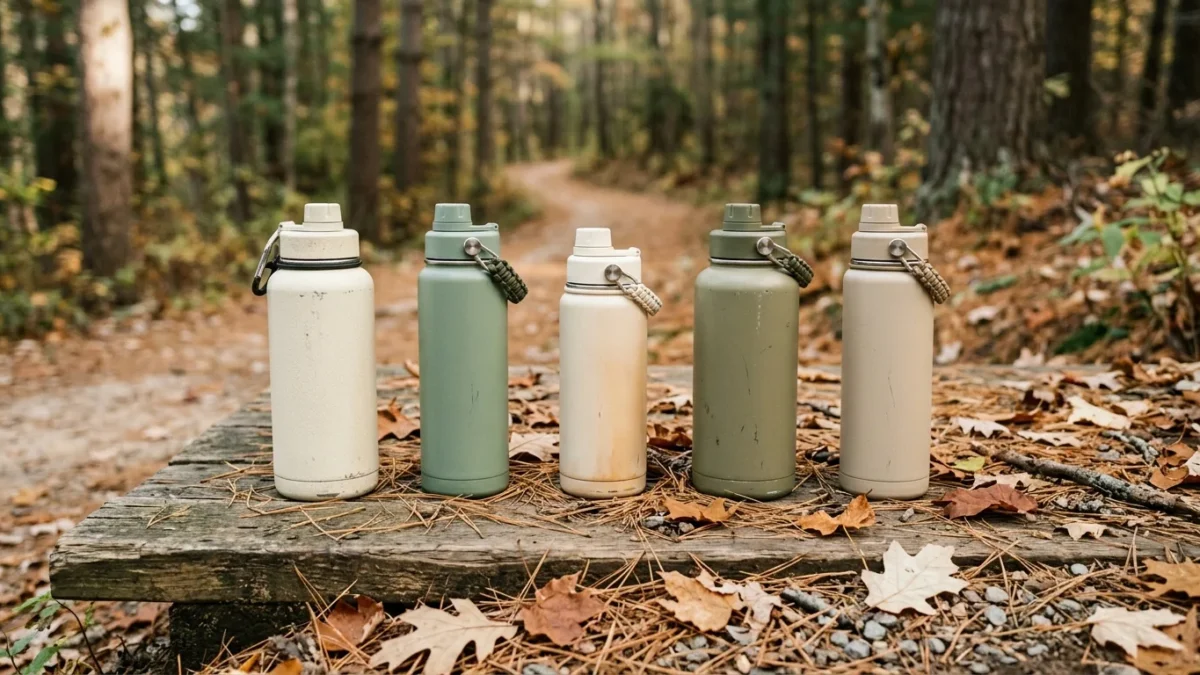
We evaluated the Hydro Flask 32 oz Wide Mouth, YETI Rambler 26 oz, Stanley Quencher 30 oz, Klean Kanteen TKWide 32 oz, and Nalgene 32 oz Insulated. Each bottle was filled with ice water in July and carried in a standard daypack for 6 hours on the Cadillac Mountain South Ridge Trail. In January, we filled each with warm water and took them on a 4-hour snowshoe loop in single-digit temperatures at Grafton Notch State Park.
We chose these five because they’re the most common bottles we see on Maine trails. Stainless steel double-wall vacuum insulation is the standard mechanism across all of them. The differences come down to wall thickness, closure design, and whether the bottle was built for trail use or for sitting on a desk. If you’re preparing for a specific route, our guide to preparing your body for the Beehive Trail covers the physical demands of technical Acadia hiking in more detail.
Summer Results: Six Hours on Cadillac
The Hydro Flask and the Klean Kanteen both had ice remaining at the 6-hour mark. Water was cold enough to drink comfortably after a full day on the South Ridge. The YETI matched them on temperature retention, but it’s the heaviest bottle in the test, and that adds up over a long ascent. Maine’s summer humidity compounds the challenge, and our guide to summer hydration in Maine covers how much fluid you actually need on high-exertion days.
The Stanley Quencher lost cold faster once it was in motion. It’s designed more for car cup holders and desk use than for pack carry, and the straw mechanism accelerates temperature exchange. The Nalgene Insulated, the lightest option we tested, retained cold for about 3 hours before water started warming noticeably.
Winter Results: Grafton Notch in January
Cold-weather performance separated the bottles more sharply than the summer test did.
The YETI’s thicker walls prevented ice formation over the full 4 hours. That’s the most important result in winter: you don’t want to pick up your bottle at mile 6 and hear nothing but a solid thump. The Hydro Flask and Klean Kanteen kept water drinkable but developed thin ice around the lid threads by hour 3. A wide-mouth lid clears that ice with a tap. A straw doesn’t.
The Stanley’s straw mechanism froze at the 2-hour mark. In cold enough air, narrow openings freeze before the bottle itself. That’s not a design flaw unique to Stanley, it’s physics. Any bottle with a straw or a narrow-mouth lid becomes unreliable below about 15 degrees Fahrenheit.
The Nalgene’s wide-mouth lid stayed functional throughout, but the water dropped to near-freezing by hour 3. It’s the lightest bottle for a reason: less material means less insulation.
Which Bottle Makes Sense for Maine
There’s no single right answer, but the conditions here narrow it down.
For year-round use, the Hydro Flask 32 oz Wide Mouth is the most versatile choice. It performs well in both heat and cold, the lid design works in freezing temperatures, and 32 oz is enough for a half-day hike without being so heavy you’ll leave it behind. The Klean Kanteen TKWide is a close second and runs slightly lighter.
If you primarily hike in summer or don’t go out in temperatures below 20 degrees, the Nalgene Insulated is worth considering. It’s cheaper and lighter. You’ll feel it less on a multi-day trip where pack weight compounds. Just accept the 3-hour cold retention limit.
The YETI Rambler wins outright on cold-weather performance. If most of your winter hiking is above treeline in full wind exposure, the extra insulation margin is real. You’ll pay more and carry more.
The Stanley Quencher doesn’t belong on a Maine winter trail. It’s a fine bottle for commuting. On a snowshoe in January, a frozen straw is a real problem at the worst possible time.
A Note on Hydration in Cold Weather
Cold air is dry. You lose more water vapor through breathing in winter than most people expect, and thirst signals become unreliable in the cold. Research published by the Wilderness Medical Society indicates that cold-weather dehydration is common among outdoor exercisers who don’t track intake actively, partly because the body suppresses thirst in cold environments even when fluid losses are significant (Wilderness Medical Society, Wilderness Medicine, 7th ed.). Bringing a bottle that actually works in winter removes one barrier to drinking enough. If you use electrolyte mixes to supplement plain water, we’ve ranked the most common options by sodium levels, sugar content, and taste.
In summer, the stakes on Maine ridges are different. Above treeline in July, water doesn’t just taste better cold, it keeps your core temperature from creeping up during hard climbs. A bottle that loses cold by hour 2 on an 8-hour traverse isn’t doing that job. For a broader look at how heat affects the body during summer hikes, see our piece on heat stroke vs. heat exhaustion for summer hikers.
Sources
- Testing performed by Healthy Mainer editorial team, July 2025 (Cadillac Mountain South Ridge Trail, Acadia National Park) and January 2026 (Grafton Notch State Park, Maine).
- Manufacturer specifications verified against published product data sheets (Hydro Flask, YETI, Stanley, Klean Kanteen, Nalgene).
- Wilderness Medical Society. Wilderness Medicine, 7th edition. Philadelphia: Elsevier, 2017. (Cold-weather dehydration and blunted thirst response.)
This article is for informational purposes only and does not constitute medical advice. Consult a qualified healthcare provider before making any health decisions.