Tick Season Does Not End in Summer: The Fall Adult Deer Tick Peak
The University of Maine’s Tick Lab took in 5,486 ticks in 2025, mailed from all 16 counties and 411 different towns. Sort the 4,035 blacklegged ticks in that pile by life stage and something jumps out. There were 3,090 adult females and 72 adult males, against 812 nymphs and 53 larvae. The tick most Mainers actually found on themselves and sent to Orono was an adult, not one of the tiny nymphs that dominate the June headlines. And adults keep their own calendar, one that runs straight through the weeks when most of us have already put the repellent back in the mudroom closet.
Two peaks, and the second one lands in late fall
The Tick Lab’s 2025 surveillance report lays out the year in plain language. “Adult blacklegged ticks are most active from spring to late fall with two peaks, one in April or May and another peak in late October or early November,” it says. “Nymph numbers usually peak in June and early July. When temperatures permit, blacklegged ticks can be active year round.”
Cross into New Hampshire and UNH Cooperative Extension draws nearly the same shape. Its fact sheet on tick biology puts adult blacklegged activity at “early October to late-November, plus late March through May,” while nymphs are “most active from May 15th through early or mid-July.” The same sheet adds a line worth reading twice: “Activity continues in mild winter weather (temperatures above 40F) when there is no snow cover.”
The research literature has formalized the split. A 2024 study in Parasites & Vectors, pooling Ixodes scapularis surveillance from Connecticut, Maine, New Hampshire, New York and Vermont between 1989 and 2021, states it flatly: “the nymph season is defined as May to September and the adult season is October to December.” Maine was the only state in that dataset with records spanning the entire period. The fall tick season is not a hedge. It is a named season in the surveillance science, and it opens about when the foliage does.
The autumn tick is likelier to be carrying something
UMaine tested 3,001 adult blacklegged ticks and 779 nymphs in 2025, and the infection rates split along life stage. Borrelia burgdorferi, the Lyme bacterium, showed up in 45.2% of the adults and 25.0% of the nymphs. Anaplasma phagocytophilum was found in 10.2% of adults against 6.9% of nymphs. Babesia microti, 14.2% against 6.4%. Powassan virus turned up in 0.9% of adults and in none of the nymphs tested.
Field sampling points the same direction on raw numbers. In that northeastern dataset, researchers dragging cloth through vegetation collected more adults than nymphs in both states. Maine averaged 128.1 adults per hectare against 38.7 nymphs. New Hampshire averaged 66.4 adults against 5.8 nymphs.
None of that makes an adult tick more dangerous than a nymph in some absolute sense. UMaine is clear that nymphs matter precisely because their small size lets them feed unnoticed, and a bite you never find is the one that gets you. The honest reading is narrower and more useful. Fall is the underwatched season. The stage of tick that is close to twice as likely to carry Lyme bacteria is out in numbers at exactly the point on the calendar where vigilance falls off. Our full Maine and New Hampshire guide to ticks and Lyme covers the whole year, and this is the chapter people skip.
The official calendars do not agree with each other
Part of why fall gets ignored is that federal and state guidance say different things. The US CDC’s tick bite prevention page tells readers “ticks are most active during warmer months (April-September).” That window closes a full month or two before the adult peak UMaine documents. Read only the federal page and you would reasonably conclude that Columbus Day weekend is past the risk.
State guidance is more generous. New Hampshire DHHS says “Ticks are active any time the outside temperature is above 40°F and they are not covered by snow. Tick exposure can occur year-round, but ticks are most active during warmer months (April-November).” Maine CDC frames it as biology rather than a date range: “Did you know ticks can make their own antifreeze to survive during the winter? Any time the temperature is above freezing, ticks could be out.”
That has been tested directly. Winter flagging experiments published in the Journal of Medical Entomology in 1994 found adult Ixodes scapularis had “an apparent threshold of questing activity at 4 degrees C,” roughly 39 degrees Fahrenheit, and the authors concluded the public “may be at risk of contracting Lyme disease any time during the winter when temperatures exceed 4 degrees C.” Thirty years on, that temperature threshold is still the operative rule, and it is a lower bar than most people assume.
Which brings up the folk belief that a hard frost ends tick season. It is a comforting idea, and every agency above contradicts it. Frost takes care of the mosquitoes. It does not clear the leaf litter of adult deer ticks, and a mild afternoon in November or a bare-ground thaw in January can put them back in play.
Maine’s deer seasons sit right on top of the peak
This is where the two calendars collide in a way Mainers can feel. The 2026 seasons set by Maine’s Department of Inland Fisheries and Wildlife run expanded archery from September 12 to December 12, regular archery October 3 to 30, the youth deer hunt October 23 and 24, the Maine-resident-only day October 31, general firearms November 2 to 28, and statewide muzzleloader November 30 to December 5, extending to December 12 in WMDs 12 to 18 and 20 to 29.
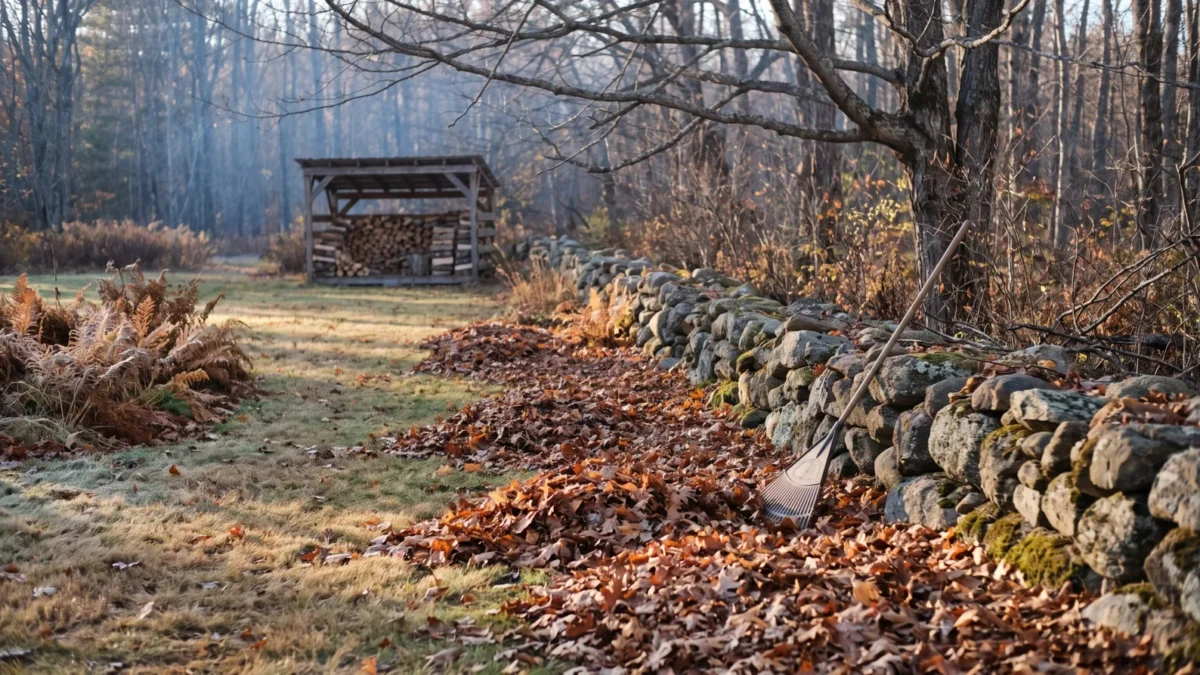
Lay that over “late October or early November” and the two calendars are the same calendar. The busiest stretch of the Maine outdoor year, which is also when people are raking leaves, stacking the woodpile, and clearing brush along the treeline, sits inside the adult tick’s peak. Maine CDC lists hunting and yard work among the activities where exposure happens, and notes that plenty of people pick up ticks in their own yard or neighborhood rather than deep in the woods. The state gives hunters one specific piece of advice: use a permethrin-treated tarp when handling deer. If you are unclear on how permethrin differs from what goes on skin, we compare the options in our review of DEET, picaridin and permethrin.
What is actually circulating here
The stakes are not theoretical. Maine reported 3,232 probable Lyme cases in 2024, a rate of 230.0 per 100,000 residents and a 10% increase over 2023, with cases in all 16 counties. The median patient was 60 years old, the highest rate fell in the 65-and-older group, and Knox County led the state.
Anaplasmosis, the infection UMaine found in 10.2% of adult ticks, reached 1,318 confirmed and probable Maine cases in 2024, a rate of 93.8 per 100,000 and a 5% rise on the year before. Twenty percent of those patients were hospitalized, the median age was 67, and cases appeared in 15 of 16 counties, with Lincoln County highest. Powassan is far rarer and far heavier when it lands. Maine recorded 7 human cases of Powassan encephalitis in 2024, all neuroinvasive, all 7 hospitalized, average age 71. NH DHHS notes that about 10% of Powassan encephalitis cases are fatal, and roughly half of survivors are left with permanent neurological damage.
Read the ages together and a pattern emerges that fits the season. The heaviest burden in Maine falls on people in their sixties and older, which is also the demographic doing a great deal of the fall yard work.
What changes when the season stretches
Not much, honestly, and that is the point. The habits that work in June work in November. The check is the part that matters most, because attachment time is the lever you control. NH DHHS puts it this way: “Tick removal within 24 hours of attachment can prevent Lyme disease, but the spread of other tickborne diseases can happen with shorter periods of attachment time.” Getting one off fast is no substitute for avoiding the bite, but it is often the difference between a nuisance and a problem. Our step-by-step removal guide covers the technique and the mistakes worth skipping.
The adjustment for fall is mostly mental. Attach the tick check to the hunt, the leaf pile, and the trip to the woodshed the same way you attach it to a July hike. Treat 40 degrees, not the first frost, as the line where you can ease off. Carry the same routine into a January thaw. For the wider regional picture and the testing options on both sides of the border, our overview of tick season across New England pulls the prevention and testing pieces together.
Maine’s fall is short and worth being outside for. The ticks are not a reason to stay in. They are a reason to keep doing in October what you were already doing in June.
Sources
- University of Maine Cooperative Extension. Tick Surveillance Program Annual Report 2025. https://extension.umaine.edu/ticks/wp-content/uploads/sites/42/2026/05/Tick-Surveillance-Program-Annual-Report-2025.pdf
- Maine Center for Disease Control and Prevention. Ticks. https://www.maine.gov/dhhs/mecdc/diseases-conditions/insect-borne-diseases/ticks
- New Hampshire Department of Health and Human Services. Tickborne Diseases. https://www.dhhs.nh.gov/programs-services/disease-prevention/infectious-disease-control/tickborne-diseases
- US Centers for Disease Control and Prevention. Preventing Tick Bites. https://www.cdc.gov/ticks/prevention/index.html
- University of New Hampshire Cooperative Extension. Biology and Management of Ticks in New Hampshire (fact sheet). https://extension.unh.edu/resource/biology-and-management-ticks-new-hampshire-fact-sheet
- Parasites and Vectors (2024). Spatial and temporal distribution of Ixodes scapularis and tick-borne pathogens across the northeastern United States. https://pmc.ncbi.nlm.nih.gov/articles/PMC11583392/
- Duffy DC, Campbell SR. Ambient air temperature as a predictor of activity of adult Ixodes scapularis. Journal of Medical Entomology 31(1):178-180, 1994. https://pubmed.ncbi.nlm.nih.gov/8158624/
- Maine Department of Inland Fisheries and Wildlife. Season Dates and Bag Limits. https://www.maine.gov/ifw/hunting-trapping/hunting/laws-rules/season-dates-bag-limits.html
- Maine Center for Disease Control and Prevention. Lyme Disease Maine Surveillance Report 2024. https://www.maine.gov/dhhs/mecdc/sites/maine.gov.dhhs.mecdc/files/Lyme-SR-2024.pdf
- Maine Center for Disease Control and Prevention. Anaplasmosis Maine Surveillance Report 2024. https://www.maine.gov/dhhs/mecdc/sites/maine.gov.dhhs.mecdc/files/Anaplasmosis-SR-2024.pdf
- Maine Center for Disease Control and Prevention. Other Tickborne Diseases Maine Surveillance Report 2024. https://www.maine.gov/dhhs/mecdc/sites/maine.gov.dhhs.mecdc/files/Other-Tickborne-SR-2024.pdf
This article is for informational purposes only and does not constitute medical advice. Consult a qualified healthcare provider before making any health decisions.