How to Safely Remove a Tick (and What Not to Do)
Anyone who spends a summer afternoon in the Maine woods, or even mowing along the brushy edge of a New Hampshire backyard, has a decent chance of finding a tick later that night. It is one of the small rituals of living here now. The state had a record year in 2024, with 3,218 reported Lyme disease cases, almost 300 more than the year before, and babesiosis and anaplasmosis hit record highs too. Knowing how to remove a tick correctly, in the moment, is one of the most useful skills a Mainer can have.
Here is the good news. The method is simple, it has not changed much in years, and you almost certainly have the right tool in a drawer already.
Why getting it right, and getting it off fast, matters
Speed counts. According to the CDC, in most cases a blacklegged tick (the deer tick) has to stay attached for more than 24 hours before it can pass along the bacterium that causes Lyme disease. Remove it inside that window and you greatly reduce your odds of infection.
That said, the clock is a guideline, not a promise. A 2014 review in the International Journal of General Medicine looked carefully at the transmission-time research and concluded that the popular claim, that removing a tick within 24 or 48 hours will reliably prevent Lyme, is not actually supported by the published data. The same review confirmed two things worth holding onto: risk does climb the longer a tick feeds, and Lyme infection can never be fully ruled out after a bite, no matter how quickly you think you caught it. So pull it promptly, then pay attention to your body for a few weeks. Both steps matter.
For the wider picture on tickborne illness in our region, our complete Maine and New Hampshire tick and Lyme guide is the place to start.
The right way: fine-tipped tweezers
The University of Maine Cooperative Extension Tick Lab, the state’s official tick identification and testing service, publishes the removal steps that Maine doctors and game wardens point people toward. The CDC says the same thing. It comes down to this:
- Grab the tick as close to the skin’s surface as you can, right at the head, not the body.
- Pull straight up with steady, even pressure.
- No twisting. No jerking. No quick yank.
The reason for the slow, boring pull is mechanical. Twist or snap at it and you risk breaking the mouthparts off so they stay buried in the skin. A gradual, even draw gives the whole tick the best chance of letting go in one piece. It can feel like it is taking forever. Let it.
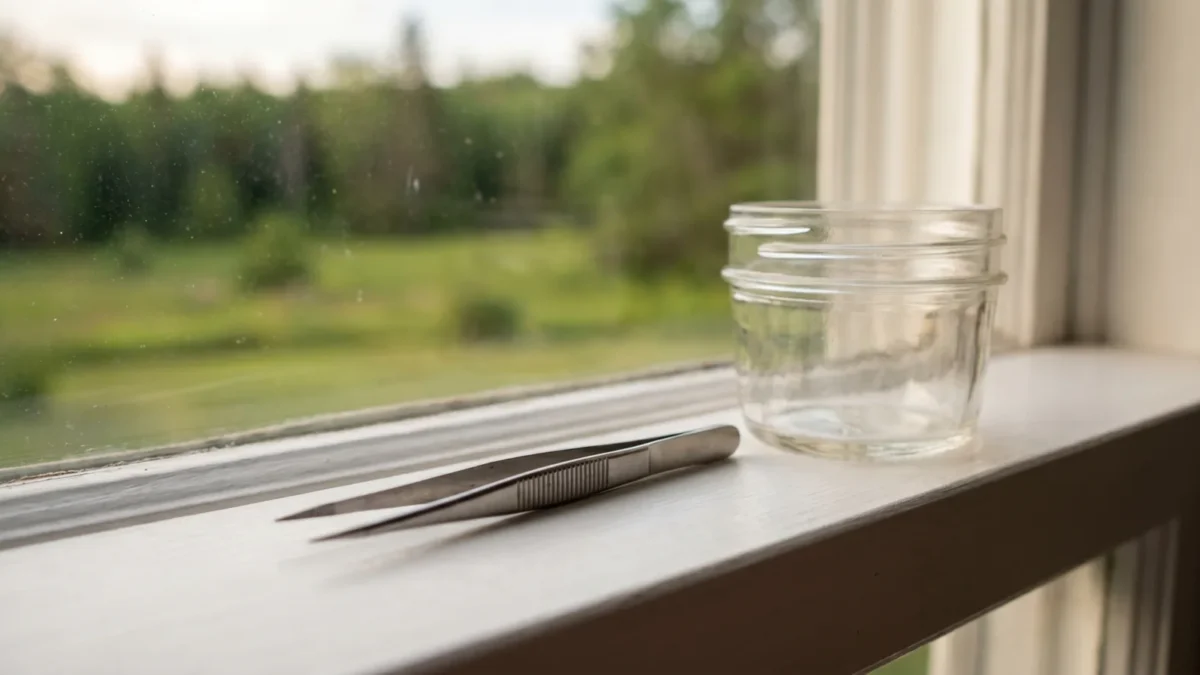
Fine-tipped tweezers are the key detail. The blunt drugstore kind meant for eyebrows can squeeze the tick’s body, which is exactly what you want to avoid.
If you’d rather use a tick spoon
Plenty of Mainers keep a plastic tick removal spoon clipped to a pack or a dog leash, and the Tick Lab describes how to use one. The motion is different from tweezers, so it helps to know it before you are crouched over a squirming kid or a wriggling spaniel.
Set the notch of the spoon on the skin near the tick. Press down lightly on the skin and slide the spoon forward until the notch frames the tick, then keep sliding to ease it off. The thing not to do here is pry, lever, or lift the spoon up like you are popping a bottle cap. Forward and flat, not up.
What not to do, and why the old tricks die hard
Ask around at a Maine campground and someone will still swear by the lit match, or a glob of petroleum jelly, or a coat of nail polish to “smother” the tick into backing out. Both the Tick Lab and the CDC are blunt about this. Skip all of it.
These folk remedies do not work, and they may make things worse. The idea behind smothering or burning is to make the tick detach on its own. Instead, agitating a feeding tick can prompt it to release more of its fluids into the bite, which is the opposite of what you want when those fluids may carry a pathogen. The boring tweezer pull beats every clever shortcut.
If the mouthparts break off
It happens, even when you do everything right. You get the body out and a tiny dark fleck stays behind in the skin. Try not to panic, and do not start digging.
The CDC’s guidance is reassuring here. If the mouthparts stay in, your body will usually push them out on its own as the skin heals, the same way it handles a splinter. You can make one gentle attempt with clean tweezers. If the fragment does not come away easily, leave it alone and let your skin do the work.
After the tick is out
Clean up next. The Tick Lab recommends washing the bite area, your hands, and your tools with rubbing alcohol, an iodine scrub, or plain soap and water. The CDC lists the same options and adds hand sanitizer in a pinch.
Then deal with the tick itself, and resist the urge to crush it between your fingers. Seal it in a small container or zip bag, wrap it tightly in tape, flush it, or drop it in alcohol. Or hang onto it. A live or intact tick can be saved for identification, which brings us to the last question people always ask.
Should you save it, and should you have it tested?
Saving the tick is genuinely useful. Knowing whether it was a deer tick, a dog tick, or a lone star tick, and roughly how long it had been feeding, gives a clinician helpful context. The UMaine Tick Lab will identify the species, and it can test the tick for the pathogens it was carrying.
Here is the careful part. The CDC does not recommend leaning on a commercial tick-test result to decide your own treatment. A few reasons: the labs that test ticks are not held to the same quality standards as clinical labs, a positive result on the tick does not prove the bacteria made it into you, and a negative result can lull you into a false sense of safety. Most important, a person who feels sick should never wait on a tick’s lab results before seeing a doctor. Think of tick testing as information and surveillance, the kind of data that helps researchers track what is spreading where, not as a verdict on your health. Our guide to sending a tick to the UMaine and UNH labs walks through the mailing process and the fees.
What to watch for in the following weeks
Mark your calendar mentally, or actually. The CDC advises watching for a rash or a fever in the several weeks after a bite, and seeing a doctor if either shows up. When you go, tell them about the bite, roughly when it happened, and where on your body the tick likely latched on. That timeline helps more than people expect.
The rash gets the most attention, and for good reason, though it does not always look like the textbook target. If you want to know what you are actually looking for, our piece on identifying the early Lyme rash covers the classic bull’s-eye and the many versions that are easy to miss.
None of this should keep you out of the woods. Griffin Dill at the UMaine Extension has noted that the lab now receives ticks in all twelve months of the year, because our milder winters keep deer ticks active any time the temperature climbs above freezing. Ticks are part of the landscape in Maine and New Hampshire now, year-round. The answer is not to stay inside. It is to check yourself after you come in, and to know exactly what to do when you find one.
Sources
- University of Maine Cooperative Extension. Tick Removal – Cooperative Extension: Tick Lab. 2025. https://extension.umaine.edu/ticks/removal/
- U.S. Centers for Disease Control and Prevention. What to Do After a Tick Bite. 2024. https://www.cdc.gov/ticks/after-a-tick-bite/index.html
- U.S. Centers for Disease Control and Prevention. How Lyme Disease Spreads. 2024. https://www.cdc.gov/lyme/causes/index.html
- Cook, Michael J. Lyme borreliosis: a review of data on transmission time after tick attachment. International Journal of General Medicine (PMC / NIH). 2014. https://pmc.ncbi.nlm.nih.gov/articles/PMC4278789/
- Maine Public (citing Maine CDC and UMaine Cooperative Extension). Maine reported record-high number of tickborne disease cases last year. 2025. https://www.mainepublic.org/health/2025-01-03/maine-reported-record-high-number-of-tickborne-disease-cases-last-year
This article is for informational purposes only and does not constitute medical advice. Consult a qualified healthcare provider before making any health decisions.