Home Air Quality Monitors: Do They Actually Help?
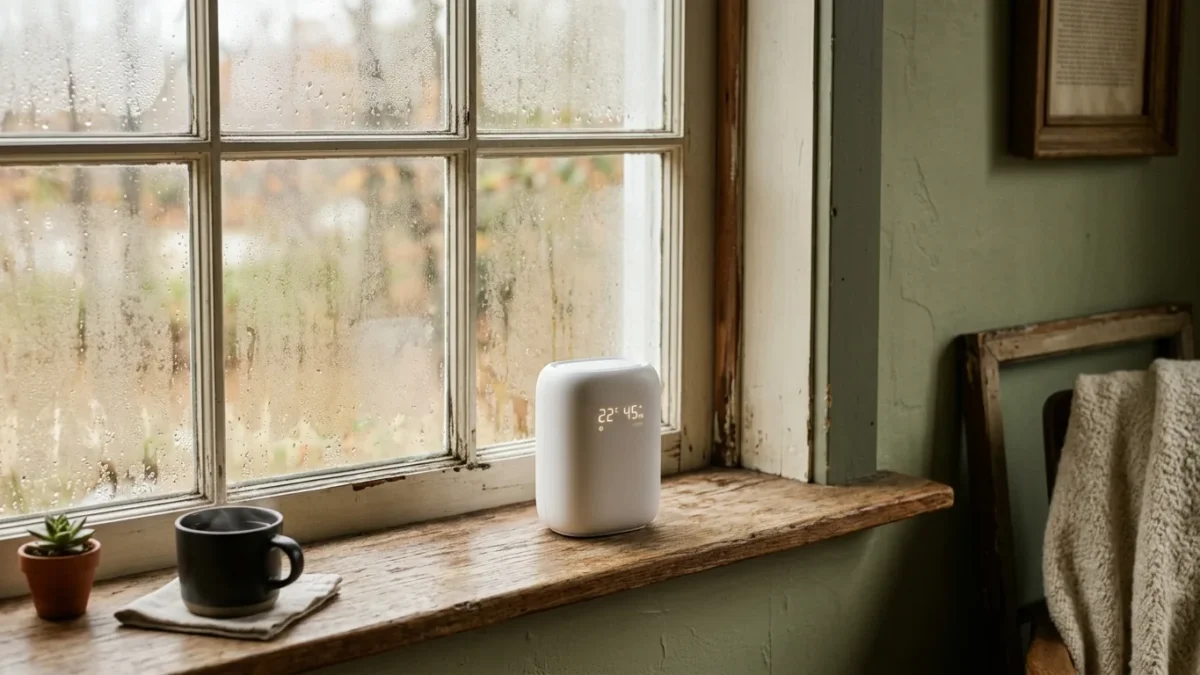
Maine homes are built tight against the cold. Modern insulation and weatherproofing keep heating costs down, but they also trap indoor air pollutants: volatile organic compounds from cleaning products and building materials, CO2 from breathing and gas appliances, and fine particulates from wood stoves and cooking. Home air quality monitors promise to make this visible. We tested three over a full heating season to see if they delivered.
What We Tested
We ran the Airthings Wave Plus, the Awair Element, and the IQAir AirVisual Pro in a 1,600-square-foot home in South Portland from October 2025 through March 2026. All three tracked PM2.5, CO2, temperature, and humidity. The Airthings also measured radon and VOCs. The IQAir pulled outdoor air quality data for comparison, which turned out to be useful context during high-wind days when indoor and outdoor numbers nearly matched.
What the Data Showed
CO2 levels in the bedroom regularly climbed past 1,500 ppm overnight with the door closed. That’s well above the 1,000 ppm level linked to measurable drops in cognitive function in published research (Allen et al., 2016, Environmental Health Perspectives). Opening a window two inches for 15 minutes before bed brought levels below 800 ppm for the first three hours of sleep — a simple adjustment that pairs well with the other sleep hygiene strategies for Maine winters covered elsewhere on this site.
PM2.5 spiked during stovetop cooking, sometimes reaching 50 to 80 micrograms per cubic meter. The World Health Organization’s 2021 air quality guidelines set a 24-hour average target of 15 micrograms per cubic meter. Running the range hood during cooking and for 10 minutes after brought levels back to baseline within 20 minutes. Without the monitor, it wouldn’t have been obvious that the post-cooking runtime mattered as much as running it during.
Radon numbers stayed below 4 picocuries per liter, which is the U.S. Environmental Protection Agency’s action level for residential spaces. That was reassuring given Maine’s geology: the state has some of the highest residential radon levels in the country, according to the Maine Bureau of Health.
Limitations Worth Knowing
Consumer-grade monitors vary in accuracy, especially for PM2.5. None of these devices are laboratory instruments. They’re best understood as relative indicators, useful for spotting patterns and behavior changes, not for precise regulatory-level measurements. The same caveat applies to other popular home health devices: our look at wearable sleep tracker accuracy found similar gaps between consumer readings and clinical-grade data. Placement matters too. A monitor near the stove reads differently than one in the center of the room, and neither tells you much about a closed bedroom at the other end of the house.
Are They Worth Buying?
That depends on whether you’ll actually change anything based on what you see. The monitor itself does nothing to the air. It identifies patterns that ventilation, filtration, and habit changes can address. For homes with wood stoves, gas cooking, older construction, or limited fresh-air exchange, the data tends to be actionable. For well-ventilated homes without combustion sources, there’s less to act on.
Of the three units, the Airthings Wave Plus stood out for covering the widest range of pollutants, including radon, which is a real concern in Maine and New Hampshire. The IQAir’s outdoor comparison feature was more useful than expected during winter, when people tend to assume outdoor air is cleaner. Sometimes it was. Sometimes it wasn’t. If you’re evaluating other consumer health monitors with a similar “does it actually change behavior?” lens, our blue light glasses research review applies the same framework to a category with equally mixed evidence.
Sources
- Allen JG, et al. Associations of Cognitive Function Scores with Carbon Dioxide, Ventilation, and VOC Exposures. Environmental Health Perspectives. 2016;124(6):805-812.
- World Health Organization. WHO Global Air Quality Guidelines: Particulate Matter (PM2.5 and PM10), Ozone, Nitrogen Dioxide, Sulfur Dioxide and Carbon Monoxide. Geneva: World Health Organization; 2021.
- U.S. Environmental Protection Agency. A Citizen’s Guide to Radon: The Guide to Protecting Yourself and Your Family from Radon.
- Maine Bureau of Health. Radon in Maine Homes. Maine Center for Disease Control and Prevention.
This article is for informational purposes only and does not constitute medical advice. Consult a qualified healthcare provider before making any health decisions.