Maine Has the Oldest Population in the Country, and Winter Falls Are a Public Health Problem
The most widely used fall prevention course in the country was assembled in Maine, and that is not a coincidence. In 2003, MaineHealth’s Partnership for Healthy Aging, the Southern Maine Agency on Aging, the geriatric medicine team at Maine Medical Center and the University of Southern Maine rebuilt an existing Boston University curriculum so that trained volunteers, not clinicians, could teach it. That version, called A Matter of Balance, is now offered by 595 organizations across 47 states, according to MaineHealth. Maine wrote the playbook because Maine reached the problem first.
It is still reaching it. The state’s population is older than any other, winter runs long, and the numbers underneath both facts deserve a closer look than they usually get.
The oldest state, and the arithmetic underneath it
Maine’s median age remains the highest in the nation, and in 2022 Maine had the largest percentage of its population aged 65 and older of any state, according to the Maine Population Outlook prepared by the Office of the State Economist and published in April 2025.
The projection in that same report is where it gets interesting. Between 2022 and 2032, Maine’s population aged 65 and older is expected to grow 35.6 percent, from 310,885 people to 421,663. Over the same decade the prime working-age population, ages 20 through 64, is projected to shrink by 4.6 percent. More older residents, and fewer working-age neighbors and family members nearby to help them shovel a walk.
Break the older group into bands and the picture sharpens. In 2022, 13.4 percent of Maine’s population was aged 65 to 74, another 6.8 percent was 75 to 84, and 2.4 percent was 85 or older, per the Maine CDC’s health equity profile of older adults. That last slice looks small. Hold onto it.
What Maine’s own health data actually shows
The Maine Shared Community Health Needs Assessment tracks fall outcomes by age band, and the gradient is steep.
In 2022, Maine’s unintentional fall-related death rate was 20.0 per 100,000 among adults 65 to 74. Among adults 75 to 84 it was 96.2. Among adults 85 and older it was 572.5. The statewide rate across all ages was 16.2 per 100,000. The oldest Mainers died from falls at roughly 35 times the rate of the state as a whole.
Emergency department visits follow the same curve. In 2021 the fall-related injury ED rate was 357.1 per 10,000 among adults 65 to 74, 765.8 among adults 75 to 84, and 1,716.8 among adults 85 and older, against a statewide all-ages rate of 261.0.
Two cautions about those figures, because they get misused. They are annual totals. Maine CDC does not publish a seasonal split, so none of these numbers can be attributed to ice, snow, or any particular month. They are also age-specific rates, which means lining them up against national age-adjusted figures produces nonsense.
Now the part that surprises people. Maine is not the worst state for falls. In 2023, 31.3 percent of Maine adults 65 and older reported falling in the previous 12 months, which ranked the state 38th, according to America’s Health Rankings using CDC survey data. New Hampshire came in at 27.4 percent, ranking 18th. Maine is worse than average on a per-person basis, but the demographic story isn’t that Mainers fall at unusual rates. It’s that Maine has an unusually large share of residents sitting in the age bands where a fall does the most damage.
One more piece of local context worth knowing: 49.2 percent of Maine adults aged 65 to 74 and 53.1 percent of those 75 and older reported arthritis in 2021, compared with 31.1 percent of Maine adults overall. Joint pain shapes how confidently a person crosses a parking lot in February.
The national backdrop, and a trend line moving the wrong way
Falls are the leading cause of injury death for adults 65 and older nationally. The US CDC counted more than 38,000 such deaths in 2021 and nearly 3 million emergency department visits for older adult falls that year.
More than one out of four people aged 65 and older falls annually. About 1 million older adults are hospitalized for a fall each year, and nearly 319,000 are hospitalized specifically for hip fractures. One in 10 falls produces an injury serious enough that the person restricts their activities for a day or more, which is its own slow problem. Less walking means less strength, and less strength raises the odds of the next fall.
The direction of travel isn’t encouraging either. The age-adjusted fall death rate among older adults rose 21 percent between 2018 and 2024, from 64.7 per 100,000 to 78.4. That is a national figure covering all adults 65 and up, and it is not comparable to Maine’s age-specific band rates above.
Where winter actually enters the picture
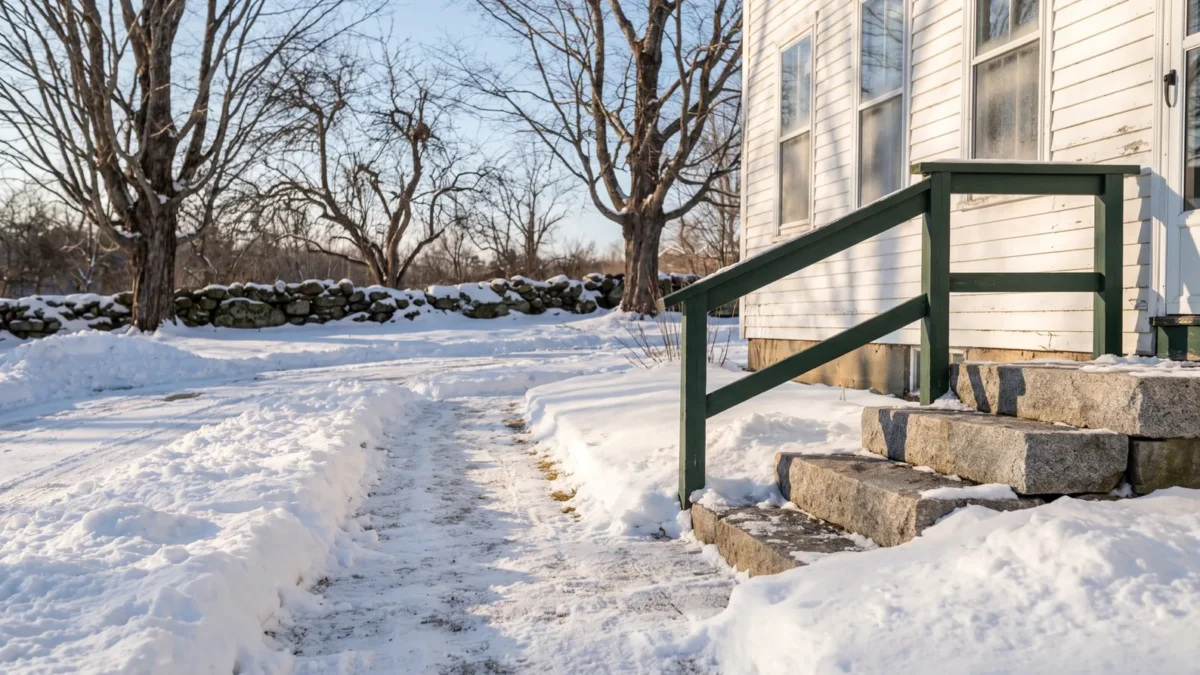
Maine winters are long and genuinely cold. NOAA’s state climate summary puts average winter temperatures between 25F in the far south and under 15F in the northern and interior parts of the state, with accumulated snowfall of 40 to 80 inches across the Southern Interior and Northern Interior climate divisions and up to 100 inches at the northern tip.
Research on what ice does to bodies isn’t Maine-specific, but it is consistent. A study published in BMJ Open in 2016 found that during snow-and-ice conditions, the overall risk of turning up at hospital with a fracture was 2.20 times the risk during control conditions (95 percent CI 1.7 to 3.0). Arm fractures ran at a relative risk of 3.2, and forearm and wrist fractures at 2.9. That pattern is the signature of the hand-out-first landing, the reflex nobody manages to suppress on a slick step.
There is also a randomized trial worth knowing about. In 2005, researchers followed 109 fall-prone older adults, mean age 74.2, who kept walking outdoors through a northern winter. Over the study the group logged 714 outdoor slips and 62 outdoor falls. Participants assigned a simple gait-stabilizing device worn on the shoe had fewer outdoor falls (relative risk 0.42) and considerably fewer injurious falls per day walked on snow and ice (relative risk 0.13). It’s one modest trial, published in the Journal of the American Geriatrics Society, and it deserves neither dismissal nor overselling.
What about the future? NOAA notes that winter warming in Maine since the mid-1990s has run at roughly twice the rate of summer warming, and projects winter precipitation to increase by more than 15 percent for most of the state by mid-century. Warmer and wetter winters sound like they ought to mean more ice underfoot, but that’s an inference, not a finding. NOAA’s summary documents temperature and precipitation. It does not track how often freezing rain falls or how many freeze-thaw cycles a Maine dooryard goes through in a season. Anyone telling you Maine ice days are measurably increasing has gone past the published record. For the wider picture of how this region’s conditions shape health, see our guide to environmental health in Maine and New Hampshire, and if you keep hiking through the cold months, our notes on winter trail etiquette and footing cover the practical side.
What the evidence supports, and what it quietly rules out
The strongest body of evidence here is a 2019 Cochrane review covering 81 trials and 19,684 older people living in the community. Exercise reduced the rate of falls by 23 percent (rate ratio 0.77, 95 percent CI 0.71 to 0.83), drawn from 59 studies and 12,981 participants and rated high-certainty evidence. The reviewers translate that into 195 fewer falls per 1,000 people over one year. Exercise also reduced the number of people experiencing at least one fall by 15 percent (risk ratio 0.85, 63 studies, 13,518 participants).
Not all exercise performed the same, though, and the differences matter. Balance and functional training cut fall rates by 24 percent (rate ratio 0.76, 39 studies, high certainty). Programs combining several exercise types did better still, at 34 percent (rate ratio 0.66, 11 studies, moderate certainty). Tai Chi came in at a rate ratio of 0.81 with low-certainty evidence from 7 studies. For resistance training on its own, plus dance and walking, the effect on fall rates remained uncertain.
The US Preventive Services Task Force reached a compatible conclusion in 2024, recommending exercise interventions for community-dwelling adults 65 and older who are at increased risk of falling. That is a B recommendation, with moderate certainty of moderate net benefit. Multifactorial interventions, the bundled approaches that change several things at once, received only a C, meaning the Task Force wants clinicians to individualize the decision rather than apply it across the board.
And one popular idea got ruled out. The Task Force recommends against vitamin D supplementation to prevent falls in community-dwelling adults 65 and older, a D recommendation, having found adequate evidence of no benefit. That is a strong verdict from a cautious body, and it applies to a supplement plenty of northern New Englanders already keep on the counter for other reasons. We went through the underlying trials in our look at vitamin D and bone health past 50.
None of the above is a routine to copy. These trials tested structured, often supervised programs across whole populations, and a research finding doesn’t convert into a schedule for any individual reader. What kind of movement is safe and useful for a particular person, at a particular age, with particular joints, is a conversation for a provider.
The program Maine sent to 47 states
Which brings the story back where it started. The original A Matter of Balance came out of the Roybal Center for Enhancement of Late-Life Function at Boston University, funded by the National Institute on Aging. The Maine collaboration in 2003, backed by the Administration on Aging, changed who could deliver it. Instead of requiring health professionals, the redesigned model trains volunteer coaches, which is what made the program cheap enough to reach small towns.
The National Council on Aging describes the course as eight two-hour sessions for groups of 8 to 12 people, led by two trained coaches, mixing discussion, problem-solving, role-play and exercise. Its focus is as much psychological as physical, because fear of falling is itself a risk factor. People who worry about falling move less, and moving less makes them less steady.
Honesty requires a caveat. The peer-reviewed evaluations of the lay-leader model that we could locate were conducted in Florida, not in Maine. Maine’s contribution is the delivery model and its reach, not a published Maine outcome study.
Still, the shape of the thing is unusual and worth noticing. A state that hit a demographic wall earlier and harder than anywhere else built a practical answer, gave it away, and watched 46 other states pick it up. With Maine’s 65-and-older population set to grow by more than a third in the next decade, the state will be testing that answer at home for a long while yet.
Sources
- Office of the State Economist, Maine Department of Administrative and Financial Services. Maine Population Outlook 2022 to 2032. April 2025. https://www.maine.gov/dafs/economist/sites/maine.gov.dafs.economist/files/inline-files/Maine%20Population%20Outlook%20to%202032.pdf
- Maine CDC. Maine Shared Community Health Needs Assessment, Health Equity Data Profile: Older Adults. March 2025. https://www.maine.gov/dhhs/mecdc/sites/maine.gov.dhhs.mecdc/files/MeSCHNA%20Health%20Equity%20Profile%20Older%20Adults%20Final%203.21.25.pdf
- America’s Health Rankings. Falls measure, adults age 65 and older, from CDC Behavioral Risk Factor Surveillance System 2023. https://www.americashealthrankings.org/explore/measures/falls_sr/ME
- US Centers for Disease Control and Prevention. About Older Adult Falls. https://www.cdc.gov/falls/about/index.html
- US Centers for Disease Control and Prevention. Older Adult Falls Data. https://www.cdc.gov/falls/data-research/index.html
- US Centers for Disease Control and Prevention. Older Adult Falls: Facts and Statistics. https://www.cdc.gov/falls/data-research/facts-stats/index.html
- NOAA National Centers for Environmental Information. State Climate Summaries: Maine. https://statesummaries.ncics.org/chapter/me/
- BMJ Open. Epidemic of fractures during a period of snow and ice: has anything changed 33 years on? 2016. https://pubmed.ncbi.nlm.nih.gov/27630066/
- McKiernan FE. A simple gait-stabilizing device reduces outdoor falls and nonserious injurious falls in fall-prone older people during the winter. Journal of the American Geriatrics Society. 2005. https://pubmed.ncbi.nlm.nih.gov/15935015/
- Sherrington C, Fairhall NJ, Wallbank GK, et al. Exercise for preventing falls in older people living in the community. Cochrane Database of Systematic Reviews. 2019. https://pubmed.ncbi.nlm.nih.gov/30703272/
- US Preventive Services Task Force. Interventions to Prevent Falls in Community-Dwelling Older Adults: Recommendation Statement. JAMA. 2024. https://pubmed.ncbi.nlm.nih.gov/38833246/
- US Preventive Services Task Force. Interventions to Prevent Falls in Community-Dwelling Older Adults: Recommendation Statement. JAMA. 2018. https://pubmed.ncbi.nlm.nih.gov/29710141/
- MaineHealth. A Matter of Balance. https://mainehealth.org/healthy-communities/prevention-and-wellness/fall-prevention-matter-balance
- National Council on Aging. Evidence-Based Program: A Matter of Balance. https://www.ncoa.org/article/evidence-based-program-a-matter-of-balance/
This article is for informational purposes only and does not constitute medical advice. Consult a qualified healthcare provider before making any health decisions.