Environmental Health in Maine and New Hampshire: A Practical Guide
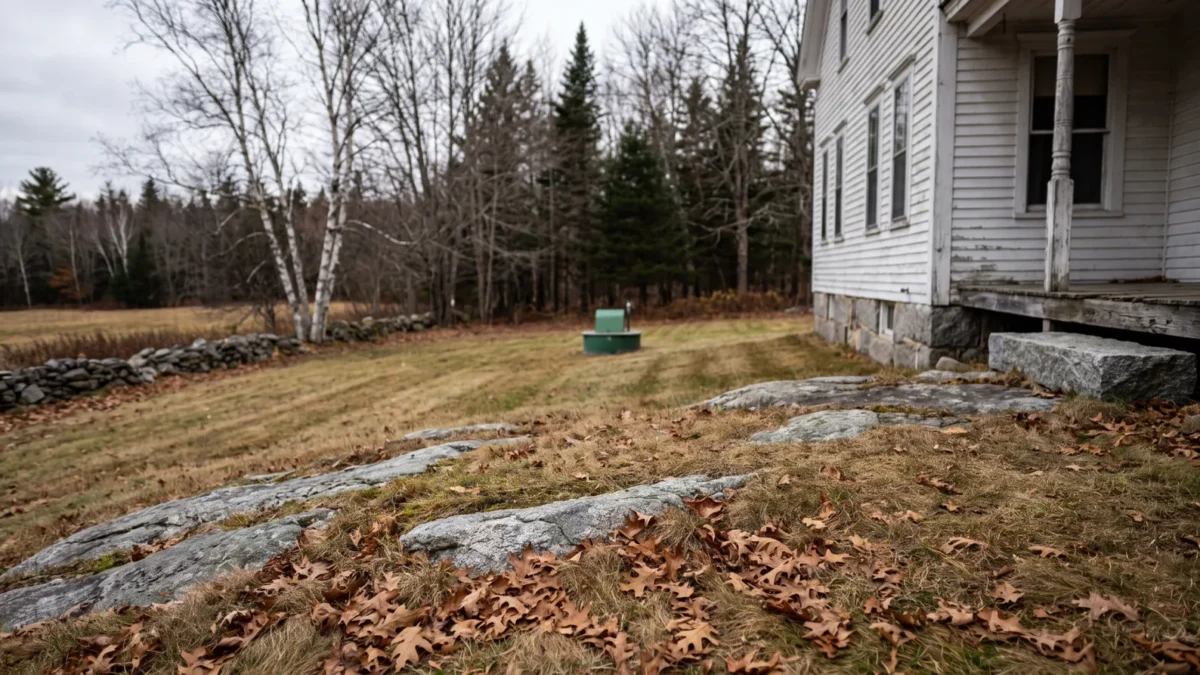
In most of the country, a water well taps an aquifer, meaning sand, gravel or porous rock that holds water in the spaces between the grains. In Maine, drilling a well usually means hunting for a crack. Maine CDC describes the state’s bedrock as predominantly crystalline, either igneous or metamorphic, and neither kind has pore spaces able to transmit water, so the driller’s job is to find a fracture large enough to be worth tapping. The result is the standard Maine bedrock well: six inches in diameter, 100 to 500 feet deep or deeper, yielding less than 10 gallons a minute. About half of Maine homeowners drink from one. In New Hampshire, close to half of residents do too. Nationally, the figure is around 15 percent.
Nobody inspects that water but the person who owns it. The EPA is direct about this. Private domestic wells are not regulated under the Safe Drinking Water Act, and they are not regulated by most state governments either, which leaves quality and safety to the well owner. That is the arrangement for more than 43 million people nationally, and for roughly half the households in this region.
Which is why environmental health in Maine and New Hampshire looks different from the national version of the subject. The questions that come up most often here are about what the rock under the house is made of, what the water carries up out of it, and what season it is.
The rock decides which problem you get
Two well types are common in the region. Bedrock wells, drilled into fractured rock, are by far the most common source of drinking water for Maine homes. Overburden wells are shallower and pull from the sand and gravel deposits left by the last period of extensive glaciation, 12,000 to 18,000 years ago. Maine CDC notes that those glacial deposits act as natural filters, which is a real advantage of the shallower option.
Depth is a trade, though. NHDES puts it plainly for New Hampshire: dug wells are less likely to have problems with minerals such as arsenic and radon, and more likely to have trouble with bacteria, low pH, road salt and nitrate. Go deeper into rock and you leave a lot of surface contamination behind. You also start drinking whatever that rock has been dissolving into groundwater for a very long time.
What the rock holds varies, and the distinction gets muddled constantly. New Hampshire’s nickname invites people to blame granite for everything in the water. The connection NH DHHS actually draws is between granite, the small amounts of uranium in it and in the state’s soil, and the radon gas that uranium forms as it breaks down. Arsenic is a different rock story. A 2024 study in Environmental Health Perspectives, run by researchers at MDI Biological Laboratory and Dartmouth working with Maine CDC, attributes well water arsenic in Maine and New Hampshire primarily to metasedimentary bedrock that leaches arsenic into groundwater, with a second path through soils contaminated by the historical use of arsenical pesticides.
Same fractured plumbing. Different cargo.
Arsenic, and the line New Hampshire drew
Arsenic has no smell and no taste, which means testing is the only way anyone finds out. It enters drinking water from natural deposits in the earth, and also from agricultural and industrial practices. Maine CDC estimates that 1 in 10 wells in Maine has too much of it. The federal Maximum Contaminant Level, which governs public water systems, sits at 10 parts per billion.
New Hampshire decided that number was too generous. On July 1, 2021, the state’s own limit of 5 parts per billion took effect for public water systems, making New Hampshire the second state after New Jersey to adopt an arsenic standard more protective than the federal one. NHDES also adopted 5 ppb as an enforceable Ambient Groundwater Quality Standard. The agency’s reasoning was arithmetic more than philosophy. Over a third of the state’s public water systems have arsenic in their untreated water, an estimated 25 to 30 percent of private residential wells test at 5 ppb or higher, and NHDES puts the number of private well users drinking water above 5 ppb at roughly 116,000 people. The agency also notes that New Hampshire ranks first in the nation for bladder cancer incidence.
Neither state’s number reaches into a private well. Maine’s arsenic figure of 10 micrograms per liter is a Maximum Exposure Guideline set by the state’s Environmental Health Program, a benchmark for interpreting a result rather than a rule anyone enforces on a homeowner. New Hampshire’s 5 ppb is enforceable in public systems and as a groundwater standard. Private wells in both states remain unregulated.
What gives those numbers weight is that some of the research is local. A cross-sectional study of 272 children in grades 3 through 5 across three Maine school districts, published in the journal Environmental Health in 2014, found that exposure to well water arsenic at 5 micrograms per liter or above was associated with Full Scale IQ scores roughly 5 to 6 points lower than in children whose well water tested below that level, after adjusting for maternal IQ and education, the home environment, school district and number of siblings. One study is not the last word on anything. It is also the kind of finding that makes a water test look like an easy call.
Students have been filling in the data gap themselves. In the All About Arsenic project, described in that 2024 Environmental Health Perspectives paper, school groups collected 3,070 drinking water samples for metals testing and 752 of them came back above New Hampshire’s 5 ppb standard. The project more than doubled the well water quality information available to public health agencies in multiple municipalities across the two states. We go further into what a homeowner does with a result in our closer look at arsenic in Maine and New Hampshire wells.
Radon shows up twice
Radon is the same uranium decay product whether it reaches you through the basement floor or the kitchen faucet, and in this region it does both.
Start with the air. Maine CDC reports that 1 out of every 3 homes in Maine tests high for radon, and that the state average is 5.9 pCi/L. Radon is the second leading cause of lung cancer in the United States, associated with an estimated 21,000 lung cancer deaths a year. The agency also makes a point worth repeating to anyone who assumes their house is exempt: any building can have radon, old or new, well sealed or drafty, with a basement or without one.
Maine advises taking action to reduce indoor radon at 4 pCi/L, and considering it at levels between 2 and 4. For water, the state’s current advisory level is 4,000 pCi/L, and as a result climbs toward 10,000 pCi/L, Maine CDC says homeowners should more strongly consider installing treatment. Advisory is the operative word in that sentence. These are state guidance levels for private water, not federal limits.
Maine also regulates who does the work. Under state law, only the owner or occupant of a residence, or someone registered with the state, may test for radon or install a mitigation system. If the house is on the market, the testing and the mitigation both have to be done by a registered radon service provider.
New Hampshire runs in the same direction. NHDES estimates that about half of the state’s bedrock wells have radon at levels of concern. NH DHHS lays out the pathway for private well households, which is that radon can come in through the foundation or out of sinks, showers and toilets, and the state’s Radon Program provides free radon test kits to New Hampshire residents. Testing the air and testing the water are separate tests answering separate questions, and our guide to radon testing in Maine homes walks through what each one involves. Heating season brings its own set of indoor air topics, which we take up in a separate piece on carbon monoxide and wood smoke.
A testing schedule a household can actually keep
Maine CDC’s guidance for private well owners splits into two rhythms. Every year: coliform bacteria, E. coli, and nitrate and nitrite. Every 3 to 5 years: the longer panel, covering arsenic, chloride, copper, fluoride, hardness, iron, lead, magnesium, manganese, pH, radon, sodium and uranium.
Then there are the moments that do not follow a calendar. Maine CDC lists them out. If you are expecting a baby. If the water changes in smell, taste or color. If the well runs dry and then comes back. When you buy a home. And after any work on the well or the treatment system, which is the one that catches people, because a repair can change the water.
Results arrive as bare numbers, which is where the state’s Maximum Exposure Guidelines earn their keep. Maine CDC’s Environmental Health Program sets them at 10 micrograms per liter for arsenic, 30 for uranium, 0.3 milligrams per liter for manganese, 10 mg/L for nitrate, 1 mg/L for nitrite, 250 mg/L for chloride and 2 mg/L for fluoride. The Maine Tracking Network also summarizes thousands of private well samples analyzed at the Maine Health and Environmental Testing Laboratory, broken out by town and by county, so a homeowner can see what water in the area has looked like. Maine CDC provides free technical assistance to private well owners at 866-292-3474, toll free in Maine, or at 207-287-4311. NHDES recommends that private well users test regularly and install treatment if it is needed.
PFAS is the newer question
In June 2021 the Maine Legislature enacted a law setting a state drinking water standard of 20 nanograms per liter, which is 20 parts per trillion, for the combined total of six PFAS compounds in public water supplies: PFOA, PFOS, PFHpA, PFNA, PFDA and PFHxS.
Private wells are the harder case. Maine CDC notes that PFAS testing for a private well is expensive and offered by only a few laboratories, and its advice is to contact a state toxicologist to talk through whether testing makes sense for a given property rather than ordering a test by default. History matters more than curiosity here, and the state is the one holding the history. On treatment, Maine CDC points to filters certified to NSF/ANSI 53, the carbon standard, or NSF/ANSI 58, the reverse osmosis standard, as able to reduce PFAS concentrations. Those are certification categories rather than product recommendations, and which one fits depends on what the water actually contains. We cover the state program and what it has turned up in our piece on PFAS in Maine drinking water.
What does not come from the well
Mercury arrives by air and ends up in fish. Because it settles out of the atmosphere into Maine waters and builds up in fish over time, Maine CDC issues safe eating guidelines for the state’s inland waters. Pregnant and nursing women, women who may become pregnant, and children under age 8 are advised to eat no freshwater fish caught in Maine, with a single exception: brook trout and landlocked salmon, limited to one meal a month. All other adults and children older than 8 can eat two freshwater fish meals a month, plus one meal a week of brook trout or landlocked salmon. The logic underneath the advice is that fish which eat other fish, such as pickerel and bass, carry the highest mercury levels, and older fish carry more than younger ones. Our guide to reading Maine’s mercury advisory works through how it applies from one species and one pond to the next.
Lead is a housing question rather than a geological one. Maine CDC states that dust from lead paint in older homes and apartments is almost always the cause of lead poisoning in Maine. The state requires that every child be tested for lead at ages 1 and 2 by their provider, and since October 1, 2022, providers must confirm any capillary blood lead level of 3.5 micrograms per deciliter or higher with a venous sample. Maine CDC offers free home lead dust test kits to families with young children or a baby on the way.
Where a household actually starts
None of this needs a project plan. It needs a few tests, spaced out, and some idea of what the numbers mean when they come back.
On a private well with no recent test, the annual bacteria and nitrate panel is the obvious starting point, and Maine’s free technical assistance line exists for exactly the question of what to test for and how to read the result. For indoor air, New Hampshire residents can request a free kit from the state Radon Program, and Maine’s action level of 4 pCi/L gives a clear line to compare a result against. With a young child in an older house, Maine’s free lead dust kits and the required blood testing at ages 1 and 2 cover the exposure route the state has identified as the main one.
The through line is that here the rock and the water and the house all belong to one system, and the state agencies have already done most of the work of telling residents where to look. The part they cannot do happens at the kitchen sink: filling the bottle, mailing it off, and reading what comes back.
Sources
- U.S. Environmental Protection Agency. Private Drinking Water Wells. https://www.epa.gov/privatewells
- Maine Center for Disease Control and Prevention, Drinking Water Program. Hydrogeology and Wells. https://www.maine.gov/dhhs/mecdc/healthy-living/health-and-safety/drinking-water-safety/private-wells/hydrogeology-and-wells
- New Hampshire Department of Environmental Services. Private Wells. https://www.des.nh.gov/water/drinking-water/private-wells
- New Hampshire Department of Environmental Services. Drinking Water. https://www.des.nh.gov/water/drinking-water
- Maine Center for Disease Control and Prevention. Arsenic in Drinking Water. https://www.maine.gov/dhhs/mecdc/healthy-living/health-and-safety/drinking-water-safety/public-water-systems/information-for-consumers/drinking-water-contaminants/arsenic-in-drinking-water
- New Hampshire Department of Environmental Services. More Protective Arsenic Standard Will Reduce Risk for Many. March 8, 2021. https://www.des.nh.gov/news-and-media/blog/more-protective-arsenic-standard-will-reduce-risk-many
- Maine Center for Disease Control and Prevention. Private Well Water. https://www.maine.gov/dhhs/mecdc/healthy-living/health-and-safety/drinking-water-safety/private-well-water
- Maine Tracking Network (Maine CDC). Private Well Water. https://data.mainepublichealth.gov/tracking/private-wells
- Maine Center for Disease Control and Prevention. Radon In Maine (fact sheet). https://www.maine.gov/dhhs/mecdc/sites/maine.gov.dhhs.mecdc/files/Radon%20In%20Maine.pdf
- Maine Center for Disease Control and Prevention, Radiation Control Program. Radon. https://www.maine.gov/dhhs/mecdc/healthy-living/health-and-safety/indoor-safety/radon
- New Hampshire Department of Health and Human Services. Radon. https://www.dhhs.nh.gov/programs-services/environmental-health-and-you/radon
- Taylor A, et al. Environmental Health Perspectives 132(8):87006. August 2024. DOI 10.1289/EHP13421. https://pmc.ncbi.nlm.nih.gov/articles/PMC11338042/
- Wasserman GA, et al. A cross-sectional study of well water arsenic and child IQ in Maine schoolchildren. Environmental Health 13:23. April 1, 2014. https://ehjournal.biomedcentral.com/articles/10.1186/1476-069X-13-23
- Maine Center for Disease Control and Prevention. PFAS and Well Water. https://www.maine.gov/dhhs/mecdc/healthy-living/health-and-safety/pfas-in-maine/pfas-and-well-water
- Maine Center for Disease Control and Prevention. Fish and Seafood (Safe Eating Guidelines). https://www.maine.gov/dhhs/mecdc/healthy-living/health-and-safety/food-safety/fish-and-seafood
- Maine Center for Disease Control and Prevention. Childhood Lead Poisoning Prevention. https://www.maine.gov/dhhs/mecdc/healthy-living/health-and-safety/lead-poisoning-prevention
This article is for informational purposes only and does not constitute medical advice. Consult a qualified healthcare provider before making any health decisions.