Radon Mitigation Cost in Maine: How a System Works and Who Can Install One
A Maine homeowner whose test comes back near the state average of 5.9 picocuries per liter, the number Maine CDC publishes alongside its finding that 1 out of every 3 Maine homes has a high radon level, usually goes looking for a price next. There is no published radon mitigation cost to find. EPA’s consumer guide to fixing a home gives no dollar figures at all, and that is deliberate. It says only that most homes can be fixed for about the same cost as other common home repairs, that costs may vary depending on the size and design of your home and which radon reduction methods are needed, and that you should get an estimate from one or more qualified contractors. The closest thing to an official number sits in EPA’s October 2025 benefit-cost analysis, which models the installation of an active soil depressurization system at $1,826 in 2023 dollars, plus about $206 a year to operate and $476 to replace the fan roughly every decade. In Maine, the more answerable question is who is allowed to do the work. Under the state’s Radon Registration Act, no one may offer advice or plans on reducing radon, or contract to modify a building to reduce it, unless they are registered with the state, and a mitigation company’s initial registration costs $75.
What an active system actually does
Radon comes from the breakdown of uranium in rocks and soil, and Maine CDC is blunt that any building can have it, whether old or new, well-sealed or drafty, with or without a basement. It’s one of a handful of exposures that come with the ground and water under a house here, and we’ve mapped the wider set in our guide to environmental health in Maine and New Hampshire. The gas works up through the soil and into the building. So the standard fix doesn’t filter indoor air. It changes the pressure under the slab so the soil gas goes somewhere else.
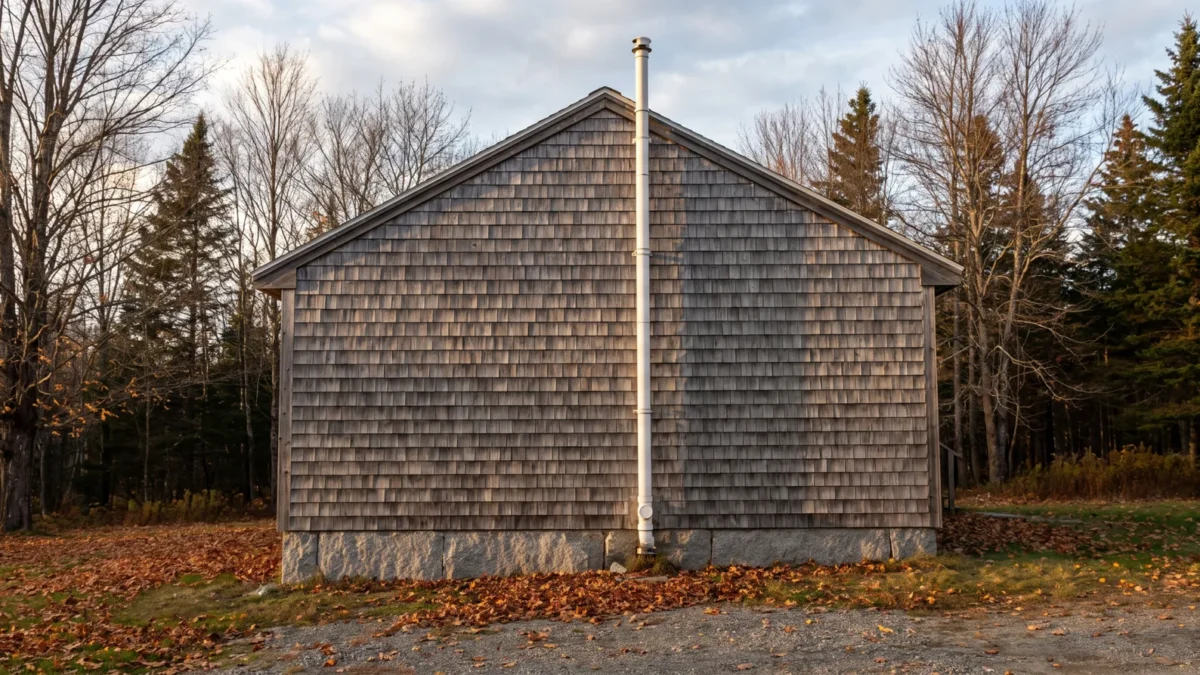
EPA calls active subslab suction, also known as subslab depressurization, the most common and usually the most reliable radon reduction method. One or more suction pipes are inserted through the floor slab into the crushed rock or soil underneath. A radon vent fan draws the gas out and releases it outdoors, creating a vacuum beneath the slab so soil gas takes the pipe rather than the gaps in the foundation. EPA notes that often, only a single suction point is needed, which is a useful thing to know before a contractor walks a basement and starts counting. Maine CDC lands in the same place, describing active sub-slab depressurization systems as the most common and effective systems, and passive versions running with no fan as not as effective.
Houses that aren’t a simple slab over gravel get other approaches. EPA’s technique table also covers drain-tile suction, block-wall suction, sump-hole suction, submembrane depressurization for a crawlspace, and basement pressurization. Maine CDC puts heat recovery ventilation at roughly a 50 percent reduction, which is real but partial, and an HRV is more often installed for winter humidity and condensation problems than for soil gas. Well water is a separate job with separate hardware, and Maine CDC treats it that way: aeration can remove 95 to 99 percent of radon from water, while granular activated carbon reduces it 85 to 95 percent and is typically recommended below 10,000 pCi/L, with the carbon replaced every few years because radioactivity builds up in the tank.
Why a radon mitigation cost is hard to pin down
Search that phrase and you’ll find an $800 to $2,500 range attributed to EPA on page after page. It isn’t in the current Consumer’s Guide to Radon Reduction. That document contains exactly one dollar figure, and it’s for replacement filters on a heat recovery ventilator. The range comes from older editions and from contractor marketing, and it has been repeated long enough to look like an agency position.
What EPA does publish is a modeling input, and it’s worth reading as exactly that. The October 2025 benefit-cost analysis exists to weigh national radon programs, not to quote homeowners. It itemizes an active soil depressurization install at $1,826 in 2023 dollars, operating costs of $206 per year, fan replacement every 10 years at $476, testing including post-mitigation tests at $169, and a warning device replacement at year 37 for $151, over an assumed intervention lifespan of 74 years. Those are national averages assembled from studies going back decades, stated in a single year’s dollars. They are the numbers the federal government uses in its own arithmetic. They are not what a crew in Aroostook or York County will write on an estimate, and no state agency in Maine publishes a regional figure to compare them against.
One line in that same table is worth carrying into any conversation about new construction. EPA prices radon-resistant features built into a new home at $619 for the passive measures, plus $56 for the initial test and $476 to install a fan if the finished house still tests above the action level. Roughing it in while the foundation is open costs materially less than cutting into a finished slab later.
In Maine, mitigation is a registered trade
This is where the state stops resembling a generic national guide. Title 22, section 775 of the Maine Revised Statutes makes it unlawful for a person to offer advice or plans to reduce radon in new or existing structures, or to contract to modify an existing structure to reduce radon, without registering with the state. Maine CDC adds one carve-out and one hard line: an owner or occupant may install a system in their own home, but if the property is for sale, the mitigation has to be done by a registered radon service provider.
The registration itself is cheap, and the paperwork behind it is more informative than the fee. A mitigation company, whether it works on air, water, or both, pays $75 to register initially, prorated to $37.50 for applications filed after April 1 and before August 1. A testing company or stationary lab pays $150. The registration year runs October 1 through September 30, and the state does not process initial applications or changes during August or September, which matters if you’re trying to line up work at the end of summer. Those fees aren’t general revenue either. They feed the Radon Relief Fund, established as a nonlapsing fund to support the radon-related research, testing, educational and mitigation activities of the division.
The application form is the single most useful public document in this whole process, because it spells out what a registered mitigator has already promised in writing. Companies must attest that they’ll follow ASTM E2121-03, the standard practice for installing radon mitigation systems in existing low-rise residential buildings, and ASTM E1465-08A for new low-rise residential construction. They must declare which of Maine’s 16 counties they’ll serve. And the state sorts companies into Small Residential and Specialist tiers, with no Specialist registration approved unless at least one employee documents advanced training or experience in that service. Asking a contractor for their Maine registration, and which tier it covers, is a fair question with a real paper answer behind it.
The Gold Standard statute and the first $600
Maine also carries a radon law with no counterpart elsewhere in New England. Title 22, section 785 established the Maine Gold Standard for Radon Testing and Mitigation Initiative on July 1, 2022. Participating landlords test every 2 years and must mitigate within 6 months if results show 4.0 picocuries per liter of air or above. For landlords, homeowners and builders in the program, the statute says the department pays all testing costs and the first $600 in mitigation expenses.
Two cautions before anyone budgets around that. The statute is what exists on paper, and the Radon Relief Fund behind it is fed by those $75 and $150 registration fees, which is a modest pot for a statewide promise. The state radon program’s public pages also don’t currently walk a homeowner through enrolling. Treat the $600 as something to ask the Maine CDC radon program about directly rather than as a rebate you can count on when you sign a contract.
How far the levels actually drop
EPA’s reduction table gives a 50 to 99 percent range for the whole soil-suction family: subslab, drain-tile, block-wall, sump-hole, submembrane in a crawlspace, and basement pressurization. Natural ventilation in a crawlspace rates 0 to 50 percent. The top of that range gets quoted on its own often enough that it’s worth saying plainly. Ninety-nine percent is a ceiling, not an expectation.
The field data fills in what the range means in practice. EPA’s model assumes a mitigated home settles at 1.0 pCi/L and calls that conservative, and the studies it cites came in lower. A Minnesota study by Steck in 2008 measured post-mitigation levels averaging 0.8 pCi/L. Stanley and colleagues, testing homes in southern Alberta in 2017, found 90 houses that had averaged 15.5 pCi/L beforehand came down to an average of 0.9 pCi/L after. A 2019 systematic review of radon interventions worldwide reached the same conclusion about method, finding that active sub-slab or sump depressurization achieved significant and sustained reduction more reliably than passive approaches like sealing, membranes, block and beam, simple ventilation or filtration, and noting that in some settings an active system needs to be combined with another system and installed by a trained radon professional.
Reduction, though, not elimination. EPA’s own phrasing is that with today’s technology, radon levels in most homes can be reduced to 2 pCi/L or below, and that any radon exposure carries some risk. Maine advises acting to reduce indoor air radon at 4 pCi/L and considering reduction between 2 and 4, with a separate advisory level of 4,000 pCi/L for well water.
What to check after the crew leaves
EPA publishes an installation checklist a homeowner can walk with no technical background. The system has to be clearly labeled. Exhaust pipes must vent above the roof surface and 10 feet or more above the ground, and at least 10 feet away from windows, doors or other openings unless they vent at least 2 feet above those openings. The exhaust fan can’t be located in or below a livable area. And a warning device, meaning a liquid gauge, sound alarm, light indicator or dial gauge, has to be installed where it can easily be seen or heard, because a fan that quits doesn’t announce itself.
Then the retest, which matters more than any line on the invoice. EPA says a post-mitigation measurement should be done within 30 days of installation but no sooner than 24 hours after the system is running with the fan on, that a two to seven day measurement is recommended, and that windows and doors stay closed for 12 hours before and during the test apart from normal entry and exit. EPA also recommends an independent follow-up measurement rather than relying only on the installer’s own test, to eliminate any potential conflict of interest. That’s not an accusation aimed at contractors. It’s the same separation you’d want on any job where the person who built the thing also grades it.
Upkeep is light without being nothing. EPA says radon fans may last five years or more and that manufacturer warranties tend not to exceed five years, while the 2025 cost model assumes replacement every 10 years. Those are two different statements from the same agency and should be read that way: the fan is a recurring expense on no fixed schedule. It should never be switched off, because the system only works while it runs. EPA recommends retesting at least every two years, and Maine says the same, that homes with mitigation systems should be tested every 2 years to make sure the system is working as intended.
Why bother with any of it is answered in the first lines of EPA’s guide. Radon is the leading cause of lung cancer for non-smokers and the second leading cause for the general population, and if you smoke and your home has high radon levels, the risk is especially high. At national scale, EPA estimates that testing 2 million existing homes and mitigating 85 percent of those above the action level would avoid 3,100 to 8,000 excess lung cancer deaths over the lifetime of the systems, worth $9 billion to $20 billion in net present value, a return of $7.38 to $15.27 for every dollar invested. For one house on one road in Maine the math is smaller and much simpler, and it still starts in the same place. Get the number first, then price the fix.
Sources
- U.S. Environmental Protection Agency. Analysis of Benefits and Costs of Radon Reduction Strategies Recommended by the EPA: Cost-Effective Interventions for Lung Cancer Prevention (October 2025). EPA. https://www.epa.gov/system/files/documents/2025-12/analysis-of-benefits-and-costs-of-radon-508.pdf
- U.S. Environmental Protection Agency. Consumer’s Guide to Radon Reduction: How to Fix Your Home (EPA 402/K-10/005). EPA. https://www.epa.gov/sites/default/files/2016-12/documents/2016_consumers_guide_to_radon_reduction.pdf
- Maine Revised Statutes, Title 22, Section 775. Radon mitigation; registration required. Maine Legislature. https://legislature.maine.gov/statutes/22/title22sec775.html
- Maine Revised Statutes, Title 22, Section 784. Radon Relief Fund. Maine Legislature. https://legislature.maine.gov/statutes/22/title22sec784.html
- Maine Revised Statutes, Title 22, Section 785. Maine Gold Standard for Radon Testing and Mitigation Initiative. Maine Legislature. https://legislature.maine.gov/statutes/22/title22sec785.html
- Maine DHHS Radon Section. HHE 806 (12/2025), Application for Initial or Revised Company Radon Service Provider Registration. Maine DHHS. https://www.maine.gov/dhhs/mecdc/sites/maine.gov.dhhs.mecdc/files/HHE%20806-2026%20Application%20for%20Business%20Radon%20Registration.pdf.pdf
- Maine Center for Disease Control and Prevention. Radon Mitigation Systems (fact sheet). Maine DHHS. https://www.maine.gov/dhhs/mecdc/sites/maine.gov.dhhs.mecdc/files/Radon%20Mitigation%20Systems.pdf
- Maine Center for Disease Control and Prevention. Radon In Maine (fact sheet). Maine DHHS. https://www.maine.gov/dhhs/mecdc/sites/maine.gov.dhhs.mecdc/files/Radon%20In%20Maine.pdf
- Maine Health and Environmental Testing Laboratory. Radon (state radon program page). Maine DHHS. https://www.maine.gov/dhhs/mecdc/services/maine-public-health-laboratory/environmental-chemistry/radiochemistry-and-radon-testing/radon
- Khan SM, Gomes J, Krewski DR. Radon interventions around the globe: A systematic review. Heliyon. 2019;5(5):e01737. https://pubmed.ncbi.nlm.nih.gov/31193708/
This article is for informational purposes only and does not constitute medical advice. Consult a qualified healthcare provider before making any health decisions.