Balance Exercises for Seniors: What the Fall-Prevention Trials Support
Balance exercises for seniors are movements that force the body to work at staying upright: standing on one leg, walking heel to toe, stepping sideways or backward, rising out of a chair without pushing off with the hands. Plain stuff, and better evidenced than most of what gets recommended to people in their seventies. A Cochrane review of 108 randomized trials covering 23,407 older adults living in their own homes found that programs built around balance and functional exercise reduced the rate of falls by 24 percent, the largest effect of any single exercise type the reviewers examined. A separate meta-regression of 88 trials went after the design question and found that the programs producing the biggest reductions shared two features. They genuinely challenged balance, and they ran more than three hours a week. The US Preventive Services Task Force gives exercise a grade B recommendation for preventing falls in community-dwelling adults 65 and older who are at increased risk.
What follows is what those trials measured, and what they did not.
A demographic problem Maine reached first
Among adults 65 and older, Maine’s unintentional fall-related death rate was 128.0 per 100,000 in 2021, against a national rate of 78.0, according to the CDC state tables published in MMWR. Across all states that year the figure ran from 30.7 per 100,000 in Alabama to 176.5 in Wisconsin, so Maine sits high in the spread without being the worst of it. New Hampshire came in at 103.6.
The share of people actually falling is much closer to average. In 2020, 29.6 percent of Maine adults 65 and older reported a fall in the previous year, and 28.8 percent of New Hampshire’s did, against 27.6 percent nationally. The gap between an ordinary fall rate and a high death rate is largely a story about age structure. Maine’s State Plan on Aging Needs Assessment says so plainly: Maine “leads the nation in persons ages 65 and older.” That same report counts 325 deaths attributed to older adult falls in Maine in 2021 and ranks the state 8th highest in the country per capita.
The plan also gives Maine a median age of 44 in 2020 against 38 for the United States, with residents 65 and older making up 22 percent of the population and projected to reach 29 percent by 2050. (Those population figures are sourced inside the report to a private forecasting firm, not to the Census Bureau.) A statewide survey conducted for the same plan found that almost 20 percent of respondents, 582 people, had fallen in the previous six months, and that recent fallers were more likely to rate their own health as fair or poor.
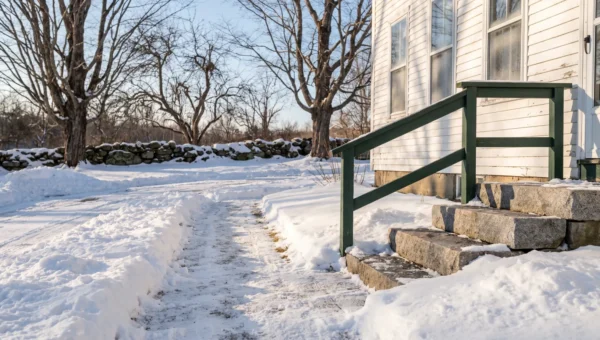
Winter is the obvious regional overlay here, and it deserves care. No seasonal or indoor-versus-outdoor breakdown of these falls is published for Maine, New Hampshire or the country, so ice belongs in this article as context rather than as a number. The state plan mentions it only qualitatively, listing slippery walkways that “cause falls when people go out to get mail, put trash out, get to their car” among the ordinary consequences of a driveway nobody has plowed. We laid out the full picture of Maine’s fall statistics in our earlier piece on why winter falls are a public health problem in the oldest state, and the separate cardiovascular risk of clearing that driveway in what snow shoveling asks of the heart.
What counted as balance exercises for seniors in the trials
The federal Physical Activity Guidelines for Americans define balance training as “static and dynamic exercises that are designed to improve individuals’ ability to resist forces within or outside of the body that cause falls while a person is stationary or moving.” Its worked examples are walking backward, standing on one leg, using a wobble board, walking heel-to-toe, and practicing standing up from a sitting position.
“Functional” in the trial literature means that same idea applied to the tasks of an ordinary day. Getting up off the floor. Turning while carrying a bag of groceries. Stepping over a threshold in poor light. Standing up out of a low couch without a push. The exercise is the situation, made harder on purpose and, in most of the research, done under supervision.
The trials the Task Force reviewed for its 2024 statement are remarkably consistent on shape. Nearly all of them, 30 of 37, included gait, balance and functional training. About two thirds, 25 of 37, layered strength and resistance work on top of that. Most ran as supervised group classes, most commonly two to three sessions weekly for roughly 12 months, though the full range across the evidence base stretched from 2 months to 30.
How big the effect is, and what makes it bigger
Cochrane’s headline figure covers exercise of every kind pooled together: a 23 percent reduction in the rate of falls (rate ratio 0.77, 95% confidence interval 0.71 to 0.83), rated high-certainty evidence, drawn from 108 trials across 25 countries. The average participant was 76 years old and 77 percent of them were women.
Sorting by type is where the useful detail sits. Balance and functional exercise cut the rate of falls by 24 percent (rate ratio 0.76, 39 studies, high certainty). Programs mixing several types, most often balance and functional work plus resistance training, probably did better still at 34 percent (rate ratio 0.66, moderate certainty). Tai Chi came in at 19 percent (rate ratio 0.81), rated low certainty.
The meta-regression is the more interesting document, because it asks what separates a program that works from one that barely does. Pooling 88 trials and 19,478 participants, it found a 21 percent overall reduction. Then it tested design variables, and two of them accounted for 76 percent of the variation between trials: whether the program genuinely challenged balance, and whether participants did more than three hours a week. Trials with both features reduced falls by 39 percent (incident rate ratio 0.61, 95% CI 0.53 to 0.72). Roughly double the average effect, out of the same ingredients arranged differently.
The things that did not hold up
Cochrane is candid about the gaps, and they are the ones most likely to surprise a reader. For programs that were primarily resistance training, and for dance programs and walking programs, the effect on the rate of falls and on the number of people who fall is uncertain. No trial in the review compared flexibility or endurance exercise against a control at all.
The Physical Activity Guidelines put the walking point more bluntly: “It is important to note that doing only low-intensity walking does not seem to reduce the risk of fall-related injuries and fractures.” A daily loop around the block earns its place for plenty of other reasons. Steadiness on a February sidewalk is not reliably one of them.
None of that demotes strength work. It appears as a component inside most of the effective programs, and muscle matters for outcomes well beyond falling, which is the ground we covered in what grip strength actually predicts and protein intake and age-related muscle loss. The evidence simply does not support treating resistance training as a replacement for balance work.
Vitamin D is the genuinely unsettled item. The Task Force recommended against vitamin D supplementation for fall prevention back in 2018. Its 2024 statement replaces that one and deliberately declines to address vitamin D, noting that the evidence will be covered by a separate recommendation now in progress. The strongest recent federal document on falls is therefore silent on the question by design, which is not how most coverage describes it. We went through the skeletal evidence separately in our look at vitamin D and bone health after 50.
The tai chi question
Tai chi collects more headlines than the pooled evidence quite justifies, and one trial explains why. In 2018, researchers randomized 670 community-dwelling adults aged 70 or older who had either fallen in the preceding year or had impaired mobility, mean age 77.7, into three arms. Two 60-minute classes a week for 24 weeks. Measured against the stretching arm at six months, the therapeutic tai ji quan group had an incidence rate ratio of 0.42 (95% CI 0.31 to 0.56) and the multimodal exercise group 0.60 (0.45 to 0.80). Compared head to head, tai ji quan produced 31 percent fewer falls than the multimodal program (0.69, 0.52 to 0.94).
Striking result. It is also one specific tailored curriculum, tested against one specific comparison program, in people already at high risk of falling. Cochrane’s pooled rating for Tai Chi remains low certainty, weaker than the high-certainty finding for balance and functional exercise generally. A fair reading is that a well-designed tai chi class is one plausible way to deliver a real balance challenge. It does not crown tai chi the best exercise for the job.
Confidence is part of the mechanism
Falls are the leading cause of injury-related illness and death among older adults in the United States. The Task Force’s own framing figures: 27.5 percent of community-dwelling adults 65 or older reported at least one fall in 2018, 10.2 percent reported a fall-related injury, and an estimated 38,742 deaths resulted from fall injuries in 2021.
Fear travels with those numbers and carries physical consequences, because people who expect to fall move less, and moving less erodes the capacity that keeps them upright. The most widely distributed American program aimed at that loop was finished here. A Matter of Balance was developed and evaluated at Boston University’s Roybal Center for Enhancement of Late-Life Function with National Institute on Aging funding, and in 2003 MaineHealth’s Partnership for Healthy Aging rebuilt it into a Volunteer Lay Leader model with grant support from the Administration on Aging. MaineHealth still manages the program and its master trainer certification. It is now offered by 595 organizations across 47 states.
What that program has been shown to do is worth stating precisely. A meta-analysis of the lay leader model identified 17 studies involving 3,860 participants and pooled the 13 with sufficient data, reporting an effect of -0.29 (95% CI -0.40 to -0.19) on fear of falling and 0.51 (0.42 to 0.60) on fall-related efficacy, meaning a person’s confidence in going about daily activities without falling. Those studies measured fear and confidence. Fall rates were not the endpoint.
Reading the research without turning it into a prescription
Every dose figure above belongs to a trial protocol or a guideline document. Neither is a plan for a particular person with a particular set of knees and a particular history of near misses. The federal guidelines do contain one key guideline written specifically for this age group, and it is the closest thing to official instruction in the file: “As part of their weekly physical activity, older adults should do multicomponent physical activity that includes balance training as well as aerobic and muscle-strengthening activities.” That document adds that multicomponent programs are the most successful at reducing falls and injuries, and that fall prevention studies generally include about three sessions a week.
Turning that into a Tuesday morning is a conversation for a clinician or a qualified trainer who can watch how a person actually moves, and that goes double for anyone who has already fallen, uses a walking aid, or is working around a painful joint. The population-level question is settled enough to be genuinely useful. The individual question is a different question, and by the state’s own accounting, no state has a larger share of residents sitting with it than this one.
Sources
- Kakara R, Bergen G, Burns E, Stevens M. Nonfatal and Fatal Falls Among Adults Aged >=65 Years, United States, 2020-2021. MMWR Morbidity and Mortality Weekly Report. 2023;72(35):938-943. https://www.cdc.gov/mmwr/volumes/72/wr/mm7235a1.htm
- Maine Department of Health and Human Services, Office of Aging and Disability Services. Maine State Plan on Aging Needs Assessment Report 2025-2028. January 2024. https://www.maine.gov/dhhs/sites/maine.gov.dhhs/files/inline-files/SPOA-Final-Report-2024.pdf
- Sherrington C, Fairhall NJ, Wallbank GK, et al. Exercise for preventing falls in older people living in the community. Cochrane Database of Systematic Reviews. 2019. https://pubmed.ncbi.nlm.nih.gov/30703272/
- Sherrington C, Michaleff ZA, Fairhall N, et al. Exercise to prevent falls in older adults: an updated systematic review and meta-analysis. British Journal of Sports Medicine. 2017;51(24):1750-1758. https://pubmed.ncbi.nlm.nih.gov/27707740/
- US Preventive Services Task Force. Falls Prevention in Community-Dwelling Older Adults: Interventions. 2024. https://www.uspreventiveservicestaskforce.org/uspstf/recommendation/falls-prevention-community-dwelling-older-adults-interventions
- US Preventive Services Task Force. Interventions to Prevent Falls in Community-Dwelling Older Adults: US Preventive Services Task Force Recommendation Statement. JAMA. 2024;332(1):51-57. https://pubmed.ncbi.nlm.nih.gov/38833246/
- US Department of Health and Human Services. Physical Activity Guidelines for Americans, 2nd edition. 2018. https://odphp.health.gov/sites/default/files/2019-09/Physical_Activity_Guidelines_2nd_edition.pdf
- Li F, Harmer P, Fitzgerald K, et al. Effectiveness of a Therapeutic Tai Ji Quan Intervention vs a Multimodal Exercise Intervention to Prevent Falls Among Older Adults at High Risk of Falling: A Randomized Clinical Trial. JAMA Internal Medicine. 2018;178(10):1301-1310. https://pubmed.ncbi.nlm.nih.gov/30208396/
- MaineHealth. Fall Prevention: A Matter of Balance. https://www.mainehealth.org/healthy-communities/prevention-and-wellness/fall-prevention-matter-balance
- Yoshikawa A, Ramirez G, Smith ML, Lee S, Ory MG. Systematic review and meta-analysis of fear of falling and fall-related efficacy in a widely disseminated community-based fall prevention program. Archives of Gerontology and Geriatrics. 2020;91:104235. https://pubmed.ncbi.nlm.nih.gov/32911232/
This article is for informational purposes only and does not constitute medical advice. Consult a qualified healthcare provider before making any health decisions.