Sending a Tick for Testing: A UMaine and UNH Lab Guide
It usually happens after the lawn gets mowed. You peel off your socks, run a hand along your ankle, and there it is, a deer tick the size of a poppy seed dug in just above the bone. The first instinct is to get it out. The second, for a lot of Mainers and Granite Staters, is to drop it in a plastic bag and wonder whether a lab can tell you what it was carrying. Two public university labs, one at the University of Maine and one at the University of New Hampshire, will do exactly that. Here is how the process works, what it costs, and the more complicated question of what a result actually means.
Why so many ticks end up in the mail
The volume is striking. In 2024, the University of Maine Cooperative Extension Tick Lab in Orono processed 4,776 tick submissions from 398 towns spanning all 16 of Maine’s counties, most of them deer ticks. That is a lot of envelopes from a state of 1.3 million people.
The reason is in the disease numbers. Maine logged a record number of Lyme disease cases in 2023, more than 2,900 statewide, with the highest rates in the Midcoast and Down East regions. So when a tick turns up on a kid’s scalp or a dog’s ear, sending it off feels like doing something useful. It often is, as long as you know what the test answers and what it leaves open. For the wider picture on tick-borne illness in the region, our complete Maine and New Hampshire tick and Lyme guide covers the landscape.
How the UMaine Extension Tick Lab works
The Maine lab keeps it simple. Testing costs a flat $20 for Maine residents, and that single fee covers both species identification and the pathogen panel that matches the species. The price went up from $15 in April 2023, when the lab added testing for Powassan virus and Heartland virus. One catch worth knowing up front: the lab does not test ticks submitted from outside Maine.
You mail the tick to the UMaine Extension Diagnostic and Research Lab, ATTN: Tick Lab, 17 Godfrey Drive, Orono, ME 04473. Results generally come back within three business days of the specimen arriving at the lab. Not three days from when you drop it in the mailbox, three days from when it lands on the bench in Orono, so factor in transit time.
What gets tested depends on what you caught. Deer ticks (the blacklegged ticks that carry most of the trouble in New England) are screened for the agents of Lyme disease, anaplasmosis, babesiosis, and Borrelia miyamotoi disease. Dog ticks and Lone Star ticks get a different panel: Rocky Mountain spotted fever, ehrlichiosis, and tularemia. Every tick submitted, regardless of species, is now also screened for Powassan virus and Heartland virus, the two additions from 2023.
One practical relief: the tick does not need to survive the trip. The lab uses PCR testing, which detects the genetic material of disease organisms, and that works whether the tick is alive or dead. A tick that got crushed during removal, or one that dried out in a bag on the counter for a week, can usually still be tested, because the organisms live in the tick’s salivary glands and gut.
What a tick test can and cannot tell you
This is the part people skip, and it matters more than the mailing address. A positive tick test tells you the tick was carrying a pathogen. It does not tell you that you were infected.
The federal Centers for Disease Control and Prevention is blunt about this. In its guidance on what to do after a tick bite, the CDC says testing individual ticks is generally not recommended and that results should not be used to make treatment decisions. The agency lays out the reasons plainly. Tick-testing labs are not held to the same standards as clinical diagnostic labs. A positive result does not mean the person was infected, since a carrying tick may not have transmitted anything. A negative result can give false reassurance, because the tick that bit you might not be the one you found. And people who do get sick usually develop symptoms before a mailed-in result comes back. The UMaine lab agrees with the spirit of this, noting that a positive tick test should not be treated as a medical diagnosis.
So what is the test good for? Surveillance, mostly, and peace of mind that is honest about its limits. Knowing a deer tick from your yard carried Lyme bacteria might sharpen your attention to symptoms over the next few weeks. It is not a substitute for watching your own body.
On that point the CDC is specific: if you develop a rash or a fever within several weeks of removing a tick, see a doctor, and tell them about the bite, when it happened, and where you were likely exposed. That advice does not wait on a lab result. If you want to understand why a blood test in that early window can also come back falsely negative, our explainer on how accurate Lyme testing is walks through the two-tier method.
New Hampshire options
Granite Staters have their own lab. The UNH Tick Testing Lab in Durham takes samples from New Hampshire residents through an online system: you order and pay at the lab’s website, which gives you a confirmation code, then either mail the tick or drop it off in person. The mailing address is the UNH Collaborative Core Wet Lab, 35 Colovos Road, Durham, NH 03824. For local drop-off, there is a red cooler in the main vestibule of Gregg Hall on the UNH campus. Results are emailed, as early as three days after the lab receives the sample.
The UNH panels work the same way Maine’s do, by species. Blacklegged ticks are screened for Lyme (Borrelia burgdorferi), Borrelia miyamotoi, anaplasmosis, babesiosis, and Powassan virus. Dog ticks get a non-Ixodes panel covering ehrlichiosis, tularemia, Rocky Mountain spotted fever, and Powassan.
Not everyone wants the full pathogen workup. If you only need to know what kind of tick you found, New Hampshire has a free route. The state Department of Agriculture, Markets and Food offers free tick identification to residents, which it uses to track where different species are spreading. Those ticks are identified but not tested for disease. UNH Extension’s insect identification service also identifies arthropods for a per-specimen fee. Both answer the “what is this” question; neither answers the “was it carrying anything” question.
What the 2024 Maine numbers reveal
The UMaine lab’s annual surveillance report is one of the better windows into regional tick risk, because it is built from thousands of real ticks people actually encountered. The 2024 results are sobering. Of the deer ticks tested, 41.5 percent carried the bacterium that causes Lyme disease. Smaller shares carried other pathogens: about 12 percent had the babesiosis parasite, roughly 9.7 percent carried the anaplasmosis agent, and 1.1 percent carried Powassan virus.
The geography of the bites is the detail that tends to surprise people. Most encounters reported to the lab in 2024 did not happen deep in the backcountry. They happened at home. Sixty-eight percent of exposures occurred on the submitter’s own property, and yardwork was the single most common activity at the time of the bite. Only 16 percent of people who submitted a tick had been using any protective measure. Mowing, weeding, hauling brush along the wood line. That is where the deer ticks are.
Step by step: removing, storing, and submitting
If you find an attached tick, the removal comes first, and how you do it matters for both your health and the test. Fine-tipped tweezers, a steady grip as close to the skin as you can manage, and a slow straight pull. No petroleum jelly, no lit match, no twisting. Our guide on how to safely remove a tick covers the do’s and the dangerous don’ts in detail.
Once it is out, here is the short version of getting it tested.
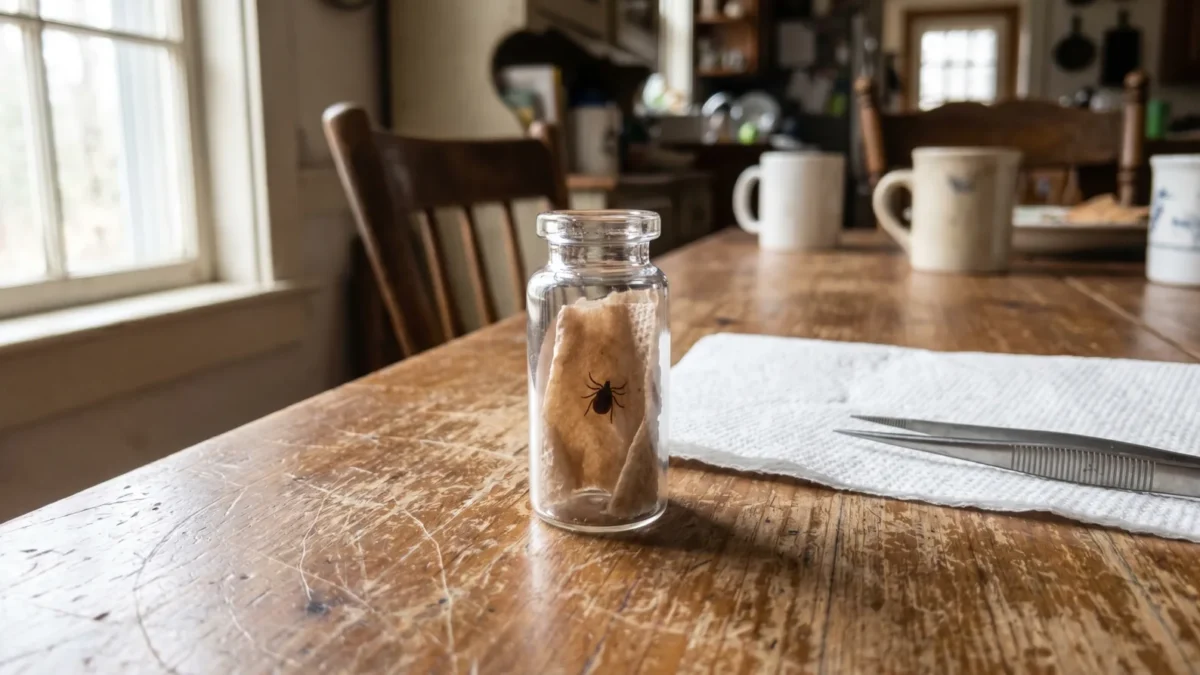
- Drop the tick in a small sealable bag or a vial. A scrap of slightly damp paper towel helps, but a dry tick is fine to send.
- Maine residents: package it up and mail it to the Tick Lab in Orono with the $20 fee, following the submission instructions on the lab’s site.
- New Hampshire residents: order and pay online first to get your confirmation code, then mail the tick to Durham or use the red cooler in Gregg Hall.
- Note the date you found it and where you think you picked it up. That detail is useful to you and, if you ever see a doctor, to them.
- Do not wait on the result to act. Watch for a rash or fever over the next few weeks and call a provider if either shows up.
A tick in a baggie is data, not a diagnosis. Used that way, both labs are a genuinely useful regional resource, and at twenty dollars in Maine, a cheap one. Just keep the more important monitoring where it belongs, on you.
Sources
- University of Maine Cooperative Extension Tick Lab. Tick Testing Frequently Asked Questions. University of Maine. 2025. https://ticktesting.umaine.edu/ticktestinfo.php
- University of Maine Cooperative Extension. Submit a Tick – Cooperative Extension: Tick Lab. University of Maine. 2025. https://extension.umaine.edu/ticks/submit/
- University of Maine. UMaine Extension Tick Lab adds Powassan virus and Heartland virus to tick testing service. University of Maine. 2023. https://umaine.edu/news/blog/2023/04/17/umaine-extension-tick-lab-adds-powassan-virus-and-heartland-virus-to-tick-testing-service/
- University of Maine Cooperative Extension. 2024 Surveillance Report from UMaine Extension Tick Lab highlights tick-borne disease risk. University of Maine. 2025. https://extension.umaine.edu/2025/04/17/2024-surveillance-report-tick-lab-highlights/
- U.S. Centers for Disease Control and Prevention. What to Do After a Tick Bite. CDC. 2024. https://www.cdc.gov/ticks/after-a-tick-bite/index.html
- University of New Hampshire Cooperative Extension. Tick Testing – UNH Extension. University of New Hampshire. 2025. https://extension.unh.edu/tick-testing
- New Hampshire Department of Agriculture, Markets and Food. Insects, Spiders and Ticks. State of New Hampshire. 2025. https://www.agriculture.nh.gov/farms-businesses/plant-industry/pest-identifications/insects-spiders-and-ticks
- University of New Hampshire Cooperative Extension. Insect and Other Arthropods Identification – UNH Extension. University of New Hampshire. 2025. https://extension.unh.edu/agriculture-gardens/pest-disease-growing-tools/insect-other-arthropods-identification
- Maine Center for Disease Control and Prevention. Maine CDC Reports Record Number of Lyme Disease Cases. Maine DHHS. 2024. https://www.maine.gov/dhhs/mecdc/node/947
- Maine CDC Environmental Public Health Tracking. Tickborne Diseases – MaineTracking Network. Maine CDC. 2025. https://data.mainepublichealth.gov/tracking/tickborne
- Sun Journal. Lyme disease cases spike Down East and set new record for state. Sun Journal. 2024. https://www.sunjournal.com/2024/01/16/lyme-disease-cases-spike-down-east-and-set-new-record-for-state/
This article is for informational purposes only and does not constitute medical advice. Consult a qualified healthcare provider before making any health decisions.